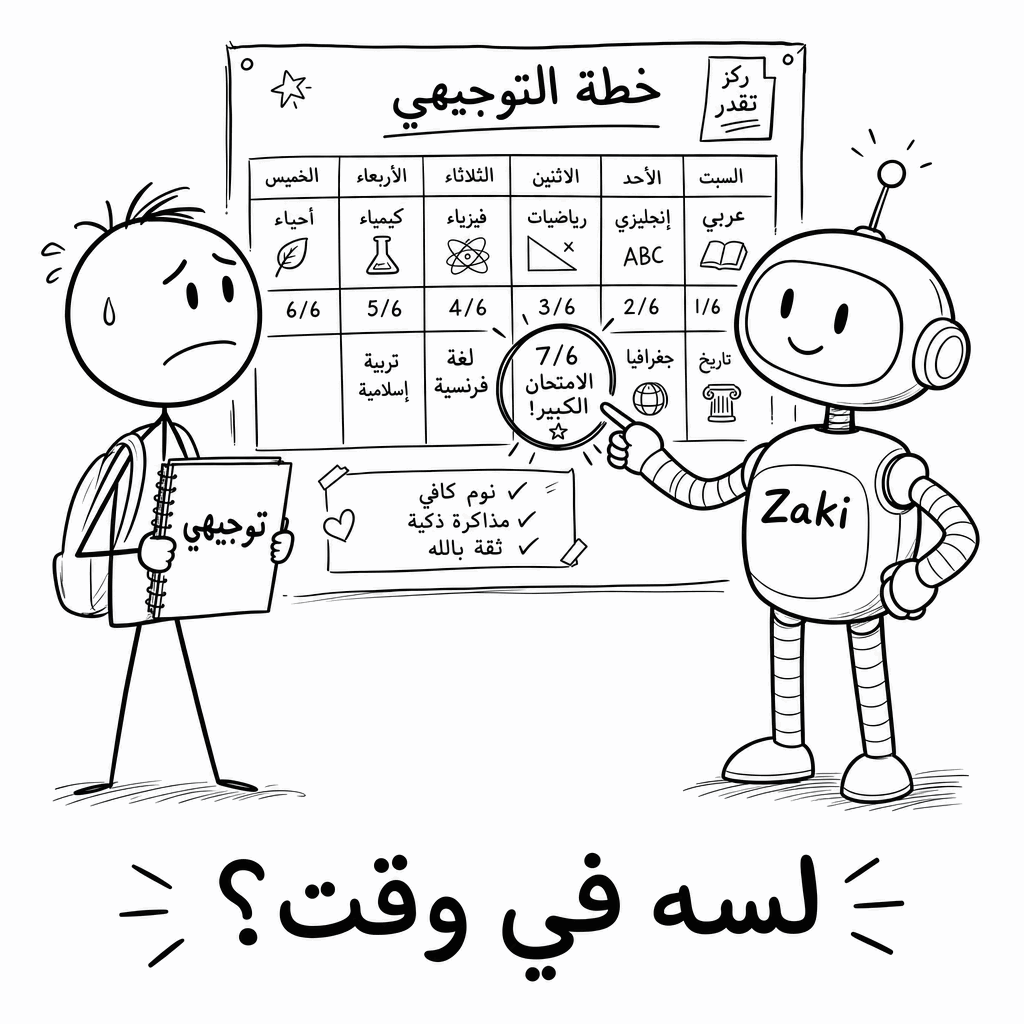
Tawjihi Exam Night Checklist: 15 Things Before Sleeping The last hour before a Tawjihi exam can feel like standing in a hallway between two worlds. On one side: weeks of work, messy notebooks, half-finished flashcards, and a quiet fear that you missed something obvious. On the other: a desk, an exam booklet, and a version of you that must perform on demand. Most students try to bridge this gap with more study. One more page. One more definition. One more question. But exam night is not a knowledge problem. It is a state-of-mind problem. Your goal is to arrive tomorrow with a brain that can recall, select, and write under pressure. Here is your Tawjihi exam night checklist: 15 things to do before sleeping. Not to be perfect, but to be ready. ## The exam night checklist (save this) Keep it simple. You are aiming for calm execution, not heroic effort. - Do a short, high-yield review (not a full session)
- Prepare your exam kit and tomorrow's plan
- Reduce decisions (clothes, breakfast, route)
- Quiet your mind (worry list, breathing)
- Protect sleep like it is part of your grade ## 15 things to do before sleeping ### 1. Do a 20-minute confidence loop, not a cram Pick one small loop you can finish. - Science subjects: definitions + one diagram + one common calculation pattern.
- Humanities: key themes + one essay plan skeleton.
- Math: three representative problems you already know how to do. If you need structure, borrow the exam-first idea from How to Study for Tawjihi Exams: study by exam and topic, not by "the whole subject." ### 2. Use flashcards for recall, not reading Reading feels soothing. It is also misleading. Instead, do active recall: a short Flashcards set where you actually have to retrieve information. Ten to twenty minutes is enough. ### 3. Do 5 questions maximum (and stop) Yes, questions. But not a marathon. Five ministerial-style items are enough to wake up your exam brain and remind it what exam wording feels like. Use the Question Bank like a warm-up, then end. ### 4. Decide your first 5 minutes strategy A lot of exam anxiety comes from uncertainty at the start. Write down your opening script: - Read instructions slowly.
- Scan the exam booklet.
- Start with the section you trained most.
- If stuck for 60 seconds, star it and move. This is not content. It is control. ### 5. Pack your Tawjihi exam kit tonight Future-you should not have to improvise. Pack: - Pens (blue/black), pencils, eraser, ruler
- Calculator (if permitted) + check batteries
- Seat card (بطاقة الجلوس) and ID as your school requires
- Water bottle (check your school's rules on bottles and labels) When your bag is ready, your nervous system gets the message: we have handled this. ### 6. Choose clothes like you are removing friction This sounds trivial until it is 6:45am and you are negotiating with a hoodie. Set out comfortable layers. Exam halls can be oddly cold or oddly warm. Remove the tiny decisions that drain you. ### 7. Set two alarms (not twelve) Set one alarm to wake up, and one backup. Then put your phone away from the bed so alarm setting does not slide into scrolling. Performance loves sleep. It hates late-night dopamine. ### 8. Write a 5-line worry list If your brain is looping, give it a container. On paper, write: - What I am worried about
- What I can do about it (one action)
- What I cannot control
- One thing I did well in preparation
- What time I will stop thinking about this This is not positive thinking. It is closing open tabs. ### 9. Ask Zaki one clarification (only if it removes confusion) This is a rule with teeth: you can ask one question. If there is a concept that keeps snagging you, get a clean explanation in Zaki and move on. Do not use chat to open new topics. Exam night is for tightening, not expanding. ### 10. Do not try to fix your whole grade tonight There is a story students tell themselves: "If I just work hard enough tonight, I can change everything." Sometimes that story creates effort. Often, it creates panic. A calmer story works better: "Tonight, I am protecting the version of me who can actually show what I know." ### 11. Eat like tomorrow matters Avoid the heavy, greasy, experimental dinner. Choose normal, balanced food. Hydrate, but not so much that you will wake up repeatedly. Your exam does not reward a heroic stomach. ### 12. Do a short reset: shower, stretch, or 8-minute walk Your body is part of the learning system. A warm shower can lower physiological stress. Light stretching can release tension you have been carrying in your shoulders for weeks. The point is not fitness. It is signaling safety. ### 13. Set a hard stop time for screens Pick a time (ideally 30–60 minutes before sleep) where screens end. If you need a night-before rhythm, borrow structure from Exam Time-Management Guide: calm is a strategy, not a personality trait. ### 14. Use a minimum viable plan for the morning Write down: - Wake-up time
- Leave time (early enough for traffic and check-in—confirm with your school)
- What you will eat
- What you will review (if anything) This prevents the classic morning trap: you wake up, feel behind, and start improvising. ### 15. Sleep like it is part of your revision This is the most underrated part of Tawjihi preparation. Sleep consolidates memory. It improves attention. It stabilizes mood. It is not a soft habit; it is a performance tool. If your mind will not settle, try a simple routine: lights low, slow breathing, and remind yourself you are not trying to learn tonight. You are trying to arrive. ## A quick checklist you can copy into Notes - [ ] 20 min recall (Flashcards)
- [ ] 5 questions max (Question Bank)
- [ ] Decide first 5 minutes strategy
- [ ] Pack bag + Seat card + ID
- [ ] Clothes ready
- [ ] Two alarms
- [ ] Worry list (5 lines)
- [ ] One clarification (Zaki) then stop
- [ ] Eat + hydrate normally
- [ ] Shower/stretch
- [ ] Screens off time
- [ ] Morning plan written (leave time confirmed with school)
- [ ] Lights out Review the official Tawjihi exam schedule on TawjihiAI — if any date differs, return to the [your school]( or your school.