
The topic explained
LESSON 5A GRAMMAR
- I can use articles to express different meanings.
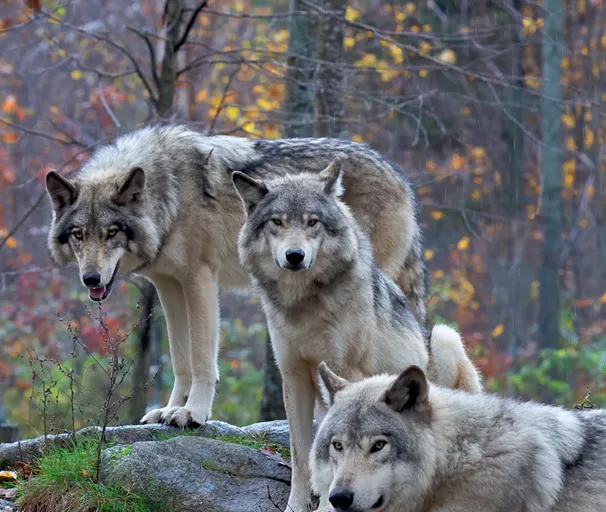
Wolves, deer, gazelles: what do they suggest?
What connotations do you have when you look at the groups of animals in the photos?
Articles
The or no article: four gap sentences
Complete the sentences with the or no article (ø).
1 Maha Al-Bargouthi, who was _ first Jordanian to win a gold medal at Paralympics, was born in __ Amman.
2 _ Burj Khalifa, which is currently tallest building in world, was constructed during _ 2000s.
3 _ best time to visit Al Ain in UAE is during winter months when it is __ cooler.
4 I was just looking at photos of my _ trip to Jordan. I think most interesting part of trip was visiting __ Dead Sea.
Which rule explains each the?
The definite article is used when the topic is known. It can be known because:
it has been mentioned before.
it is unique.
it is a superlative (which makes it unique).
it’s talking about one of a pair of comparatives.
it is a geographical name for certain countries, bodies of water or mountains.
we are talking about a group, class or species.
it is an ordinal number (e.g., first, second, etc.).
It’s a period of time, such as decades or seasons.
Same noun, different article: why?
In pairs, explain the differences between the underlined parts of the sentences.
a The orang-utan is the most solitary of the great apes.
b An orang-utan had been killed by poachers.
a Unlike most species of deer, the moose does not form a herd.
b The herd of deer at Belton Park has been there for over 300 years.
a I had never seen a sand cat before in the wild.
b The sand cat came close to me, but didn’t see me.
a Wolves are highly social animals that live in packs.
b The alpha wolves in the pack decide when they will travel and hunt.
a Mountain gazelles are generally active in the early morning and around sunset.
b The male mountain gazelle uses calls to communicate threats or signs of danger to other gazelles.
a An adult male polar bear weighs around 350–700 kilograms.
b I saw a polar bear running towards me and screamed.
a The last known white rhinos are both female.
b The species is therefore considered extinct.
a He was attacked by a hippo and ended up in hospital.
b A friend of the man, who works in the hospital, said his condition was stable.
A, the or nothing: the crowd text
Complete the text with a/an, the or no article (ø). In pairs, explain your choices, using the rules from Exercises 2 and 3.
Why do we follow the crowd?
1 ___ Human beings are social creatures.
On average, we spend around 75 percent of our waking time in direct communication with other people, and very often we are indeed influenced by what 2 ___ others think, especially by what those around us think.
If we already hold 3 ___ strong opinions, listening to others who think differently may make no difference.
But 4 _ research does show that when we are surrounded by people who think 5 _ same as us, but more strongly, our own views will become more forceful, and we may feel more entitled to act on them.
This is how 6 ___ crowds can have their emotions manipulated.
In one experiment, 7 _ psychologist compared people’s behaviour in 8 national park in 9 __ USA, on two different trails.
On one trail, there was 10 ___ sign asking people not to take pieces of ancient petrified wood home, explaining that 14 tonnes were taken each year by walkers.
On the other trail there was no such sign.
You might imagine that 11 ___ sign which asked people not to take the wood would have a positive impact, but in fact, the opposite happened.
People on 12 _ trail which had the sign took 13 _ largest amount because they reasoned that it couldn’t be that bad if lots of other people were doing it too.
Study Watch Out! In pairs, find more examples of fixed phrases using the in the texts in Lesson 4A.
SPEAKING Work in pairs. Think about a situation when following the crowd may have good or bad consequences. For example, rescuing someone in danger. Prepare to talk for 1–2 minutes about your chosen situation and what happened. Listen to your partner and make a note of how they use articles. At the end, give them feedback both on the content of what they said and any correct or incorrect use of articles that you noticed.
WATCH OUT!
Fixed phrases with the: learn them as chunks
The indefinite article: a/an
A or an: the listener does not know which one
We use a/an with a singular countable noun when the listener doesn’t know which particular thing is being referred to, or it doesn’t matter which one. This is because:
- it is one of many of the same class, e.g. a computer, an orange
- we mention a person or thing for the first time: I’ve read a really good book.
The definite article: the
The: both of you know which one
- was mentioned before: I’ve read a really good book. The book is about ...
- is unique: The Earth revolves around the Sun.
- is defined specifically by the words that follow, e.g. a relative clause: I love the book that my brother gave to me a few years ago.
- is a proper name: I like the crime novels of Agatha Christie.
More with the: superlatives, pairs, dates
- superlatives: The longest river in Egypt is the Nile.
- comparatives (when identifying one of a pair): I have two cousins. The older (of the two) is my favourite.
- ordinal numbers: The first man to walk on the moon was Neil Armstrong.
- decades, centuries: in the 1970s; in the 21st century
The with names: countries, seas, families
- plural names for countries, groups of islands and mountain ranges: the Netherlands, the Philippines, the Alps
- seas, oceans, rivers, deserts and areas: the Baltic sea, the Pacific ocean, the Thames, the Atacama desert, the Highlands
- a group of people by their surname: the Smiths, the Joneses
No article
No article: ø
- We use no article with plural and uncountable nouns when we make general statements: Life was very hard and over one million people emigrated.
- We use no article with words like prison, hospital, school, college, etc. when we are talking about their purpose as an institution, e.g. I go to school every day.
- He’s gone to college and he’s living in another city now.
- We use no article when we are referring to abstract nouns, e.g. peace, justice, courage.
No article: lakes, islands, countries
- We use no article when referring to lakes, single islands, individual mountains: Lake Ontario, Ibiza, Snowdon
- We use no article with most geographical names, continents, countries, cities and towns, states: Europe, Dubai, Glasgow, Arizona (exceptions: the USA, the UK, the United Arab Emirates, the Hague)
No article for a whole species
- We use no article when we are referring to a group, class or species in general: Blackbirds can be seen all year round.

