The lesson explained
62
LITERATURE SPOT
1 What do you know about the famous author
Charles Dickens? Read the Fact Box and check your ideas.
2 LS2.1 Listen to two students talking about Great Expectations by Charles Dickens and answer the questions.
1 Why is James going to read Great
Expectations?
2 Why is James concerned about reading the novel?
3 What themes in the novel does the boy mention?
4 Why will Harvey not tell James about the central question?
3 Look at the picture on page 63 and read the extract. Which characters are shown in the pictures?
4 Read the extract again. Decide if statements
1–6 are true (T) or false (F).
1 □ Mrs Joe believes that going to Miss
Havisham’s house will improve Pip’s situation in life.
2 □ Pip has a positive first impression of Estella.
3 □ Pip was surprised at being asked to play by Miss Havisham.
4 □ Pip tells Miss Havisham exactly what he thinks about Estella.
5 □ Estella put Pip’s food on the ground to make him feel bad.
6 □ Pip agrees with the advice Joe gives him after his visit to Miss Havisham’s house.
5 Replace the underlined parts of the sentences with the correct forms of the highlighted words from the extract.
1 He looks messy and untidy. He hasn’t brushed his hair and his shirt is untucked.
2 All my plants died because I forgot to water them.
3 My grandfather swept the roads. He had a very low social position in life.
4 There’s no one quite like my strange and unusual uncle who wears old-fashioned clothes and reads books to his plants.
5 What a sad, dark place this is.
6 ‘Don’t you know what four plus four is?’ the boy laughingly and cruelly said to his little brother.
7 The wall was old and falling apart into small pieces.
6 What meaning does the author want to convey in these phrases from the extract?
1 Then she jumped on me like an eagle on a lamb.
2 As I stood before her, I noticed the clocks, all stopped at twenty minutes to nine.
3 Tears sprang to my eyes.
7 REFLECT | Culture In pairs, discuss the questions.
1 Why do you think Miss Havisham is wearing such strange clothes?
2 Why do you think Miss Havisham wants Pip to play with Estella?
8 WRITING TASK Write a description of how you imagine Pip’s life to be when he’s a grown man.
GLOSSARY conceited – excessively proud and vain deserted – without people, empty recluse – a person who lives alone and avoids other people vile – extremely unpleasant weary – tired yp ed
LITERATURE SPOT Great Expectations
Charles Dickens is often considered to be the greatest novelist of the Victorian era. He was not only popular after his death, but he also was extremely popular during his lifetime – something that no previous author had achieved at that time. Some of his most notable books are
A Tale of Two Cities, Hard Times and Oliver Twist. His books appealed to all members of society, from rich to poor, for their entertaining, intelligent tales with well-observed characters that readers really cared about. It is thought that his own life story influenced some of his best loved novels, David
Copperfield and Great Expectations.
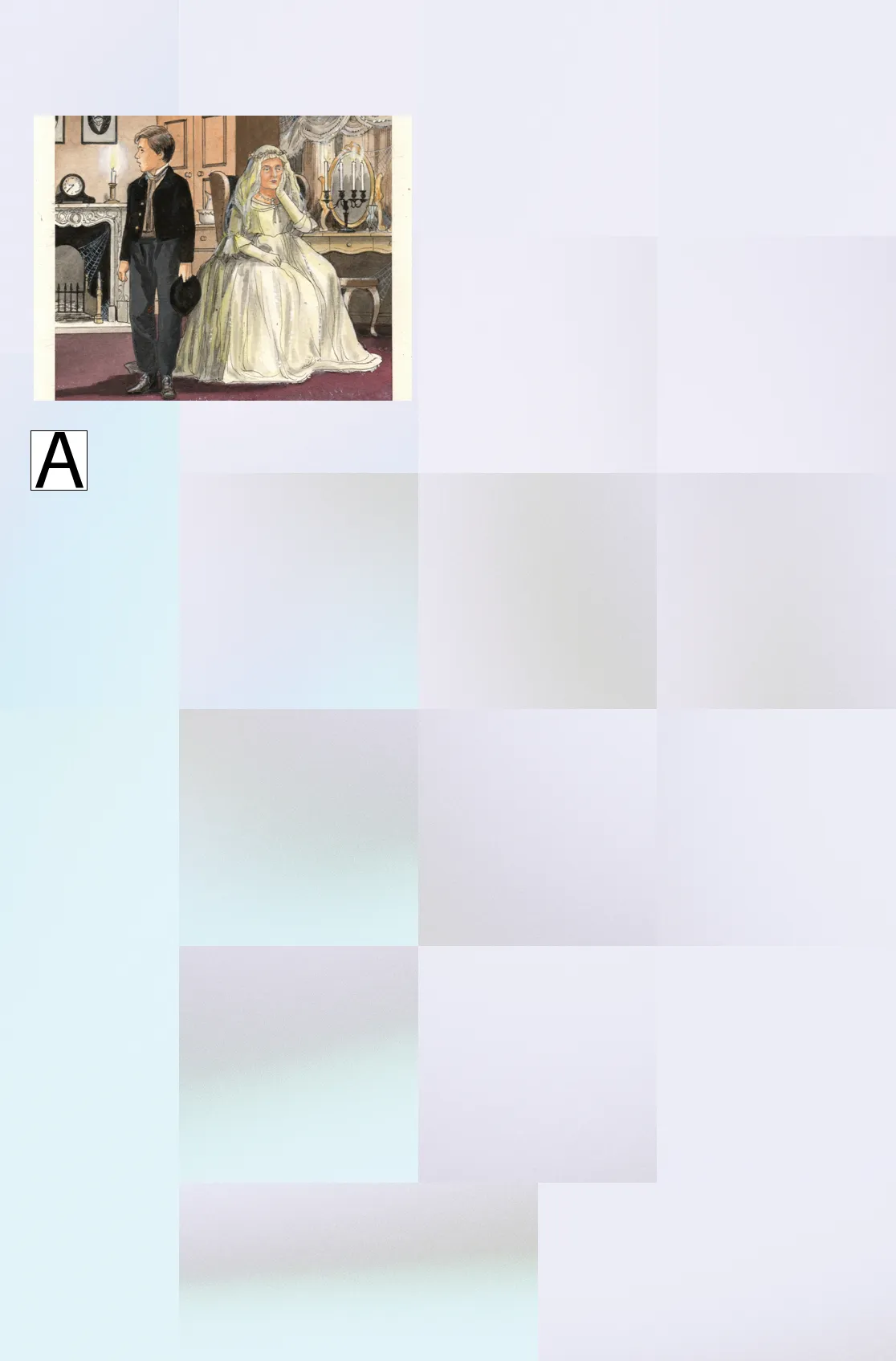
CHARLES DICKENS Ayear passed. I toiled hard every day, helping neighbours with small jobs, but in the evening, I went to the village school. The old lady who was supposed to teach me would sleep through the classes, leaving her kind and understanding granddaughter, Biddy, to show me how to read and write.
One night Joe saw me sitting by the fire as I was practising my writing. ‘I say, Pip, what a scholar you are!’ he said. ‘Did you never go to school, Joe?’ I asked. ‘No, Pip,’ he replied.
‘My father forbade me from going, but he had a good heart. He taught me to be a blacksmith. And after he died, I met Mrs Joe.'
Just then Mrs Joe came in. ‘If this boy isn’t grateful to me now,’ she exclaimed, ‘he never will be!’ I tried to look appreciative, but I didn’t understand what Mrs Joe meant.
‘Miss Havisham wants Pip to go to her house,’ she said. ‘And he must go or I will work him hard!’
Everyone in the village had heard of Miss
Havisham; she was a very wealthy but eccentric lady who lived in the nearest town.
However, most people had never seen her because she was a recluse and never left her dismal, old house. ‘So how does she know
Pip?’ Joe asked. ‘She doesn’t know Pip,’ Mrs
Joe replied. ‘Uncle Pumblechook visited her, and she asked him if he knew a boy who would go there to play. The boy’s fortune will be made by going to Miss Havisham’s house, and he’s going there tomorrow!’ Then she jumped on me like an eagle on a lamb. I was washed and scrubbed very well that night.
Uncle Pumblechook took me to Miss
Havisham’s house in my finest clothes, the very next day. We waited at the gate until a very proud-looking young girl appeared. ‘This is Pip,’ said Mr Pumblechook. ‘Come in, Pip,’ she said, opening the gate.
Uncle Pumblechook was not invited in. Leaving him at the gate, I followed the girl through an unkempt courtyard. The house looked deserted and some of the windows were bricked up.
Everything was dark in the entrance hall with no sign of life or feeling, and we went upstairs by the flickering of candle light. The girl left me at a door, telling me to enter.
Inside was a dressing room lit by candles; the shutters were closed, so no daylight could enter.
And then I saw her: the strangest lady I had ever seen. She was dressed entirely in white silk and lace, with a long white veil and flowers in her hair. But her hair was white, the flowers were long since perished, and the white dress was now yellow with age. I saw a bride in a wedding dress, but everything about her had decayed.
‘Let me look at you,’ she said. As I stood before her, I noticed the clocks, all stopped at twenty minutes to nine. ‘Do you know what I have here?’ the lady continued, her hands on her heart. ‘Yes, madam,’ I replied. ‘It’s your heart.’ ‘A broken heart,’ she exclaimed. Then after a moment, she added, ‘I am weary and I am bored. Play!’
Taken aback, I wondered what game I could play, finally replying that I could not do so alone. ‘Call
Estella!’ the old lady said.
When Estella entered, I recognised her at once as the girl who had admitted me. Now she was told to play with me. ‘But he is just a common working boy!’ she objected. Miss Havisham whispered to her, but I could not hear clearly what she said.
And so Estella and I played games while Miss
Havisham looked on silently. ‘What rough hands you have!’ Estella said, scornfully. ‘And what vile boots!’ I was ashamed. Finally, Miss Havisham summoned me to her side. ‘What do you think of her?’ she asked, looking at Estella. ‘I think she is very conceited. And very rude,’ I whispered, before stopping abruptly, fearing I would say too much. ‘I would like to go now, please’.
Miss Havisham made me promise to come back in six days. Then Estella led me back through the dark, crumbling house and out into the garden.
Before I left, Estella gave me some food and drink, but instead of handing it to me she placed it on the ground. Tears sprang to my eyes. When she saw that she had humiliated me, she smiled.
I returned to the forge, hurt and ashamed of my humble life. Later, when I was alone with
Joe, I recounted everything; that the girl at Miss
Havisham’s house had said I was common, and that I wished it was not true. Joe told me to be happy with my position in life, but I could not forget what had happened.
Great Expectations