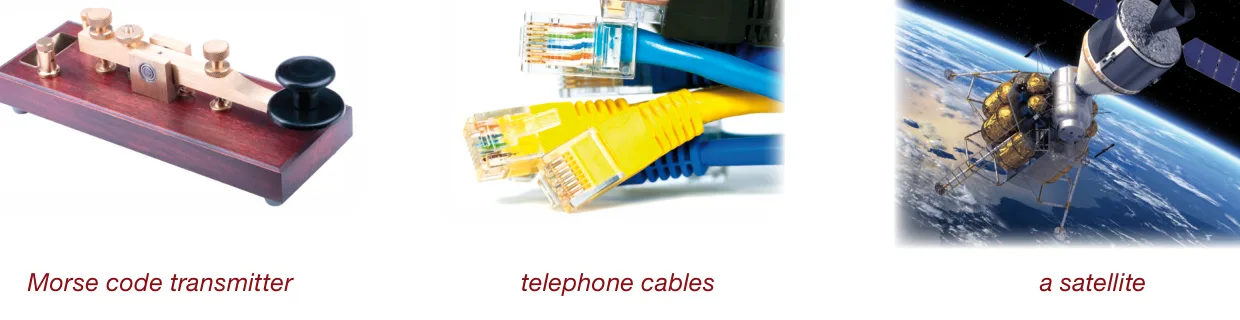
Text: developments in communications technology 1 In the middle of the 19th century, a man called Samuel Morse worked out how to send messages by radio using short and long electrical sounds instead of letters of the alphabet. By doing this, he completely changed the way people used to communicate, and so changed the world forever. It was the first time in history that a message had been sent without someone actually having to carry it. 2 In 1999, about 150 years later, people stopped using this way of communicating. It had been replaced years before by international telephone lines. Until the 1950s, there were no telephone lines under the Atlantic or Pacific Oceans. The first one was able to carry fewer than 100 voices, which at the time was regarded as a large number. The ones we use today carry more than a million. 3 Nowadays, of course, we have mobile phones and broadband Internet, which make it possible to send a message from one place to another anywhere in the world in less than a second. The messages are sent via satellites – those things up in space travelling round the Earth which we can’t even see. It really is amazing when you stop to think about it, but what’s more amazing is that we almost never do stop and think about it. 4 In the world of ICT (information and communications technology), everything changes very quickly, and the speed at which things change always increases. The facts about ‘technology take-up’ (the time it takes ordinary people to start using a new invention regularly) are surprising. After the radio was invented, it took 40 years for the number of listeners to reach 50 million in the United States. The same number of people were using the personal computer only 15 years after it was introduced. And 50 million Americans were regularly using the Internet just five years after it was introduced. 5 If things carry on like this, who knows what the next step will be? Opinions among scientists vary, and it has to be said that some of their ideas are hard to believe. But think about this: only about 25 years ago, mobile phones were the kind of thing that only appeared in stories and films, and not many people believed they would become a normal part of everyday life so soon.