
The topic explained
1 Look at the pictures on the web page below.
UNIT 3
- telling personal stories
- using three past tenses together in narratives
- using prefixes (co- and mis-)
- using time phrases and pronouns to make stories cohesive
- writing personal stories or anecdotes
Three true stories from a funny stories website
Look at the pictures on the web page below. Then discuss in pairs what you think might be happening.
- FunnyStories.com is full of true, real-life stories posted by readers.
- You can search under these headings
| Headings | Stories about |
|---|---|
| Coincidences | (stories about strange, unexpected events and connections) |
| Misunderstandings | (stories about people getting the wrong idea) |
| Unintended meanings | (stories about saying things that aren’t quite what you mean) |
Story A: a cake for Mr Aziz
Story B: a woman on the train
Next, a story about an old friend.
Story C: a pat on the wrong head
Last, a story from a hotel breakfast room.
Period 1 / Reading and comprehension
Sort the stories and learn their key words
Read the three stories on the web page. Then decide which heading each one should go under.
1 coincidence 2 misunderstanding 3 unintended meaning
3 Match the words and phrases from the stories with their meanings.
1 kept in touch 2 mentioned 3 patting 4 error 5 straight 6 colleague 7 bald 8 stranger a without hair b immediately c said something about d stayed in contact e someone you don’t know f hitting gently g mistake h someone you work with
4 Use the words and phrases in Activity 3 to complete the sentences below.
1 While he was away, he ___ with his family by email.
2 Instead of stopping for a coffee, I went ___ home.
3 I remember she ___ the name of a book yesterday, but I can’t remember the title.
4 He looks older than he is because he’s almost completely ___ .
5 I’ve no idea who he was. He was just a ___ .
6 While I was ___ my friend’s cat, it bit me.
7 I see him every day, but he isn’t a friend of mine. He’s just a ___ .
8 It’s hard to speak another language without making a single ___ .
5 Rewrite the sentences using the phrasal verbs in the box. Change the form of the verb if needed.
1 I didn’t realise who she was at first, but we discovered that we’d been at school together.
2 He was visiting the town for a few days, so I let him stay in my flat.
3 We hadn’t seen each other for years, so having a meal together was a good chance to talk about news and events.
6 Discuss the questions in pairs or small groups.
Which story do you think is the funniest? Which do you think is the strangest?
Period 2 / Reading and comprehension
Is it a small world? The maths of coincidence
1 Discuss the questions in pairs or small groups.
1 Has anything like the following ever happened to you or someone you know?
Tell your partner(s) about it.
▸ meeting someone you know in an unexpected place ▸ thinking about someone and getting a message from the same person soon afterwards ▸ talking to a stranger and finding that you share a birthday, a past experience or a friend
2 Which of these opinions is closest to your own?
I think strange coincidences must mean something. It’s hard to explain why they happen so often.
I know coincidences often happen and they seem strange, but they’re just part of normal life.
- People often think experiences like this are evidence of something mysterious happening, some kind of hidden plan outside our knowledge.
- The scientific explanation is less exciting, and perhaps that’s why some people are reluctant to accept it.
- A very common example of the latter is talking to a complete stranger and finding that you have the same birthday.
- What are the chances of that happening?
- Actually, the chances are better than you might think, and there’s a mathematical way to prove it.
- The other part of the scientific explanation for coincidences is simply that there are so many events in people’s lives.
- Just think of the number of people that you have had any kind of connection with during your life.
- There are probably over 10,000, and the older you get, the more there will be.
- If you are the kind of person who talks to strangers, you will definitely come across coincidences.
- Basically, when you think about how complex our lives are, especially nowadays with the Internet, the only surprising thing is that coincidences don’t happen more often.
Period 2 / Reading and comprehension: tasks
1 Replace the underlined parts of the sentences with words or phrases from the text.
(The sentences are in the same order as the words and phrases in the text.) 1 I was surprised to meet him by chance so far away from his home town.
2 She has a lot of things that she knows about this subject because she’s studied it for years.
3 Most people are not willing to answer questions about their age.
4 Of the two pieces of advice I’ve just given, the last one I mentioned is more important.
5 He didn’t expect to find his friend’s name by chance in the newspaper.
2 Choose the best answer to the questions. Circle A, B or C.
1 According to the writer what do people mean when they say ‘It’s a small world.’?
A We can communicate easily with people who are far away.
B Strange events happen more often than you might expect.
C People’s lives are more connected than they used to be.
2 Why does the writer think some people don’t want to believe scientific explanations for strange coincidences?
A They prefer a more exciting explanation.
B They don’t trust what scientists say.
C They misunderstand scientific ideas.
3 If there are 30 people in a room, what is the probability that two of them have the same birthday?
A 55% or more
B 80% or more
C 50% or less
4 What is the writer’s conclusion about coincidences?
A They probably have some meaning.
B They don’t happen as often as we think.
C They are not really surprising at all.
5 What does the phrase the latter (line 9) refer to?
A finding unexpected connections
B events that happen unexpectedly
C seemingly random things
3 Do an experiment to test the writer’s idea about shared birthdays.
▸ How many people are there in your class?
▸ Were any two (or more) people born on the same day?
Period 3 / Language and vocabulary study
Telling a story: past simple and past continuous
1 Look at the examples. Then answer the questions below.
1 Which example shows two completed actions in the past?
2 Which examples show one action that happened while another action was in progress?
3 Which tense do we use for a) completed actions?
b) uncompleted actions?
2 Complete the sentences with the correct tense of the verbs in brackets: past simple or past continuous.
1 I ____ him to come back later because I ____. (ask / work) 2 He ____ the right answer, but the teacher ____ him. (give / not hear) 3 Her mother ____ her why she ____. (ask / cry) 4 It ____ while I ____ to work. (rain / walk) 5 She ____ a taxi to the station and ____ just in time. (take / arrive) 6 While he ____ around the room, he ____ someone come in. (look / hear)
3 Work in pairs. Tell your partner about what you did after school yesterday. Include details, ▸ where you went ▸ what the weather was like ▸ what time you got home ▸ who was there when you arrived and what they were doing ▸ anyone who wasn’t there, and why not ▸ what you did in the evening
Prefixes co- and mis-
4 Look at the examples. Then complete the rules.
1 We use the prefix __ to add the meaning of wrong(ly) or bad(ly).
2 We use the prefix __ to add the meaning of with, together or at the same time.
Period 3 / Language and vocabulary study (continued)
5 Complete the sentences using the words in the box with either co- or mis- as prefixes.
1 She only gets angry when students __ in class.
2 Please keep phone conversations quiet to avoid disturbing your __s.
3 Students sometimes __ words that look the same as a word in their own language but have a different meaning.
4 Both their names are on the front of the book because they are the __s.
5 I thought he said he was from Australia, but I think I __ because he’s actually Austrian.
6 __ often gets better results than everyone working alone to solve a problem.
7 He flew the plane alone, without a __.
8 Information in adverts isn’t usually untrue, but it can __ people and give them the wrong idea.
Period 4 / Language and vocabulary study
Was leaving, left or had left? Order of events
Which sentence suggests that … 1 Samir was perhaps late, so there were some people he didn’t meet?
2 at the door Samir met some people leaving the party?
3 some people were perhaps waiting for Samir to arrive before leaving or perhaps left because they didn’t want to talk to him?
2 Match the sentence beginnings 1–8 with their endings a–h.
1 I felt much better 2 She found it hard to think clearly 3 As soon as I saw the photo 4 I took the book back to the library 5 When I told them about my mistake 6 They didn’t really understand 7 They decided to go for a walk 8 When I arrived I knew immediately a while the sun was shining.
b when I’d finished reading it.
c until she’d explained it twice.
d that something strange was happening.
e when the loud music was playing.
f after I’d taken the medicine.
g I recognised who it was.
h they all laughed.
3 Rewrite the sentences as single sentences, changing the tense of one verb and the order of the events if necessary. Use the word or phrase in brackets to join the two events.
1 I left the key inside the house. I got home in the evening and realised the problem. (when) 2 The bell rang. Everyone stopped working and left the building. (as soon as) 3 He rang me. It was in the middle of watching my favourite TV programme. (while) 4 His colleagues came to collect him. He was in the middle of eating his breakfast. (when) 5 I spent a long time studying this subject. I passed the exam easily. (because)
Period 4 / Language and vocabulary study (continued)
Three past tenses working together
4 Look at the way the three past tenses work together in the examples. Then answer the question below.
1 Which verb in each sentence does the main job of telling the story, and which two verbs give background information?
2 What is the tense of the main verb?
3 Which parts of the timelines below relate to which verbs? Label them.
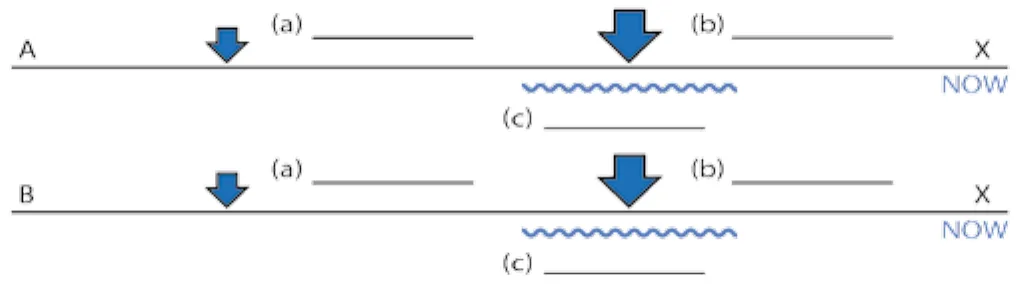
5 Complete the sentences with the correct tense of the verbs in brackets: past simple, past continuous or past perfect.
1 While we ____, she ____ someone who had been in our class when we were at school. (talk / mention) 2 He got wet during his walk because it ____ and he ____ to take an umbrella. (rain / forget) 3 The day before, I ____ to phone him, so I gave him a quick call while I ____ my breakfast. (promised / have) 4 When I went in, everyone ____, probably because someone ____ a joke. (laugh / just tell) 5 I thought the dog ____ because it ____ someone outside, but there was nobody there. (bark / hear)
Period 5 / Integrated skills
Samira's story: put the events in order
1 Look at the pictures. Then discuss the questions in pairs or small groups.
1 What is happening in each picture?
2 Who are the two people?
3 What is the connection between the pictures?
2 Listen to Samira explaining what happened in the situation in Activity 1. What was the coincidence?
3 Listen again and number the sentences to show the correct order of events in the story.
She went into the interview room.
The interview carried on as normal.
Samira picked it up and gave it back to him.
She felt embarrassed.
A man parked his car and opened the window.
Samira walked to the interview.
He didn’t say anything about what had happened before.
He was smiling.
She said something to the man.
He asked her the normal questions.
The man shook her hand and thanked her.
Perhaps she got the job, but she doesn’t know yet.
She went for a coffee.
He dropped an empty sweet packet out of the car window.
She recognised the man immediately.
4 Write Samira’s story. (To make the story clear, be careful to use the correct tenses and join the events with simple time words like when, while and as soon as.) Samira was going for an interview. While she was walking to the building, she _ As soon as she went in, she At the end, _
Period 6 / Writing
Write your own story about a coincidence
1 Look at the picture. Then discuss the questions.
1 What do you think has just happened?
2 Why do you think the two men are surprised?
2 Number the sentences in the correct order to make the story. (Look carefully at the underlined words and think about how they join the sentences together.) One day at breakfast, Martin got a watch out of his pocket.
Martin then told us that he’d found the watch on the same beach.
Some time ago, I was working at a school in the North of England.
To prove this, he pointed to his initials on the back and told us he’d lost it on a beach the year before.
So I invited him to stay with my family one summer.
I met another teacher there called Martin and we became good friends.
We were all amazed when he said it used to be his.
My brother Tom was staying there too.
Tom saw it and asked if he could have a closer look.
3 Write your own story about a strange coincidence or a misunderstanding. (It can be a true story about something that happened to you or someone you know, or a made-up story.) Before writing, think about these points:
▸ Who are the people in the story?
▸ What happened, where and when?
▸ How will you join the story together and what tenses will you use?
4 When you have finished, show your story to a partner and ask him/her to guess whether it’s true or made-up.
PROGRESS TEST 1 (UNITS 1–3)
Progress test: reading about routines
Reading 1 Read the text about routines. Choose the best title for each paragraph.
(There is one more title than you need.)
A The negative side of routine paragraph
B Odd habits paragraph
C Regular lives paragraph
D Manage your time paragraph
E Routine and memory paragraph
F Who is the book for? paragraph
2 Decide whether the statements are TRUE or FALSE.
1 Some people might find the book’s title misleading. TRUE FALSE 2 The book has a lot of useful advice. TRUE FALSE 3 Time seems to pass faster when we’re doing the same thing every day. TRUE FALSE 4 Getting older is the main reason for forgetting things. TRUE FALSE
3 What do these words, highlighted in the text, refer to?
1 them (line 5) 2 it (line 6) 3 which (line 7) 4 them (line 11) 5 They (line 17)
4 Answer the questions.
1 What advice is given in the first part of the book?
2 What benefit does breaking your routine bring?
20/17 marks
Progress test 1 Period 2
Progress test: vocabulary and language study
1 Match the words in the box with their meanings below.
1 keep trying _ 2 take part (in) 3 someone you work with 4 sure 5 unable to move 6 mistake 7 unable to wait __
2 Complete the sentences with the words in the box.
1 You don’t have to do this course. It’s ___ .
2 There’s no ___ buying a new phone if the old one still works.
3 I was ___ to go out because I was very tired.
4 It isn’t the only reason for his success, but it’s certainly one ___ .
5 Instead of playing football after school, he went ___ home.
6 I need to think of a good ___ for being late.
7 There’s nothing we can do to stop it happening; it’s ___ .
3 Match words 1–5 with a–e in the box to make fixed phrases. Then use the phrases to complete the sentences.
1 high 2 like 3 unintended 4 comfort 5 foundation a course b zone c priority d minded e meanings 1 If you’re stuck in a routine, you need to leave your _ _ .
2 He did a _ _ before starting university.
3 Joining a club is a good way to meet _ - _ people.
4 Making lots of money isn’t a very _ _ for him.
5 It can be funny when people say things with _ _ .
Progress test 1 Period 2 (continued)
4 Complete the sentences with the prepositions in the box.
1 I was surprised when I ran ___ an old friend of mine yesterday.
2 That was no accident. I’m sure he did it ___ purpose.
3 While he was away we kept ___ touch by email.
4 There were a lot of products ___ show and I didn’t know which one to buy.
5 I caught up ___ a lot of old friends at the party.
6 There are various things that young people worry ___ .
5 Circle the correct tense to complete the sentences.
1 I read / am reading a really interesting book at the moment.
2 A lot of people think the new building looks / is looking ugly.
3 I have / am having my breakfast, so I’ll call you back in ten minutes.
4 I can’t understand what the writer means / is meaning.
5 You should stop for a rest. You’ve driven / been driving for four hours.
6 I only started this book yesterday and I’ve already read / been reading 150 pages.
7 His eyes are tired because he’s played / been playing computer games for three hours.
6 Complete the sentences with the correct form of the verbs in brackets: to + infinitive or -ing form.
1 Thank you for agreeing _ me with this work. (help) 2 I enjoy TV, but tonight I’d like something different. (watch / do) 3 They wouldn’t stop , but they promised more quietly. (talk / speak) 4 ‘Did you remember the tickets?’ (bring) ‘Yes, I remember __ them in my pocket before we left. (put)
7 Complete the sentences with the correct tense of the verbs in brackets: past simple, past continuous or past perfect.
I needed to be at work early this morning because there was some work that I (1) _ (not finish) the day before. Unfortunately, just as I (2) (leave) the house, the phone (3) (ring). It was my mother. After talking to her, I (4) (run) to the bus stop, but the bus (5) __ (already go).
25/23 marks
Progress test 1 Period 3
Progress test: write about your favourite subject
1 Write a paragraph (100–150 words) about your favourite school subject. Include the following information.
▸ What subjects you are learning at school this year ▸ Which ones you like best and are most interested in ▸ Why you like the subject ▸ How long you have been studying the subject ▸ Which area of the subject you find most interesting ▸ What you would like to do with the subject in the future 5 marks


