

09 Unbelievable
- VOCABULARY Expressions and adjectives related to illusion, surprise and incredulity, word families, adjective-noun collocations, collocations related to science
- I can use adjectives and expressions to describe disbelief and surprise.
From the prescribed Advanced English textbook
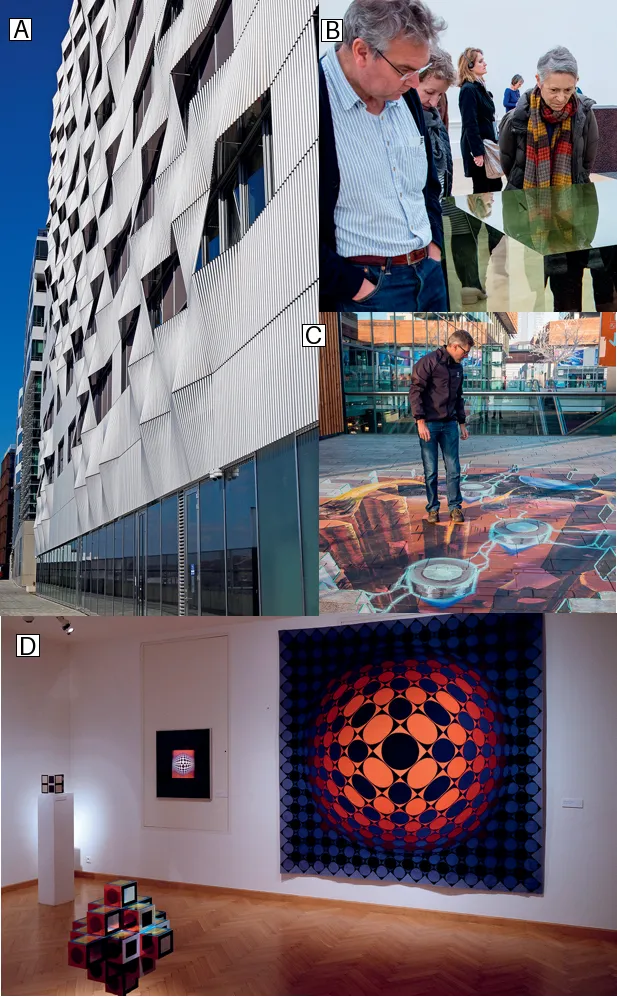
Photos: A wave-panel building, B gallery visitors, C street painting, D coloured sphere.
1 9.1 Listen to people talking about their experiences and match speakers 1–4 with photos A–D.
Match speakers 1–4 with photos A–D: speaker 1
Match speakers 1–4 with photos A–D: speaker 2
Match speakers 1–4 with photos A–D: speaker 3
Match speakers 1–4 with photos A–D: speaker 4
2 9.1 Listen again. Match speakers 1–4 with sentences a–f. There are two extra options.
The speaker mentions …
a. the time devoted to the preparation of the trick.
b. how disappointing the illusion would be if we accepted it wasn’t real.
c. how an illusion was created from a simple object.
d. an example of a childhood experience.
e. the reactions of other people as well as his/her own.
f. his/her broad knowledge of the subject of illusion.
3 Write the adjectives in the box next to their meanings 1–3.
You can’t explain or believe it.
You can’t look away.
You can’t move; very exciting.
4 9.1 Look at Exercise 3 and tick the adjectives in the box the speakers used in their descriptions. Listen again and check. Then complete the sentences below with the words from the box.
Whenever I see illusions like this, it’s completely ___ .
The effect was completely ___ .
At that age, the appearance of the building was completely ___ .
5 Complete the highlighted expressions with the words from the box.
It was impossible to work out how the illusion worked. It had everyone scratching their ___ .
The jug looked as though it were suspended in midair. It ___ me how it didn’t fall down and smash into pieces.
It seemed to go ___ all the rules of gravity!
The performance was spectacular. It _ me over – I was completely _ in by the clever illusions.
Seeing yourself a completely different shape was ___ else, mind-boggling and rather disconcerting.
We had no idea how he ___ it off!
I saw a photo of a house once that completely defied ___ . It looked transparent.
For a moment I was really taken ___ , thinking the house was invisible!
In the film, there’s a scene where the whole city seems to fold up. It completely ___ me away!
6 Study Active Vocabulary. Then complete the article with words formed from the words in bold.
Most of us have grown so used to films that feature incredible special effects that we have almost become blasé about it. Some of the techniques seem 1 ___ (DECEIVE) easy.
But, in order for each special effect to be 2 ___ (BELIEVE), a whole range of creative artists needs to be involved.
There is a general 3 ___ (ASSUME) that everything is in the hands of computer animators, but nothing could be further from the truth.
Yes, computers are essential in creating apparently 4 _ (EXPLAIN) scenes, but many imaginative old-school tricks are still employed in the 5 _ (DECEIVE).
Among these are the model makers who fashion miniatures which can be computer scanned, make-up artists, who spend an 6 _ (IMAGINE) amount of time building faces and masks that are 7 _ (CONVINCE), and animatronics experts who design and build mechanical robots.
We know that the worlds created are 8 _ (ILLUSION), but we are in the hands of masters, and their aim is to make us trust the truth of these alternative 9 _ (REALITY).
Most of us have grown so used to films that feature incredible special effects that we have almost become blasé about it. Some of the techniques seem 1 _ (DECEIVE) easy. But, in order for each special effect to be 2 (BELIEVE), a whole range of creative artists needs to be involved. There is a general 3 (ASSUME) that everything is in the hands of computer animators, but nothing could be further from the truth. Yes, computers are essential in creating apparently 4 (EXPLAIN) scenes, but many imaginative old-school tricks are still employed in the 5 (DECEIVE). Among these are the model makers who fashion miniatures which can be computer scanned, make-up artists, who spend an 6 (IMAGINE) amount of time building faces and masks that are 7 (CONVINCE), and animatronics experts who design and build mechanical robots. We know that the worlds created are 8 (ILLUSION), but we are in the hands of masters, and their aim is to make us trust the truth of these alternative 9 __ (REALITY).
Now go to Workbook page 28 for the next lesson.
□ I can use adjectives and expressions to describe disbelief and surprise.
Sign up free to read the rest of this subunit; we bring you back here.
A preview of “Illusion and Surprise” from the unit “Unbelievable” in Advanced English: 7 lesson sections, 3 definitions, 6 worked questions.
Source: National Center for Curriculum Development, 1A Vocabulary and Speaking: Expressions and adjectives related to illusion, surprise and incredulity (pp.40-41)





