
The topic explained
1 1.4 Listen to three conversations where people meet for the first time. Which do you think is the best question they use to keep a conversation going?
LESSON 4A GRAMMAR
- I can use question tags and echo questions to keep a conversation going.
- I can identify specific information in a radio interview and talk about emotional intelligence.
- I can use fixed phrases to express emotions.
Keep a conversation going
Listen to three conversations where people meet for the first time. Which do you think is the best question they use to keep a conversation going?
Question tags: a short question at the end
Where does the tag go, and how is it built?
Question tags and echo questions
Look at the underlined examples of question tags from the dialogues. Then complete the sentences 1−4 below with the words in the box.
end modal negative positive
A question tag is a short question added to the ___ of a sentence.
We form a question tag using an auxiliary or a ___ verb and a pronoun.
A positive statement usually has a ___ question tag.
A negative statement usually has a ___ question tag.
PRONUNCIATION Listen and match what you hear with intonation pattern A or B below.
Which pattern is used for a question and which for confirming something the speaker already knows?
Look at these more unusual question tags. Choose the correct words to complete the sentences.
This is silly, isn’t it / this?
Nothing ever changes, do / does it?
Come and look at this, will / don’t you?
Everyone was there, weren’t / wasn’t they?
Don’t be late, are / will you?
No one likes him, do / does they?
In pairs, look at the echo question in italics. Then answer questions 1−3 below.
What is the function of an echo question?
Do we use a positive or a negative question to reply to a positive statement?
Which intonation pattern from Exercise 4 do we use with an echo question: A or B?
LESSON 5A LISTENING AND VOCABULARY
Feelings: strong words and stronger ones
THINK BACK In pairs, look at the photos above and discuss what emotions you think the people are feeling.
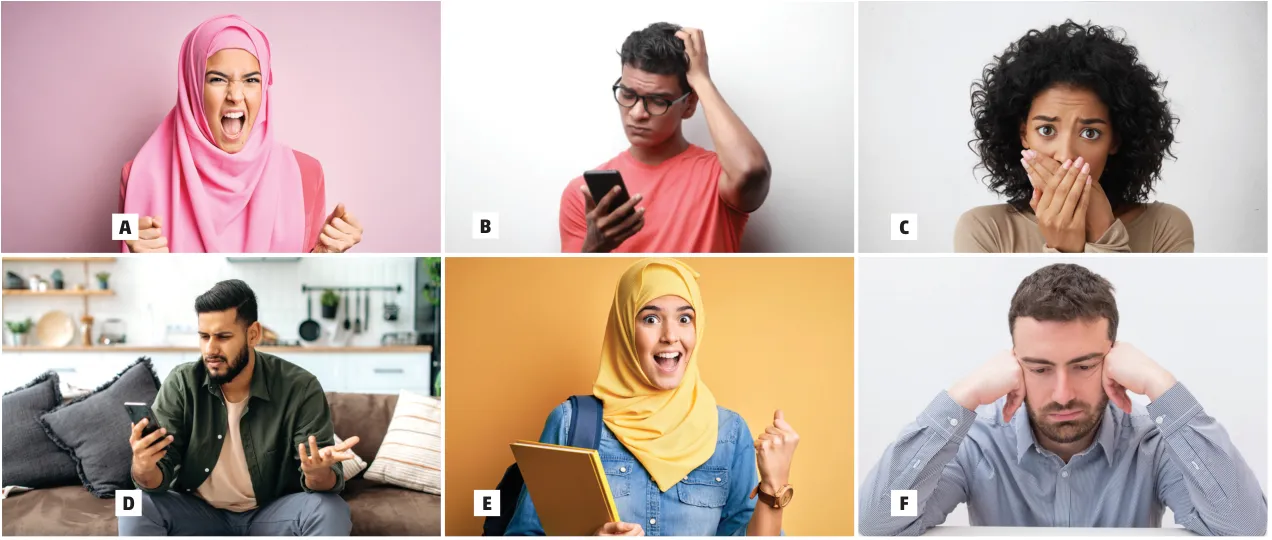
- Match the adjectives below with their synonyms in Exercise 1. Which of the words have a stronger meaning than their synonyms?
- 1 terrified frightened
- 2 astonished
- 3 exasperated
- 4 livid
- 5 tense
- 6 ecstatic
- 7 bewildered
- 8 devastated
Match the adjectives below with their synonyms in Exercise 1.
Which of the words have a stronger meaning than their synonyms?
Complete the sentences with the adjectives from Exercise 2.
I’m completely ___ about my exam results – I never thought I’d do so well!
He has no idea how he lost his phone. He feels completely ___ .
Randa’s mother was absolutely ___ when she found out that her daughter had cheated in the exam again.
She felt very ___ as she waited for her job interview.
He’s ___ that someone will find out his secret.
Nothing is changing and he is becoming more and more ___ about the situation.
EQ: the skill behind your emotions
Listen to an interview. What is the difference between IQ and EQ?
What is the difference between IQ and EQ?
Listen again and complete the sentences with one word.
One piece of research showed that people with high emotional intelligence ___ a lot more than those with a low EQ.
Emotional intelligence is not ___ , which is different from IQ.
One way to become more self-aware is to write a ___ .
We need to learn how to recognise our negative emotions in order to be able to ___ them.
Other people cannot make us feel a certain way; we are largely ___ for our own moods.
Body language, such as ___ , can demonstrate that you are listening.
Active listening can also help you to avoid ___ .
LESSON 6A SPEAKING
Say how you feel with fixed phrases
Listen to six short conversations. What is the main emotion each speaker expresses? Why did each speaker feel that way?
Complete the Speaking box with the phrases from the box.
SPEAKING| Expressing emotions
- Expressing anxiety
- It’s been keeping me up at night.
- I’m worried sick about …
- Expressing relief
- I can breathe a sigh of relief now.
- That’s a weight off my mind.
- Expressing annoyance and frustration
- … is driving me up the wall!
- … really gets on my nerves.
- I’ve had it up to here with …
- Expressing surprise or disbelief
- You’ve got to be kidding me!
- Who would have thought it?
- Get out of here!
- Expressing sadness
- I’m feeling a bit down in the dumps.
- I’m feeling a bit blue.
- I’m heartbroken.
- Expressing enjoyment or happiness
- I’m walking on air!
- I can’t stop smiling!
Respond when a friend shares a feeling
Listen to six statements.
When you hear a beep, choose and say a suitable response from the box.
Replace the underlined words with phrases from the Speaking box and suitable responses in Exercise 3.
1 A I’m extremely concerned about my aunt – she isn’t very well.
B That’s awful. It’s horrible when a relative is sick.
2 A I’ve got to give a presentation in class next week. I’m really nervous. I’ve been worrying about it a lot.
B There’s no need to worry. You’ll be great!
3 A My parents are taking me to Florida this summer.
B I don’t believe you! You lucky thing!
A Yes, I’m so happy.
4 A I’m completely fed up with people gossiping behind my back.
5 A I finally finished my geography project.
That must be a relief for you.
STUDENT A
- In pairs, role play the two situations. Use language for expressing emotions and for responding from this lesson.
- You can’t decide what subjects to choose for your final year at school. You’re really worried about this. Tell your friend how you feel.
- You did badly in your exams. Tell your friend how you feel.
- Your partner is going to tell you about two different situations. For each situation which your partner describes, respond according to these instructions.
- Express your happiness at the situation.
- Express your surprise and pleasure.
Grammar Reference: Question tags and echo questions
- It is formed using do / does / did (in simple tenses) or the auxiliary + a pronoun.
- Modal verbs are usually repeated in the tag questions, just like auxiliaries: I can email my CV, can’t I?
- A positive statement usually has a negative question tag and a negative statement has a positive question tag: You don’t understand, do you?
Tricky tags: intonation and special cases
- Exceptions: Let’s go to the cinema, shall we?
- Someone has bumped into your car, haven’t they?
- Nobody came to the presentation, did they?
- I’m still employed, aren’t I?
- Question tags can also be used for:
- requests: Buy me the newspaper, could you? You’ll cook the dinner today, won’t you?
- invitations: Come to visit us next summer, won’t you?
- commands: Write it down, will you? Don’t make a mess, will you?


