
The topic explained
VOCABULARY Cause and effect phrases, compound nouns for threats to the environment, describing wildlife and threats to wildlife
02 Looking ahead
- I can use a variety of forms to talk about future predictions.
- I can talk about threats to the environment.
- I can understand signposting in a lecture and talk about climate change.
LESSON 1A VOCABULARY AND GRAMMAR
The future: bright or terrifying?
In pairs, read the definition of ‘dystopia’ and discuss the question. Do you enjoy reading books, watching films or playing video games set in a dystopia?
Now the other side of the article: the dystopian one.
Read the magazine article about two different visions of the future. Which text is dystopian?
Will or going to: how sure are you?
Which verb form shows that you have evidence right now?
… TERRIFYING!
Future forms for predictions
THINK BACK Look at two predictions from the texts. Which verb form is used when there is some evidence now for the prediction?
1 Such cars are already a reality and are going to become more common in the next few years.
2 A few lucky people will be rich and the rest of us will be poor.
Three tenses: in progress, finished, still going
At that future moment, will the action be under way, done, or still continuing?
Match the underlined phrases (1–4) in the article to these tenses.
a Future Perfect Simple b Future Perfect Continuous c Future Continuous 1 will be living 2 will have been trying 3 will have stopped 4 we’ll be fighting
Now match tenses a–c in Exercise 4 to explanations 1–3 below.
1 an activity in progress at a specific time in the future 2 an activity which will be completed by a specific time 3 an activity which continues up to a specific point in the future
Choose the correct answers to complete the sentences.
1 By 2050, software will be able / will have been able to predict traffic jams.
2 In a few years, tablets won’t exist anymore. They will be / will have been replaced by smartwatches.
3 By the time today’s young people retire, they will be working / will have been working for 70 years.
4 I don’t think we will need / are going to need passwords, as computers will be able to recognise our faces.
5 In a few decades, everyone will be growing / will have been growing their own food.
2.1 Complete the article with the phrases from the box. Then listen and check.
is likely to mean is unlikely will be eating will have risen will have to By 2075 the population of the world 1 ___ to more than nine billion.
This 2 ___ that we will need to use more and more land for housing.
We will also need to produce more food and it 3 ___ that we will be able to produce enough meat to feed all those people without further damaging the environment.
Our eating habits 4 ___ change.
It may sound disgusting, but in a few years, all of us 5 ___ it!
Wha t will we be eating in the future?
Rewrite the sentences below using the phrases from the box.
a big cause of as a consequence of cause (v) give rise to result from result in 1 This may be due to better education.
2 As a result of better medicine, people are likely to live until the age of 100.
3 Global warming is certain to lead to water shortages.
LESSON 2A VOCABULARY | Threats to the environment
Compound nouns for environmental threats
In pairs, look at the ‘before’ and ‘after’ photos. What do you think happened?
Complete the compound nouns. Then listen and check.
emissions energy erosion fuels fumes gases layer loss rain scarcity species turbine warming waste 1 acid _ 2 endangered 3 exhaust 4 fossil 5 global 6 greenhouse 7 habitat 8 ozone 9 renewable 10 soil 11 toxic 12 vehicle 13 water 14 wind _
ACTIVE VOCABULARY| Compound nouns
Two words, one idea, and where the stress goes
- The first word can be a noun, adjective or a verb, but the second word is always a noun, e.g. climate change (N + N), industrial waste (A + N), swimming pool (V + N).
- When both words are nouns, the stress is always on the first noun, e.g. climate change.
- When the first word is an adjective or a verb, the stress is on the second word, e.g. industrial waste.
Complete the sentences with compound nouns from Exercise 2.
1 80 percent of the energy we consume is provided by ___ which pollute the atmosphere.
2 Deforestation causes ___ because tree roots are no longer in place to bind the earth together.
3 It is claimed that ___ from cars kill twice as many people as accidents caused by vehicles.
4 Up to 300 homes can be powered by one _, using _ .
5 _ is the greatest threat to _ which are close to extinction.
6 For safety reasons, ___ must be stored in sealed containers underground.
7 ___ damages buildings, forests, and kills fish.
LESSON 3A LISTENING AND VOCABULARY
Weather words that go together
SPEAKING In pairs, look at the photos and make a list of weather-related vocabulary to describe them. Which of the types of weather have you seen?
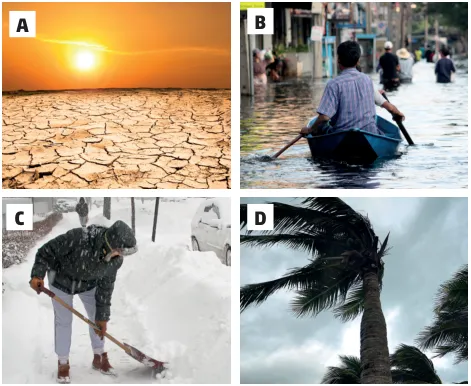
Make more weather-related collocations, using the nouns from the box.
floods heat humidity rain snow temperatures weather winds 1 blistering _ 2 freak 3 gale-force 4 heavy 5 high 6 scorching 7 soaring 8 sub-zero 9 torrential __
Follow a lecture by its signposts
2.4 Listen to a lecture about climate change. Does the speaker agree with any of the arguments in Exercise 3?
Study Active Listening. Then match the signposting phrases to the functions.
1 I’m going to be talking about … 2 In other words, … 3 The second thing is … 4 … whereas … 5 So, to sum up, … a sequencing an argument b indicating that the speaker is going to paraphrase what they just said c introducing the topic d concluding e contrasting two ideas
2.4 Listen again and complete the notes with up to three words in each gap.
1 The percentage of scientists who believe that climate change is real is about ___ .
2 To understand changes to climate, it is necessary to look at the ___ rather than the current weather.
3 It is possible that warmer weather may actually cause more ___ .
4 In the past, temperature changes were gradual and caused by natural factors such as solar activity and ___ .
5 While carbon dioxide may help plants to grow, it also causes freak weather which destroys ___ .
ACTIVE LISTENING| Signposting
7 REFLECT | Society Discuss the questions.
Grammar Reference: Future forms for predictions
- We use will:
- to make predictions based on our opinions or expectations.
- We often use will with phrases like I think, I’m sure, I expect, or adverbs like possibly, probably, definitely: He’ll probably be late, as usual.
- I’m sure you won’t have any problems with it.
- to express a decision made at the moment of speaking: On second thoughts, I think I’ll leave it till the weekend.
- We use going to:
- to talk about existing plans or intentions for the future: I’m going to study Architecture at college.
- to make a prediction based on evidence you have now: You are going to have a busy weekend! (I know all the things my friend has to do at the weekend.)
| Future Continuous | will + be + Present Participle | an action that will be in progress at a particular time in the future |
| Future Perfect Simple | will + have + Past Participle | an action that will be completed before a particular time in the future |
| Future Perfect Continuous | will + have + been + verb -ing | a duration of an action which is still ongoing at some point in the future |
- By the end of the century, more people will be living in the country than in cities.
- Will you be working on it at 5.30?
- to talk about events that will happen as part of the normal course of events, or routine: She’ll be visiting her family at the weekend. (She does it every weekend.)
- As with other continuous forms, we do not use state verbs (be, believe, forget, like, want, etc.) with the Future Continuous.
- In 100 years’ time half the world’s languages will have disappeared.
- Will you have finished it by then?
- I will have been living in Berlin for three years in July.
How certain is the prediction?
- Other modal verbs can be used instead of will with Future Continuous and Future Perfect forms to show different degrees of certainty (might, may, could).
- We can use certain phrases with the structure be + adjective + infinitive to talk about how probable it is that a future prediction will actually happen:
| be bound/certain/sure to | this is almost definite |
| be likely to | this is probable |
| be unlikely to | this is improbable |
Word List: Unit 2, Lessons 1–3
Say what caused what
| a big cause of | /ə bɪɡ kɔːz ɒv/ |
| as a result of | /æz ə rɪˈzʌlt ɒv/ |
| as a consequence of | /æz ə ˈkɒnsɪkwəns ɒv/ |
| be due to | /ˌbi ˈdjuː tə/ |
| give rise to | /ɡɪv raɪz tuː/ |
| lead to something | /ˈliːd tə ˌsʌmθɪŋ/ |
| result from | /rɪˈzʌlt frɒm/ |
| result in | /rɪˈzʌlt ɪn/ |
| acid rain | /ˌæsɪd ˈreɪn/ |
| endangered species | /ɪnˌdeɪndʒəd ˈspiːʃiːz/ |
| exhaust fumes | /ɪɡˈzɔːst ˌfjuːmz/ |
| fossil fuel | /ˈfɒsəl ˌfjuːəl/ |
| global warming | /ˌɡləʊbəl wɔːmɪŋ/ |
| greenhouse gases | /ˌɡriːnhaʊs ɡæsɪz/ |
| habitat loss | /ˌhæbətæt ˈlɒs/ |
| ozone layer | /ˈəʊzəʊn ˌleɪə/ |
| renewable energy | /rɪˌnjuːəbəl ˈɛnədʒi/ |
| soil erosion | /ˈsɔɪl ɪˌrəʊʒən/ |
| toxic waste | /ˌtɒksɪk ˈweɪst/ |
| vehicle emissions | /ˌviːɪkəl ɪˈmɪʃənz/ |
| water scarcity | /ˈwɔːtə ˌskeəsəti/ |
| blistering heat/temperature | /ˌblɪstərɪŋ ˌhiːt/ |
| freak weather | /ˌfriːk ˈweðə/ |
| gale-force wind | /ˈɡeɪlˌfɔːs ˌwɪnd/ |
| heavy snow/rain | /ˌhɛvi ˈsnəʊ/ |
| high humidity | / haɪ hjuːˈmɪdəti/ |
| scorching temperature | /ˈskɔːtʃɪŋ ˌtemprətʃə/ |
| soaring (adj) | /ˈsɔːrɪŋ/ |
| sub-zero temperature | /ˌsʌb ˈzɪərəʊ ˈtemprətʃə/ |
| torrential rain | /təˈrenʃəl ˈreɪn/ |


