
The topic explained
VOCABULARY* Behaviour, life events
03 Influences
- I can use a variety of forms to talk about present and past habits.
- I can distinguish between opinion and facts in a radio programme and talk about life events.
- I can talk about personal qualities and behaviour.
LESSON 1A VOCABULARY AND GRAMMAR
At home: who winds whom up?
Look at the photos. What are the benefits of being from a small/large family?
Families shape how we behave. Which of these phrases describe you at home?

What do you think are the good and bad things about being an only child?
THINK BACK Look at the phrases describing ways of behaving towards other people. Are these positive or negative things to do? Can you add any other phrases?
SPEAKING In pairs, talk about how you get on with members of your family. Do you think being the oldest, youngest or middle child, or an only child, affects your personality?
Past and present habits
Always annoying? Habits then and now
Look at the examples showing two forms which can be used to talk about past and present habits.
Same family, same annoyance: how do we say it about now and about then?
Find more examples of such forms in the texts in Exercise 5.
PRONUNCIATION Listen to sentences about present and past habits. Does each speaker sound neutral (N) or annoyed (A)? How does the intonation change?
Complete the short text with used to or would. Sometimes both are possible.
When he was younger, Hamzah ___ play basketball.
He ___ go to the park after school every day.
He ___ be quite tall for his age, but then all the other boys caught up.
In fact, his younger brother, who ___ be tiny, is now quite a bit taller than him.
Hamzah ___ be the best player in the basketball team, but now he prefers football!
VALUES Why is it important not to make fun of people? Discuss in pairs.
Habits in the present
Habits in the past
LESSON 2A LISTENING AND VOCABULARY
What shaped you? Life events
Which of the life events in the box can you see in photos A–C? Which of them can be the most challenging?
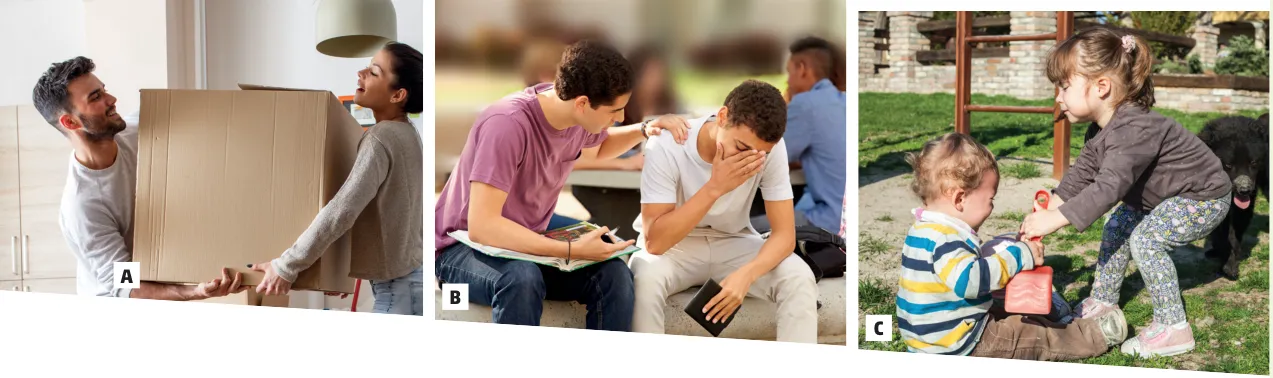
Why does the speaker think that what happens to us can influence our personality?
Does the speaker think that negative events are to be avoided? Say why.
What was the life event?
What did he/she learn from it?
SPEAKING In pairs, discuss the meaning of these phrases from the recording.
1 wasn’t doing me any favours 2 things don’t immediately go my way 3 turn out to be positive in the long run 4 the value of sticking at something
ACTIVE LISTENING | Distinguishing between facts and opinions
- It may be signalled by the use of such words as feel, believe or think or phrases such as If you ask me … / I have the impression that …
- It may be signalled by a phrase such as The data shows … / The research indicates …
LESSON 3A VOCABULARY | Personal qualities and behaviour
Who do you look up to?
Make a list of five important people. What makes them important?
Every adjective here is a verdict on someone. Who gets which one?
Listen and match the definitions you hear to ten of the words from Exercise 2.
Match the adjectives from Exercise 2 to the correct stress patterns in the table.
Tick the words and phrases which you hear.
SPEAKING Ask and answer the questions.
1 Do famous people have a responsibility to be good role models? Say why.
2 Who has more influence on you – public figures, your friends or your family?
Do you admire any of them? Say why.
Grammar Reference: Unit 3, Lesson 1A Past and present habits
- She’s always complaining about the weather. (present)
- She was forever arguing with her parents when she was younger. (past)
- They can describe both pleasant and annoying habits:
- She’ll turn up at 11 o'clock and act as if nothing’s wrong. (present)
- We’d spend the afternoons reading. (past)
- I used to feel very negative about my job.
- At our old house I used to spend a lot of time with my friends.
- Would is not used to talk about past states.


