
The topic explained
LESSON 4A READING AND VOCABULARY
- I can recognise bias in news reports and talk about protests.
- I can identify specific details in a radio programme and talk about photos.
- I can tell an anecdote.
- I can write a story.
Same hotel, two reports: whose side is each on?
1 In pairs, look at the photos from two news reports. What do you think the reports are about?
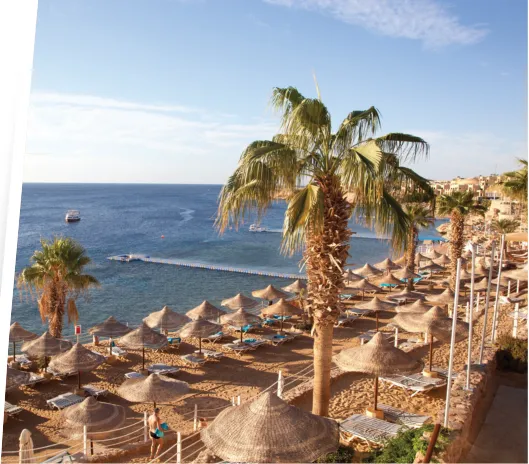
2 Read the news reports and answer the questions.
1 What opportunities does the development bring according to the first report?
2 What other things will be built as well as the hotel?
3 Why does the second report think the development won’t be good?
4 What do the protesters want to happen?
3 Read the reports again. Match sentences A–H with gaps 1–6 in the texts. There are two extra sentences.
A However, people should have the freedom to protest about things they do not agree with.
B Everyone has the right to protest, but such obstruction is illegal.
C There have been talks for years about opportunities for new developments, but they never seem to happen.
D People were furious and took to the streets in protest.
E I am also sure that locals who work at the old restaurants will probably lose their jobs.
F Not only will the hotel need local workers but there are sure to be other jobs in tourism when the hotel guests start to arrive.
G But when I put in a request to find out more about the developers on the internet, I quickly changed my mind.
H She stressed it was ridiculous to believe the residents could be guilty of harming the workers.
NEW HOTEL IS JUST WHAT THE AREA NEEDS
Now the other side: the same hotel, a different report.
NEW HOTEL, BUT NO NEW HOPE FOR LOCALS
4 CRITICAL THINKING Study Active Reading. Then read the news reports again and find examples which demonstrate bias. Why is it important to recognise bias?
ACTIVE READING | Recognising bias
Spot the signs of bias, then build nouns
- Very few texts are completely balanced or objective, but there are some key indicators that a text is more strongly biased:
- facts are missing or exaggerated
- there are overgeneralisations
- there is little respect for different opinions
- there are quotation marks to indicate that the writer does not agree with a different opinion.
| Suffixes | Nouns |
|---|---|
| -ment | statement, … |
| -tion | information, … |
| -sion/-cion | tension, … |
| -ist | |
| -er/-or | worker, … |
| -ity | opportunity, … |
| -hood | |
| -dom |
5 Find examples of nouns in the news reports with the suffixes in the table.
-ist -hood -dom
6 Complete the sentences with the correct noun forms of the words from the box.
allege improve replace solve 1 The two sides need to sit down and find a(n) ____.
2 It will be difficult to find a suitable ____ for Laila when she leaves her post.
3 The ____ against him are shocking, but he denies all of them.
4 There has been a(n) ____ in the standard of living in my country.
7 Complete the collocations from the articles with the correct verbs from the box. Then check your answers in the text.
come up with refute release report 1 The accident was bad enough for them to ____ the incident to the police.
2 Locals living on the street ____ the allegation that they did anything illegal.
3 Perhaps they can try to ____ a solution.
4 The developers ____ a statement about their ‘improvement’ scheme.
LESSON 5A LISTENING AND VOCABULARY
Four famous photos and the stories behind them
1 Check you understand the highlighted words. Then look at photos A–D and match them with these descriptions.
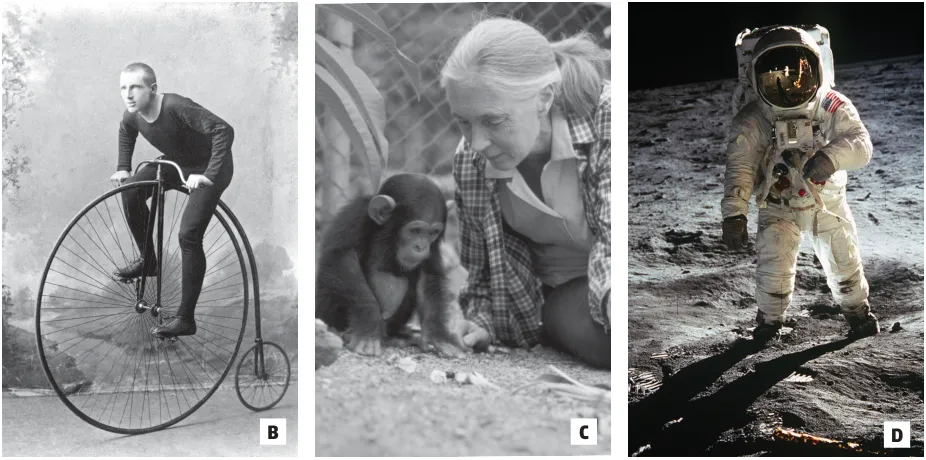
1 The shot looks like he is moving forward, but is not cropped very well because the background is actually a photo.
2 The image really captures the close relationship she developed with all the animals she worked with over her long career. It also shows a likeness between people and chimpanzees.
3 The men are shown having their lunch break; they look very natural, not as if they were posing.
4 This poignant photo is carefully composed; it looks like he is standing alone.
Check you understand the highlighted words.
Match each speaker with their statement (a–d).
3 4.6 Listen again and answer the questions.
1 Why is the year that the photo of the workers was taken significant?
2 What had just happened when the photo was taken of William Walker Martin?
3 Why was it surprising that Martin was such a fast cyclist?
4 Why was Jane’s relationship with David Greybeard particularly important?
5 Who took the photo of Buzz Aldrin?
6 What evidence is there that Buzz Aldrin was not alone when the photo was taken?
LESSON 6A SPEAKING
Telling an anecdote: what to say and when
1 What is an urban myth? Discuss in pairs.
What is an urban myth?
2 4.9 Listen and decide which stories are true, false or partly true. Then go to page 74 to check the answer.
Which phrase starts, sets the scene, turns, reacts and ends?
3 Study the Speaking box and complete it.
4 4.9 Listen again and tick the phrases in the Speaking box that you hear.
5 Choose the most suitable comment adverb to complete the sentences. In pairs, explain your choices.
1 Obviously, / Theoretically, you don’t need any help with this – you’re doing brilliantly!
2 Disappointingly, / Foolishly, I forgot to take an umbrella. I should have known it would rain.
3 Presumably, / Apparently, attention spans are getting shorter – I read that somewhere.
4 Surely, / Fortunately, you don’t expect me to believe that.
5 Presumably, / Unbelievably, he doesn’t like vegetables; I’ve never seen him eating any.
6 Personally, / Surely, I like him, but a lot of people can’t stand him.
7 Theoretically, / Clearly, your job is not important to you, or you wouldn’t keep turning up late.
8 Unbelievably, / Surely, she was rude to a customer not just once, but four times!
Saying that an anecdote is about to start
Giving background information
Introducing a turning point
Showing the speaker’s attitude
Rounding off the anecdote
LESSON 7A WRITING | A story
The man in black: a story that keeps you guessing
1 Work in pairs. Read the story. What do you think happens at the end?
The man in black
Was your prediction right?
3 Study the Writing box and find examples of: negative inversion, different verbs to describe speaking, looking and moving.
4 Read underlined sentences a–f in the story. Which past tenses are used in each example?
a I turned round and saw the man in black.
b My heart was pounding furiously in my chest as the man raced towards her.
c The day had started so well.
d I had been wandering aimlessly around the city e He was wearing a black suit and tie with dark glasses f The old woman glanced at the man and stopped as she was walking past.
5 Now match sentences a–f in the story with functions 1–5 below.
1 □□ Describing an ongoing action that forms the background to a story.
2 □ Contrasting an event in progress with a single action that interrupts it.
3 □ Describing an action which was completed before a time in the past.
4 □ Describing a single completed action in the past.
5 □ Describing a situation or action which was in progress at or up to a time in the past.
Title
Write your own story: title, structure, language
Structure
Language
- 1 to look at something closely and carefully
- 2 to take a quick look at something
- 3 to notice something or someone
- 4 to shout angrily in a low deep voice
- 5 to shout loudly, because you are excited or angry
- 6 to speak so quietly that you cannot be heard easily
- 7 to go somewhere as quickly as possible
- 8 to walk in a casual way, often in no particular direction
6 Match the highlighted words in the story with their definitions.
7 Study Watch Out! Then put the words in the correct order to make sentences.
1 he / in my ear / yelled loudly 2 she / blankly / at him / for several seconds / stared 3 they / worked / all day / very hard / in the factory 4 I / on the bench / sat / for over two hours / patiently


