
The topic explained
05 Making sense of the senses
- I can use gerunds and infinitives to talk about different actions.
- I can talk about the senses
- I can use verbs with gerunds and infinitives to talk about different actions.
LESSON 1A VOCABULARY AND GRAMMAR
Warm-up: what do you know about the senses?
In pairs, discuss the questions.
What are the names of the five senses?
Which is your strongest sense? Say why.
How are animal senses different to human senses?
Read the fact sheet below. Two of its ten facts are not true.
Which two facts are not true?
Sense words from the fact sheet: fill the gaps
Which highlighted words from the fact sheet fit these meanings?
WATCH OUT!
Gerunds and infinitives: which form follows which?
After which words do we use to plus a verb, and after which the -ing form?
Write the verbs and verb phrases from the box under the correct headings.
can’t help encourage fail feel like force happen have difficulty let make
Proprioception: read the text and fill the gaps
Read a short text about a sixth sense, then choose each verb form.
used to, be used to, get used to: three meanings
One small change in the verb phrase changes the whole meaning.
| الجملة | المعنى |
|---|---|
| I’m used to wearing glasses. | This is normal for me. |
| I’m getting used to wearing glasses. | This is slowly becoming normal for me. |
| I used to wear glasses. | I don’t wear them now. |
LESSON 2A VOCABULARY | The senses
Sounds and smells: words that describe them
In pairs, discuss the questions. What are your favourite smells? Are there any sounds you really dislike?
| الوصف | الكلمة من المنشور |
|---|---|
| the smell of something delicious cooking. | aroma |
| something difficult to detect. | subtle |
| something which is too strong. | overpowering |
| really bad smells. | smelly (adj) / stench (n) |
| delicious-tasting food. | mouth-watering |
| a pleasant smell of flowers. | scent |
Words for how things feel: match them to pictures
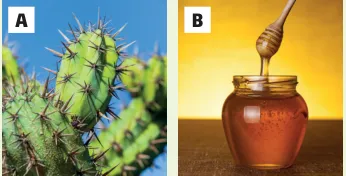
Check the meaning of the words in the box and match them with the pictures.
coarse fluffy prickly silky smooth spiky squishy sticky
WATCH OUT!
- Many words for sounds, e.g. crunch, crash, pop, buzz are both verbs and nouns/gerunds:
- I can hear the hum/humming of a machine.
- The fans were humming softly.
LESSON 3A GRAMMAR
Jobs that need a sharp sense: listen and match
In pairs, think of jobs which require a very good sense of smell, hearing, touch, etc.
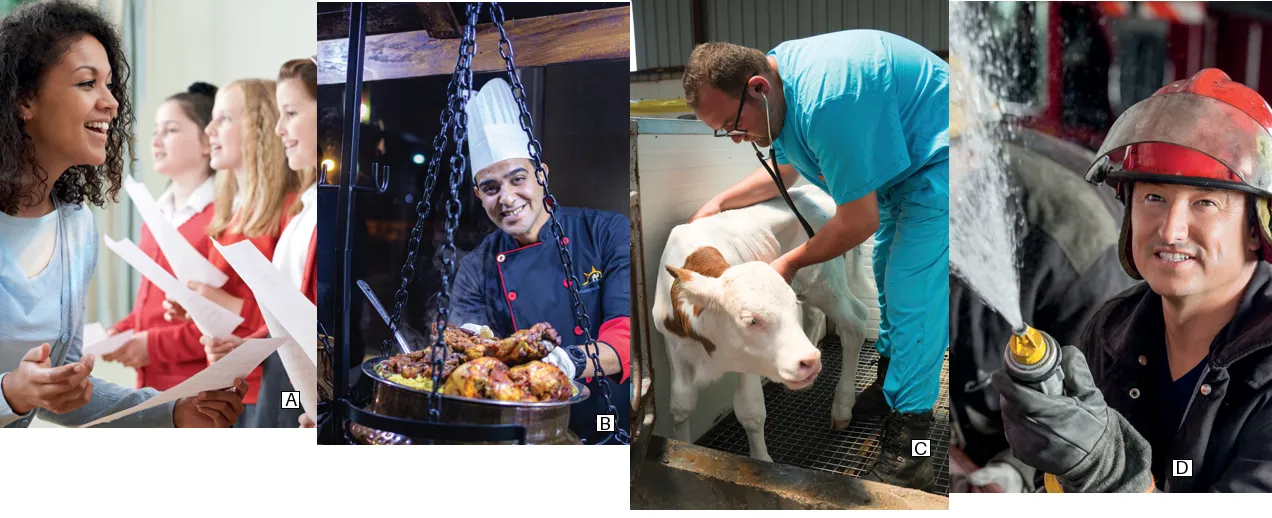
Listen and match speakers 1–4 with photos A–D.
Same verb, new meaning: remember, forget, stop, try
For some verbs, to plus a verb and the -ing form mean different things.
Look at the sentences in Exercise 3. Then complete rules a–d with infinitive and gerund or choose the correct word.
Some verbs like forget, go on, mean, regret, remember, stop and try can be followed by 1 _ or 2 _ , but the meaning changes depending on which form we use.
To talk about a completed action after the verbs feel, hear, listen to, see and watch, we use object + 3 ___ .
To talk about an action in progress after those verbs, we use object + 4 ___ .
After the verbs need, deserve and require the gerund has 5a passive / an active sense.
Complete the sentences with the correct forms of the verbs from the box.
land practise score sign wash
1 I can hear my neighbour ___ his violin.
2 Hanan felt the mosquito ___ on her leg.
3 Did you see him ___ the winning goal?
4 Do these grapes need ___ ?
5 These documents require ___ .
Grammar Reference: Unit 5 Gerunds and infinitives
- We use an infinitive with to:
- to explain the purpose of an action: You should eat them to reduce your risk of heart failure.
- Sugar is added to make the bread rise.
- after certain verbs: You need to make sure you drink a lot of water.
- They often fail to notice all the details.
- Other verbs: agree, allow, appear, attempt, encourage, expect, force, help*, persuade, plan, promise, refuse.
- *Help can also be followed by the infinitive without to: They may help your brain (to) grow.
- after certain adjectives: They’re quick and easy to cook.
- It’s important to remember that …
- Other examples: difficult, easy, helpful, likely.
- after first, second, third, last, etc.: I’d be the last to help him!
- We use an infinitive without to after let and make: They may make you feel happier.
- Let your heart slow down.
- We use a gerund (-ing form) in the same way as a noun:
- as the subject of the sentence: Jogging is good for you.
- Making bread involves …
- after certain verbs: You should also avoid stopping suddenly.
- It involves taking a test.
- Other verbs taking a gerund: can’t stand, consider, don’t mind, enjoy, fancy, imagine, risk, suggest.
- after prepositions: … your risk of having a heart attack.
- … to prevent it from rising too much.
- after be used to and get used to: I’m not used to pushing my body to the limit.
- The following verbs can be followed by the infinitive with to or the gerund, with no difference in meaning: begin, continue, hate, love and start.
- We use prefer + infinitive with to for a specific situation: I’d prefer to stay in tonight.
- We use prefer + gerund to talk about general preferences: I prefer staying in to going out.
| الفعل | + infinitive مع to | + gerund |
|---|---|---|
| remember | to remember something, then do it | to do something and remember it later |
| forget | to forget about something, so you don’t do it | to do something and (not) forget it later |
| try | to make an effort to do something difficult | to do something and see what happens |
| stop | to stop something in order to do something else | to no longer do something |
| like | to do something because it is a good idea | to enjoy something |
- I always remember to take a sandwich with me.
- I remember thinking that I needed to find a system.
- I forgot to mention that …
- I’ll never forget failing that exam.
- forget + gerund is usually used in the negative.
- I always try to plan it so that …
- You should try working in the library.
- try + gerund is often used for giving advice.
- I keep stopping to make a cup of tea.
- I don’t stop studying till I’ve finished.
- I like to spend at least three hours a day in the library.
- I like working at home.
- To talk about a completed action after the verbs: feel, hear, listen to, see and watch, we use object + infinitive without to: I saw somebody fall in the water.
- To talk about an action in progress after those verbs, we use object + gerund: I saw him talking to the lifeguard.
- After the verbs need, deserve and require the gerund has a passive sense: needs cleaning = needs to be cleaned.


