
The topic explained
1 SPEAKING In pairs, look at the photos on pages 8 and 9 and answer the question.
LESSON 4A READING AND VOCABULARY
- I can identify specific details in an article and talk about houses and space.
A: How small can a home be?
Could you live in a home that is only 37 square metres in size?
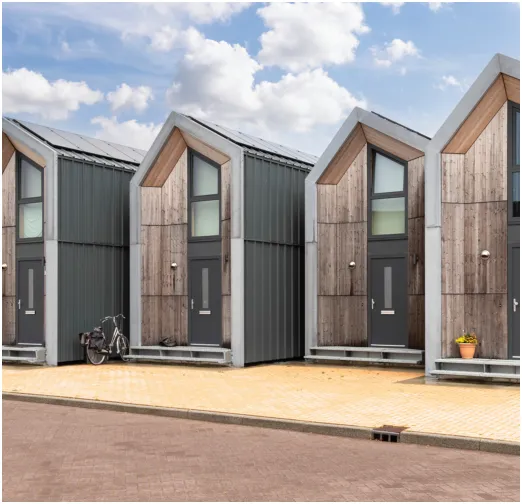
- That is the size of a so-called ‘tiny home’, which has become a big craze in some parts of the world, giving rise to a new social trend: the ‘tiny house movement’.
- These compact properties have become more popular as people recognise the benefits of ‘living small’.
- For some, it’s the only way to afford a home, but for others it’s a lifestyle choice, offering a way of living more ecologically and less wastefully.
- Living in a small space means that you have to get rid of your excess possessions.
- It also forces you to go out and engage with the rest of the world.
Tiny homes need careful planning. Who has done it best?
B: Japan, the masters of saving space
- Living small requires careful planning and who better to turn to for inspiration than the Japanese, the masters in the art of saving space.
- In densely populated cities like Tokyo, many people live in apartments smaller than ten square metres.
- They have managed to come up with ingenious space-saving solutions to make the apartments feel less cramped, such as the use of deep wardrobes and cupboards for storage.
- In this way, bedding can be folded and put away every day, allowing the room to be used for purposes other than sleeping.
- Another method is the use of sliding doors which can divide the room into different living areas when required.
C: Six people, one Mars habitat
- Living in a compact home might work for one, or even two people, but what about when you are obliged to compete for space with several others?
- This is a question being investigated by a NASA-funded Mars simulation experiment.
- A ‘habitat’ has been located on the slopes of a volcano in the Pacific Ocean, and its goal is to understand how people can successfully live and work together on trips into space.
- Six crew members share a space which is 11 metres in diameter, i.e. the size of a medium-sized, one-bedroom apartment.
- They each have their own personal space, big enough for a tiny bed and chair.
- They are not permitted to leave the capsule unless they are wearing a spacesuit.
- There have been five ‘missions’ so far, lasting between six and 12 months.
- The experiment shows that although some privacy is essential, people in confined spaces get on better when they spend more time together rather than retreating to their own private or personal space.
D and E: Does everyone need privacy?
- Professor Ellen Pader believes sharing space teaches you respect for other people, and you also learn to negotiate with people, instead of just withdrawing when things get difficult.
- In many western countries, there is an assumption that we all need privacy, but this is not a universally shared belief.
- In Mexico, for example, according to Pader’s research, people often prefer to share bedrooms and bathrooms because being alone feels like a punishment.
- We need to get the right balance between having enough of it to allow some privacy, but not so much that we no longer interact with others.
Now check you can find each idea in the article.
Which paragraph says what?
In which paragraph does the author give examples of ways to design a home to make the most of space?
In which paragraph does the author discuss the factors leading to a move towards smaller properties in some countries?
In which paragraph does the author summarise the answer to the question asked in the title?
In which paragraph does the author explain that in some cultures too much privacy is seen as a negative concept?
In which paragraph does the author outline the findings of an investigation into the implications of living with others in an enclosed space?
Read again for details
What advantages of living in a tiny home are mentioned?
What suggestions for maximising space in a small home are mentioned?
What were the findings of the NASA-funded experiment?
According to Ellen Pader, what are the advantages of sharing a space with others?
Six words for living space
| compact | Small, but arranged so that everything fits neatly into the space available. |
| excess | Additional and not needed because there is already enough of something. |
| densely populated | (In a city) having a lot of people living close together. |
| cramped | Not having enough space. |
| medium-sized | Neither small, nor large. |
| confined | Very small and restricted, surrounded by walls. |
What are some of the largest and most ___ cities in the world?
How do you feel about being in a ___ space like a lift?
Would you describe your room as small, large or ___?
If you lived in a location where space was non-existent, which of your ___ items would you throw away? Say why.
Is your room ___ enough to fit in a desk, bed and closet?
Have you ever travelled in uncomfortable ___ conditions, with a lot of people on a bus or train?


