
The topic explained
LESSON 2A VOCABULARY | Social issues
- I can talk about social issues.
- I can identify specific details and talk about social issues in documentary films.
Eight social issues in the news
Which of these problems have you heard about this week?
- environmental problems
- gender equality
- health
- homelessness
- immigration
- poverty
- racism
- unemployment
- environment
- facilities
- homes
- opportunities
- poverty
2 Read the fact file about social issues that the Jordanian Royal Family help with and complete it with the correct words.
1 helps to move people out of _ 2 aims to give better work to women and young people 3 helps to improve health 4 helps refugees to find as well as with their education, finance and work opportunities 5 promotes sustainable development that does not harm the __
3 Match the social issues from Exercise 1 with the facts from Exercise 2. Which social problem isn’t included in the fact file?
| Verb | Noun | Adjective |
|---|---|---|
| enforce | 1 | enforceable |
| 2 | 3 | equal |
| 4 | expansion | expansive |
| 5 | discrimination | 6 |
| institutionalise | institution | 7 |
| 8 | 9 | justifiable/ justified |
4 Study Active Vocabulary and complete the table.
5 7.4 PRONUNCIATION Listen to five pairs of words from the same family. Write S (same) when the main stress in both words is on the same syllable, and D (different) when the word stress changes.
1 □ equality equalise 2 □ discrimination discriminatory 3 □ institution institutionalise 4 □ enforcement enforceable 5 □ justify justifiable
ACTIVE VOCABULARY | Word building
The ending tells you the word class
Look at the last letters of a word: they often show if it is a noun, verb or adjective.
- To form nouns we commonly use:
- -dom (freedom)
- -ment (government, entertainment)
- -sion/tion/cion (conclusion, organisation, suspicion)
- -ity (equality)
- -ness (weakness)
- -ance/ence (reliance, defence)
- -ice (practice).
- To form verbs we commonly use:
- -ate (complicate)
- -ify (clarify)
- -en (shorten)
- -ute (commute)
- To form adjectives we commonly use:
- -able/ible (comfortable, flexible)
- -al (formal)
- -ful (useful)
- -ive (productive)
- -less (homeless)
Three documentaries, three social issues
A film can entertain you and still carry a serious message.
LESSON 3A LISTENING AND VOCABULARY
- 1 Chasing Coral is a documentary that follows a group of divers and scientists as they capture the damage being done to the coral reefs in our seas.
- The documentary illustrates that our oceans are dying and it is the fault of humans.
- The conclusion: immediate action is required to prevent further issues.
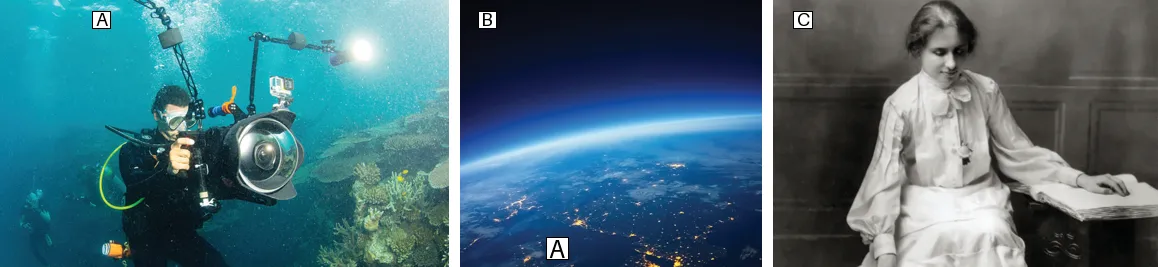
- 2 A Beautiful Planet as filmed by astronauts from the International Space Station, and looks at our planet from above.
- It shows how humans are changing our planet through industrialisation and clearing our forests.
- 3 Unconquered: Helen Keller in Her Story is a documentary first made in 1955.
- It may be old, but it is an award-winning film about a remarkable woman, Helen
Keller, who achieved great things despite being deaf and blind.
2 Read the descriptions of three documentary films. What social issues do they touch?
3 7.5 Listen to three people talking about the documentary films in Exercise 2. Decide if statements 1–6 are true (T), false (F) or if the information is not given (NG).
1 □ The documentary Chasing Coral filmed 25% of all life in the sea.
2 □ The film used a special technique to show what is actually happening.
3 □ You can see different kinds of weather on Earth from space.
4 □ The documentary will help to solve the problems of climate change.
5 □ Helen Keller could not see or hear when she was born.
6 □ Helen’s disability did not stop her from helping other people and even writing books.
Same words, different meanings
Set out or set up? Over or above? One small word can change the meaning.
4 In pairs, compare sentences a with sentences b. Work out the differences in meaning of the highlighted words.
1 a They set out to discover why and reveal the mysteries of the underwater world.
b The cameras were set up in different locations.
2 a Every day, over 10,000 acres of trees are lost.
b You can see storms in clouds passing over different countries, ... all filmed from 400 kilometres above our planet.
3 a Doctors tested her and discovered she would be permanently deaf and blind.
b The documentary proves that having a disability does not always stop people from doing amazing things.
4 a The fact that she could not see or hear did not stop her from enjoying the same things as all of us.
b In fact she also helped many other people with disabilities.
5 SPEAKING In pairs or small groups, discuss the questions.
1 What social issues did you hear discussed in the recording?


