
The topic explained
1 SPEAKING* If you could visit any historical period for a day, which would you choose?
Culture vulture
- I can use past modals to talk about hypothetical situations in the past.
Mystery objects: what were they used for?
If you could visit any historical period for a day, which would you choose?
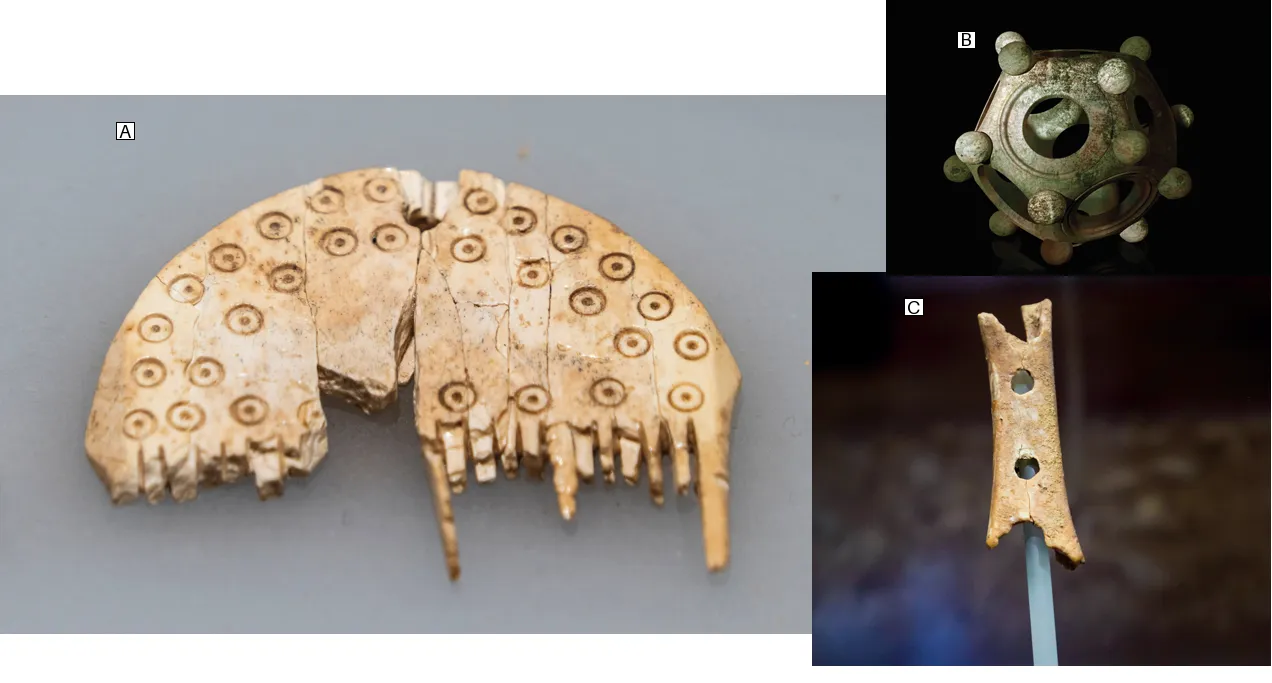
10.1 Listen to a radio podcast about the objects and check your ideas.
Past modals of speculation
THINK BACK Read these extracts from the recording and match the underlined verb forms with their meanings a–c.
The holes must have been man-made because they would fit a right-handed musician perfectly.
It can’t just have been a coincidence.
They might have been candle holders.
I’m pretty sure this was not true.
It’s possible that this was true.
I’m pretty sure this was true.
Look at the sentences from the recording. How do we form continuous and passive forms with past modals?
Grammar Reference > page 74
A wealthy person must have been planning to use it.
No-one really knows what they might have been used for.
I can’t have been paying attention.
They could have been used to knit the fingers on gloves.
Study Watch Out! Then choose the best verb form to complete the sentences below.
He might not have looked / have been looking where he was going when he tripped and fell.
This jewellery might / must have been expensive; it’s solid gold!
This picture might / can’t have been painted by the same artist; the style is completely different.
At that time, many children would have started / would have been started work at the age of eight.
He might / must have been lying; he’s untrustworthy.
He can’t / mustn’t have carried out the robbery; I was with him all evening.
WATCH OUT!
Would have: an assumption or a logical conclusion
- We use would + a perfect infinitive (have + past participle) when we are making an assumption about what happened in the past or drawing a logical conclusion:
- There would have been much simpler and cheaper ways of knitting gloves. (assumption)
- The Isle of Lewis belonged to Norway at that time, so the merchant would have been in his own country when he lost the chess pieces. (logical conclusion)
A DISCOVERY IN PETRA
Petra: a satellite spots a mystery platform

Grammar Reference: Past modals of speculation
Must, can't or might: how sure are you?
| For a past possibility we use could/might have + past participle: | They could/might have been to London. (but I’m not sure) |
| For a negative deduction about the past, we use can’t/couldn’t have + past participle: | He can’t have left, his car’s here. She couldn’t have revised because she failed her exams. |
| When we are positive about the past, we use must have + past participle: | It must have been in January 1953 when grandpa went to Paris. |
| When we are less certain, we use may/might not have + past participle: | You’d better take your laptop because Ali may/might not have taken his. |


