
The topic explained
UNIT 2 Education for success
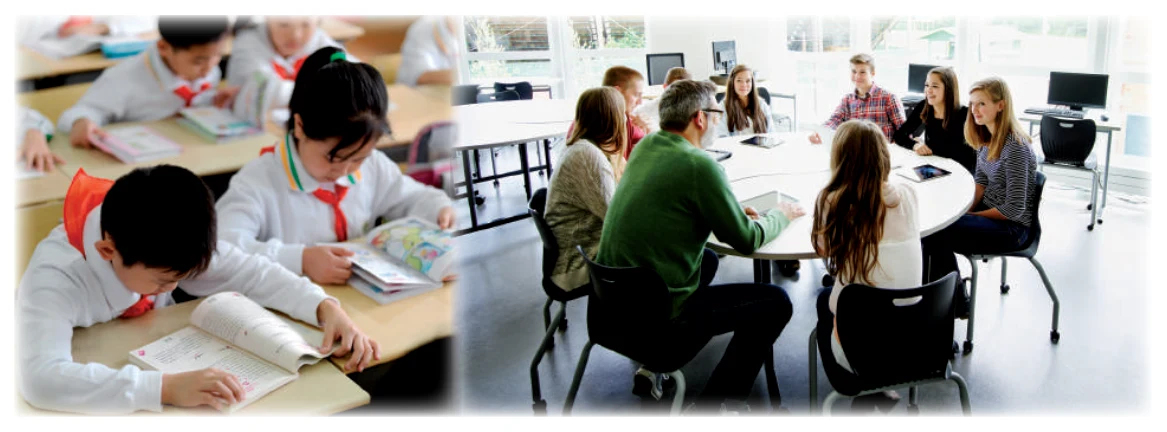
1 Look at the pictures. Then discuss the questions below in pairs or small groups.
1 What are the students doing in the pictures? 2 What impression do you get from the pictures? 3 How are the pictures similar or different from your own classrooms? 4 The pictures show classrooms in two of the most successful countries in the world (educationally and economically). Which countries do you think they might be?
2 Read the article about the two countries’ education systems. Then complete the task at the top of page 15.
Two success stories (and what we can learn from them)
Education Ministers who are hoping to improve their school systems often look at Finland and Taiwan. The first is a small country in northern Europe with a cold climate and a language hardly anyone else speaks; the second is a very small island that until fairly recently had high levels of poverty and population. Yet today both of these countries come out at or near the top in international surveys of economic success. Year after year, they also score highly in educational results. Can this be an accident, or is there a connection?
Finnish Education Minister Tuula Haatainen certainly believes there is. ‘In Finland, we believe we have to invest in education,’ she says. One reason she offers for Finland’s success is that students don’t begin ‘real’ school until they are 7, and all students between 7 and 16 get the same education. ‘We don’t divide at an early stage between students who do well and those that don’t manage so well,’ she explains. ‘Studies show that it is dangerous to divide too early into different educational paths.’
Like Finland, Taiwan has nine years of compulsory education, after which (in both countries), students choose either an academic or vocational path. Very few choose to leave school in either country. One important difference, however, is in national tests, which are very important in Taiwan but much less so in Finland.
Can other countries learn from the Finnish and Taiwanese experience? There are surely some lessons that can be learnt as long as we remember that just applying one country’s system to another isn’t a simple solution to all problems.
Period 1 / Reading and Comprehension
Decide whether these statements are TRUE or FALSE. If there is not enough information to decide, choose DOESN’T SAY. 1 The writer suggests that the economic success of Finland and Taiwan is rather surprising.
TRUE FALSE DOESN’T SAY
2 The writer believes there is a connection between education and economic success.
TRUE FALSE DOESN’T SAY
3 Tuula Haatainen thinks clever students should have special lessons.
TRUE FALSE DOESN’T SAY
4 The education systems in Finland and Taiwan have more differences than similarities.
TRUE FALSE DOESN’T SAY
5 The writer says that other countries should copy the education systems of Finland and Taiwan.
TRUE FALSE DOESN’T SAY
3 Match the highlighted words and phrases in the text with their meanings below. 1 something that joins two things together _ 2 studies 3 spend money with the hope of future benefits 4 ways of organising something 5 an answer 6 making something fit a different situation 7 put in different groups __
4 Match these names for different stages of education systems with their meanings.
| EDUCATION STAGES | MEANINGS |
|---|---|
| 1 Pre-school/nursery/kindergarten | a the first stage of education (e.g. from age 5 to age 11) |
| 2 Primary education | b children/young people have to attend school by law |
| 3 Secondary education | c the next stage of education (e.g. from age 12 to age 18) |
| 4 Further/Higher education | d learning before ‘real school’ begins |
| 5 Compulsory education | e going to college or university |
5 Use words from the first column in Activity 4 to complete the text. In my country, children usually go to _ when they’re 4 or 5. They then start their education at 6. Both this and are for everyone. Most, but not all, students then move on to some kind of or _ education.
Period 2 / Reading and Comprehension
1 Read Text A and Text B fairly quickly and look at their layout. Then answer the questions. 1 Which text is an online book review? A B 2 Which text is a newspaper report? A B 3 Which text includes a quotation from a politician? A B 4 Which text mentions a future danger? A B 5 Which text questions a common belief? A B
TEXT A THE DAILY NEWS Wednesday 27 Feb 20…
The Secretary of State for Commerce and Industry stressed the importance of education for economic growth in a speech yesterday. ‘Improving our education system will give us a generation of citizens who are better qualified to face the challenges of the technological age, as well as competition from low-wage economies in other countries in Asia and Africa,’ he explained. ‘It increases what people can earn, lifts people out of poverty and encourages opportunity.’ He also suggested that the economic health of the country will suffer in future unless more attention is paid to investing in schools and universities. ‘We could easily fall behind,’ he said. ‘I hope it won’t happen. But unless we invest more, it might.’
TEXT B
Is Education Important? The Facts about Education and Economic Growth by Andrea Wells Average customer review 4.5 out of 5 stars (4 reviews) Essential reading! by Peter Garton ‘Education leads to economic growth’ is a belief that senior people in education repeat endlessly, and you might expect Prof. Wells, as a senior academic herself, to join in. Instead, as the title suggests, her book asks some brave questions and arrives at answers that others in the ‘education industry’ might prefer not to hear. This is not an academic book. It’s essential reading for anyone interested in education (and I hope that means all of us).
Certainly there is plenty of evidence that economic success and education go together: most poor people (and nations) tend to be poorly educated, and most poorly educated people (and nations) tend to be poor. But this doesn’t mean that one causes the other. This is false logic, and is one of several assumptions that Prof. Wells questions.
To be fair, she is obviously not against education in general. Her main conclusion is that getting more and more students onto university courses (any course, at any university) produces not growth but unemployed graduates. She argues that we should move money away from universities and put it into early-years education instead, to make sure children all know the basic skills needed for life.
SHARE THIS! READ MORE REVIEWS
Period 2 / Reading and Comprehension
2 Find words in the texts that mean the same as the following. (The words are in the same order as in the texts.) Text A 1 emphasised _ 2 to accept and manage 3 problems 4 money earned from working 5 makes people want to do something Text B 6 information that proves something is true 7 ideas that many people believe without checking 8 idea that you arrive at after looking at the facts _
3 Use the words you found in Activity 2 to complete the sentences below. 1 I know there are difficulties but we can’t avoid them. We have to _ them. 2 I can’t buy this jacket until I get my at the end of the month. 3 A good teacher students to express their ideas. 4 It’s not enough just to give your opinion. You need to support it. 5 This is an important point. That’s why the lecturer it. 6 Without knowing the facts, we can only make . 7 After a long discussion, we finally reached a . 8 It’s quite a difficult job but I enjoy the _ it presents.
4 In pairs, read one of the texts on page 16 more carefully. Then explain to your partner the answers to these questions. TEXT A According to the Secretary of State, what economic problems does the country have? What does he say are the three ways in which education helps a country’s economy? TEXT B Why might Andrea Wells’s opinion surprise some readers? What example does the writer give of false logic?
5 Choose the best answer to the following questions. Circle A, B or C. 1 In Text A, what is the Secretary of State’s view of his country’s future? A He believes that more money will be invested in education. B He thinks the country’s economy will probably improve. C He is afraid of economic competition from other countries. 2 In Text B, what does Andrea Wells believe should receive more government investment? A Higher education B Pre-school and primary education C Employment opportunities
Period 3 / Language and vocabulary study
1 Look at the examples. Then complete the grammar rules. Examples Education Ministers are hoping to improve their school systems … I hope it won’t happen. Let’s hope he gets the grades he needs. I wish our school had better equipment. The headteacher wishes the school could buy more computers. I wish I wasn’t/weren’t so bad at maths.
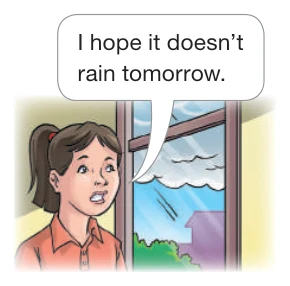
I hope it doesn’t rain tomorrow.
I wish I understood this question. Complete the grammar rules 1 We use hope + the _ form of the verb to talk about aims or ambitions. 2 We use hope + subject + to say what we want to happen (or not happen) in the future. 3 The verb after hope can be in a future form (will, won’t, going to) or the tense. 4 We use wish + the tense to say what we want to change about a present situation. 5 The past form of can is . 6 After wish, the verb to be can be either was or _.
2 Complete the sentences with the correct form of the verbs in brackets. 1 I hope I _ good marks in the test tomorrow. (get) 2 She wishes she so much homework to do. (not/have) 3 We don’t invest enough in primary education. I hope we more in future. (spend) 4 After leaving university, I hope a teacher. (become) 5 I don’t know what he’s saying. I wish I understand French. (can) 6 Most parents of young children hope they _ well at school. (do)
3 Discuss these questions in pairs or small groups. 1 What are your aims or ambitions in the near and longer-term future? (Use hope + infinitive.) 2 What are your personal hopes for the future? (Use hope + will or hope + present tense.) 3 What would you like to change about your present situation? (Use wish + past tense. Remember that could is the past form of can.)
I hope to become a doctor. I hope I get tickets for the concert. I wish I could speak English better.
4 Look at the examples. Then complete the table. Examples Pre-school education is free in Finland. When he finished his university degree, he did a postgraduate course. Her ex-employer recommended her for the new job.
| PREFIX | MEANING |
|---|---|
| pre | |
| used to be | |
| after |
5 Use words from the box to complete the sentences. prepaid post-war ex-teacher ex-soldiers prearranged postscript 1 Life in the country was difficult in the _ period. 2 After leaving school I kept in touch with my . 3 He didn’t need to pay for the hotel room because it was by his company. 4 If you have signed a letter but then remember something you didn’t include, you can add a (PS). 5 We met at a time and place. 6 _ sometimes find it difficult to manage in civilian life.
Period 4 / Language and vocabulary study
1 Look at the examples. Then complete the grammar rules. Examples Some lessons can be learnt as long as we remember that there isn’t a simple solution to all problems. University courses are available for most students provided (that) they get the right exam results. School is compulsory unless parents get permission to teach their child at home. As long as / provided you read the instructions, it’s easy to complete the form. Complete the grammar rules 1 _, and are all conjunctions: they join two sentences into one longer sentence. 2 and have similar meanings (but only if …). 3 means if … not. 4 In one of the conjunctions, we can leave out the word . 5 When the part of the sentence with the conjunction comes first, the two parts are separated with a _.
2 Complete these sentences by adding as long as, provided (that) or unless. 1 _ we are careful, there should be no danger. 2 They won’t be able to reply you tell them your contact details. 3 he works harder, he won’t succeed. 4 The company’s future looks good we continue investing. 5 __ you do your best, no-one will criticise you for failing.
3 Match the beginnings of the sentences with their endings.
| 1 Provided everyone agrees, | a unless I call you before then. |
| 2 She doesn’t mind what colour it is | b provided you call when you arrive. |
| 3 Meet me outside the cinema at 7.30 | c as long as it isn’t grey. |
| 4 You can go where you like | d he’ll definitely be in the team. |
| 5 Everything will be fine in the end | e I’m happy to follow your plan. |
| 6 Unless he gets an injury, | f as long as you don’t give up. |
4 Rewrite the sentences using the words in brackets. 1 You can borrow the book but you have to promise to return it next week. (as long as) _ 2 He has a good future, but not if he fails his exams. (unless) 3 The college will offer me a place on one condition: I have to pass the interview. (provided that) 4 Pre-school classes are free for all children who are old enough. (as long as) 5 If we don’t invest in education, we’ll never solve our economic problems. (unless) __
5 Complete the sentences with your own ideas and opinions. Then, in pairs, tell each other your answers. 1 I intend to study _ unless . 2 I hope to work as that . 3 I’d like to learn how to as long as _.
Period 5 / Integrated skills
1 Read the advice from a website about writing CVs. Decide how each tip continues by choosing from the box. they don’t want your life story to make yourself stand out (but don’t lie!) it looks very bad every job or course has different needs Education today Writing a good CV (curriculum vitae) takes time, but it’s very important. Here are our top 5 tips for a good CV.
Keep it short (2 pages maximum): _ Don’t send the same CV every time: Put things in the most positive way Include a personal statement Make sure there are no spelling or grammar mistakes: __
SHARE THIS! READ MORE TIPS
2 Listen to someone giving advice to a friend. Complete the notes using the details in the box. Work experience Personal statement two referees qualifications Basic information personal qualities contact details Education Part 1
- ___ (e.g. name, date of birth)
- ___
Part 2
- ___ (sometimes appears at the end)
Part 3
- _ and (5) _ (in reverse order). Only secondary education needed. N.B. no more than 2 pages for whole CV
Part 4 (6) _, including part-time jobs. NB leave no gaps Part 5 Other skills (show your (7) , e.g. leadership, teamwork) Part 6 Contact details of (8) __
Period 6 / Writing
1 Circle the correct time words to complete the text. Ahmad Fakhouri has loved reading (since / while) he was a child. In 1993 he started secondary school at al Hashimi School in Jordan. (During / While) he was there, his interest in literature grew. He also found he was good at learning languages. He got good marks in his school-leaving exams, especially in Arabic, English and Literature. (After / Since) leaving school, he decided to study abroad. He applied to study Literature and Translation at University College, London and was accepted.
(When / Before) starting the course, he worked as an assistant in a bookshop in Amman to earn the money to help pay for the course. (While / During) his time in London, he also started writing short stories and translating English poetry into Arabic. He completed his first degree, a BA in Comparative Literature, in 2004, and (then / following) did a one-year Master’s degree in modern Arabic poetry at Bristol University.
He returned to Jordan in 2005 and worked as tutor for the UNRWA, teaching English to Palestinian refugees. Two years (after / later), he finally had the chance to return to Palestine. He (currently / then) works as a consultant at the Ministry of Culture in Palestine.
2 Now use the information from Activity 1 to complete Ahmad Fakhouri’s CV. Name: Ahmad Fakhouri Date and place of birth: 11/06/1977, Amman, Jordan Address: Al Ersal Street PO Box 1966 / Ramallah / Palestine Telephone: 2984860 Email: fakhouri.a@gmail.com Education Remember to write this in reverse order _ Employment Remember to write this in reverse order Other Skills and Qualifications __
3 Now write your own CV, using Ahmad Fakhouri’s as a model. If necessary, invent some information. Name: Date and place of birth: Address: Telephone: Email: Personal statement Write something about what you are interested in and what you hope to do in future _ Education Remember to write this in reverse order Employment Other Skills and Qualifications _
In this Unit you have learnt about:
- school systems in different countries
- reading texts for general impression (‘gist-reading’)
- different ways of expressing conditions (as long as, provided that, unless)
- different ways of expressing hopes and wishes
- words with prefixes (ex-, pre- and post-)
- writing CVs
