
The topic explained
UNIT 4 Going places
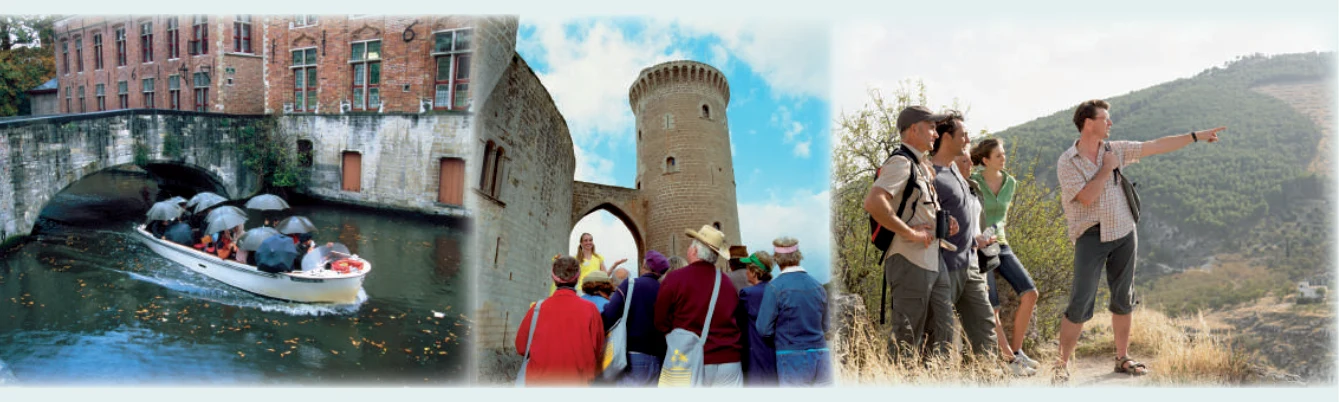
1 Discuss these questions in pairs or small groups. 1 Would you like to work as a tourist guide? 2 What are the advantages and disadvantages of this job? 3 What do you think tourists want when they visit a country or city?
2 Read the text. Then complete the tasks below and on page 39.
The step-on tour guides
For many young people, being a tour guide seems to be the perfect job, almost like a paid holiday with no expenses. In reality, of course, it can be tiring and stressful having to solve all the problems that arise and deal with the constant demands of the people who have paid money for your services.
And it seems that tourists are becoming more demanding, partly due to the internet. They already know a lot (5) of the basic information that guides used to tell them. What they want is something different and special. It’s no longer enough to take them round the famous buildings, monuments and tourist sites and tell them a few dates and interesting stories. In fact, tourists nowadays don’t like to be labelled as tourists at all. Today’s well-informed ‘traveller’ prefers culture, getting under the surface of things, seeing something of the real life of the place they’re visiting.
(10) This need has led to an increase in the popularity of ‘step-on guides’. These are people who live in the area and have local knowledge. They take over the tour temporarily and provide the kind of information that the usual tour guide can’t offer. ‘It’s a great way to meet people and give them an introduction to your town or city,’ says Moustafa, a step-on guide in Istanbul, Turkey.
Being a successful step-on guide depends on getting to know what travellers really want. This is something (15) that Moustafa has picked up from experience: ‘I treat my customers more like students than tourists. But I never lecture them. I don’t want them just to take in whatever I say. I think they’d rather interact with places and people.’
1 Look again at the questions you discussed. What does the text say that is similar to and different from your ideas?
Period 1 / Reading and Comprehension
2 Replace the underlined words and phrases in these sentences with words and phrases from the text. (The words and phrases are in the same order as in the text.) 1 As well as the hotel bill, there were a few other extra things to pay for. _ 2 My job is dealing with the public. There are a lot of things that people want from you. 3 His success as a tour guide is because of his local knowledge. 4 This city has a lot of statues and buildings that celebrate famous people or events. 5 I’m only doing this job for a short time until I find something better. 6 Nobody taught me how to play the piano. I just learnt it without having lessons. 7 She hates it if any of her friends talk to her like a teacher. 8 What I like about my teacher is his ability to have a two-way relationship with his students. _
3 The words in the table change in the same ways. Complete the table. (Note that there is no adjective from provide.)
| VERB | NOUN | ADJECTIVE |
|---|---|---|
| 1 demand | demand | demanding |
| 2 challenge | ___ | challenging |
| 3 surprise | ___ | ___ |
| 4 conclude | conclusion | concluding |
| 5 decide | ___ | deciding |
| 6 provide | ___ |
4 Now use words from the table to complete these sentences. 1 This situation is very _. There are a lot of problems we need to solve. 2 I don’t want to argue about it. This is my final . 3 I find it that he doesn’t enjoy working as a guide. 4 The part of the essay summarised the main points. 5 Young children can be very . They always seem to want something. 6 This organisation has responsibility for the of basic food to those who need it. 7 Each team has won twice, so this is the last and match. 8 In this period of hot dry weather, the _ for bottled water has increased.
Period 2 / Reading and Comprehension
1 Read the introduction to an article about ‘eco-tourism’. Then answer the question below.
A As more and more people realise the negative impact that their holidays can have on the countries they visit, the popularity of ‘eco-tourism’ is increasing. The basic idea is that tour organisers and travellers try to make sure that their activities help the environment and local communities rather than harming them. There are many different ways of doing this, but all of them are likely to interest people who prefer learning to sightseeing and would rather interact with local people and nature than sit on a beach. Here, for example, are two of the best ‘eco-tours’ we have found …
Which is the best definition of eco-tourism? A Holidays where you don’t stay in hotels and sit on beaches B Tours where you learn a lot about the geography of the area C A kind of travel that aims to avoid the negative effects of tourism D Going to places and living with local people
2 Work in pairs. Choose one of the eco-tours (B or C) each, read about it and make notes using these headings. Where you go: _ What you can do there: Where you stay: How long you are there: How much it costs: __
B Whale-watching in the Mediterranean This is a chance to take part in research into whales while sailing around the north-west coast of Italy. You will spend ten days living and sleeping on the boat as part of the crew, watching for whales and keeping records of their movements and habits to get a clear picture of the impact of human activities. You don’t need previous sailing experience, though, as you will receive full basic training. The price is between £1,100 and £1,800, including all meals and travel except the air fare to Genoa, where the boat sails from.
C Desert adventure in Tunisia Experience the unique excitement of desert life, travelling by horse or camel for a week, staying overnight with local families in traditional village houses and sharing their evening meal. You carry all other food and water with you as you travel. Local guides share their knowledge of desert plants and animals and pass on tips about how people manage to live in such difficult conditions. This is a low-impact, low-cost tour. Prices start at only £900, including your flight to Tunis airport.
3 Tell each other about the tour you read about and make notes on the other tour, using the same headings.
4 Match words and phrases from the text with their meanings below. (The words and phrases are in the same order as in the text.) 1 effect (section A) _ 2 causing hurt or damage (section A) 3 looking at famous things (section A) 4 people who work on a ship or boat (section B) 5 written details of what has been done (section B) 6 at an earlier time (section B) 7 money you pay to travel (section B) 8 not like anything else (section C) _
5 Now use the words and phrases from Activity 4 to complete these sentences. 1 The boat sank but all the passengers and _ were saved. 2 You won’t get the same feeling from any other activity. It’s a experience. 3 Our show that you have worked as a tour guide. Is that correct? 4 Tourism can have a positive or negative on a country. 5 It is possible to have a holiday without the environment. 6 He only had enough money for the train , with nothing for other expenses. 7 I don’t enjoy . I prefer finding out about the history of places. 8 At the interview they asked about my _ jobs.
Period 3 / Language and vocabulary study
1 Look at the examples. Then complete the grammar rules.
Examples Many tourists today prefer culture to beach holidays. They prefer studying to sightseeing. I’d rather travel by train than fly by plane. My friends would rather stay at home than go out.
Complete the grammar rules 1 When talking about preferences (liking one thing better than another), we can use _ + a noun or the -ing form of a verb, or would rather + the form of the verb (without to). 2 After prefer, we put the word between the two choices. 3 After would rather, we put the word _ between the two choices.
2 Complete the sentences using prefer or would rather, as shown in brackets. (For sentences 3–5, you will need to add a verb.) 1 I _ go on a history tour visit an art gallery. (would rather) 2 She healthy food fast food. (prefer) 3 They football basketball. (would rather) 4 I my homework now later. (would rather) 5 Their son computer games _ football outside. (prefer)
3 Look back at the notes you made about the two eco-tours in Period 2. Write a sentence saying which of the two tours you would rather go on and add a reason using prefer. I’d rather go on _ than because I prefer to _.
4 In pairs or small groups, discuss the choices below. Say what you prefer doing and/or what you would rather do, and give reasons. 1 travel by plane or go by train? 2 watch TV or read books? 3 read news in a newspaper or on the Internet? 4 live in a city or a village? 5 study quietly or with music? 6 play or watch sport?
Pronunciation reminder I’d rather travel by train than fly by plane. My friends would rather stay at home than go out.
I’d rather travel by train because I prefer looking at things through the window.
Period 4 / Language and vocabulary study
Examples Today’s well-informed ‘traveller’ prefers culture. They’re normally very well educated.
Complete the grammar rules 1 We often use phrases with the adverb well + the _ participle of the verb. 2 We normally use a hyphen (-) between the two words when it comes _ a noun.
2 Make phrases using well + the past participles of the verbs in the box. Then decide which you would use to describe the people or things below. inform behave educate make dress know pay write 1 someone who has a Master’s degree _ 2 a famous person 3 a person who wears good clothes 4 a child who never causes trouble 5 a strong piece of furniture 6 someone who knows a lot 7 a book with a good style 8 someone who makes a lot of money in their job (or a job that pays a lot of money) _
3 Now complete these sentences using the phrases you formed in Activity 2. 1 Although he’s _, he still finds it hard to get a job. 2 Salma is sure to know the answer. She’s very . 3 It’s a book by a writer, but I must say I didn’t enjoy it. 4 It’s important to look good when you go for an interview, so make sure you’re . 5 This chair is very . It will never break. 6 The children can come too as long as they’re _.
4 Look at the examples. Then complete the grammar rule.
Examples She picked her bag up. I picked up the pen he dropped. Please don’t leave waste paper on the floor. Pick it up. Ahmad has picked this up from experience.
Complete the grammar rule This type of multi-word verb is made by adding a particle like up to the _. If the object is a noun or noun phrase (e.g. her bag, the pen he dropped), we can put it the verb and the particle or after the particle. If the object is a pronoun (e.g. it or this), it can only go between the and the _.
5 Say what you should do in these situations, using a verb and a particle from the boxes with a pronoun between them. Some verbs and particles can be used more than once. VERB take (×2) throw (×2) fill pay try put PARTICLE on (×2) off in back (×3) away 1 You borrowed some money from your friend and now you have enough money. _ 2 You are in a clothes shop and you’re not sure if a jacket will fit you. 3 You have finished reading a book from the library. 4 You are too hot in your coat. 5 You have some old papers that you don’t need any more. 6 The sun is bright and your sunglasses are in your hand. 7 You are fishing and have just caught a fish which is too small to keep. 8 You need a visa to visit another country and have just downloaded the application form. _
Period 5 / Integrated skills
1 Look at the introduction to the visa application form (entitled ‘Read this first’) below. Say which form the following people need to complete. 1 a university lecturer attending a conference 2 a company manager meeting customers 3 a graduate starting a higher education course 4 a woman going to see her grandson 5 someone passing through on the way to another country 6 a musician playing a concert
GENERAL VISITOR (VAF1A OCTOBER 2013)
This form is for use outside the UK only. This form is provided free of charge.
READ THIS FIRST
This form must be completed in English. You may use blue or black ink. Please follow the guidance notes carefully and complete all questions as indicated. If you run out of space, please use Part 9 – Additional Information. If you are visiting the UK as a tourist or to visit friends you should complete this form. If the main reason you are applying to come to the UK is as: a family visitor, you must complete VAF1B; a business visitor, you must complete VAF1C; a student visitor, you must complete VAF1D; an academic visitor, you must complete VAF1E; a visitor in transit, you must complete VAF1H; a sports visitor, you must complete VAF1J; an entertainment visitor, you must complete VAF1K.
2 Look at the application form on page 46. Then match the official words and phrases from the form with their meanings.
| OFFICIAL LANGUAGE | MEANING | |
|---|---|---|
| 1 complete (verb) | a when you were born | |
| 2 guidance | b give | |
| 3 valid | c fill in | |
| 4 marital status | d help | |
| 5 date of birth | e correct and up-to-date | |
| 6 provide | f whether you are single, married, etc |
3 Listen to a young woman helping her relative to fill in his application form and complete the form on page 46 with his information.
4 Fill in the same application form on page 140 with your own information. Invent any details that you don’t know. (Don’t invent details if you’re ever completing a real form!)
Period 5 / Integrated skills
GENERAL VISITOR (VAF1A OCTOBER 2013) This form is for use outside the UK only. This form is provided free of charge.
READ THIS FIRST
Which type of Visitor Visa are you applying for? Put a cross (x) in the relevant box Tourist [ ] Visit friend(s) [ ] Other (please specify) _ How long do you want your visa to be valid for? Put a cross (x) in the relevant box 6 months [ ] 1 year [ ] 2 years [ ] 5 years [ ] 10 years [ ] What is the main purpose of your visit to the UK? How long do you intend to stay in the UK? __ Travel Dates On which date do you wish to travel to the UK? D D M M Y Y Y Y On which date will you leave the UK? D D M M Y Y Y Y
Part 1 About You 1.1 Given name(s) (as shown in your passport) RAVINDRA 1.2 Family name (as shown in your passport) DAHWAN 1.3 Other names (including any other names you are known by and/or any other names that you have been known by) _ 1.4 Sex Put a cross (x) in the relevant box Male [ ] Female [ ] 1.5 Marital status? Put a cross (x) in the relevant box Single [ ] Married [ ] Divorced [ ] Separated [ ] Widowed [ ] 1.6 Date of Birth D D M M Y Y Y Y 1.7 Place of Birth MUMBAI 1.8 Country of birth 1.9 Nationality INDIAN 1.10 Do you hold, or have you ever held, any other nationality or nationalities? Put a cross (x) in the relevant box Yes [ ] No [ ] If ‘Yes’ please provide details __
Period 6 / Writing
1 Read the job advertisement below. Then fill in the application form.
Are you a friendly person who enjoys meeting new people? Would you like to tell people about your area? Can you speak any other languages? If so, why not become a tour guide? For more details, go to www.myguide.com. You can download the application form, then send it with a covering letter* saying why you would like to do the job.
- a covering letter is a letter that you send with an application form
Dear Sir/Madam I enclose my application form for the position of Tour Guide. If you need any further information, please contact me. I look forward to hearing from you. Yours faithfully,
APPLICATION FOR THE POSITION OF TOUR GUIDE
Name: _ Age: Address and contact details: Education: Languages: Please write a short paragraph below saying why you would be a good person to do this job. __
In this Unit you have learnt about: being a tour guide eco-tourism verb / noun / adjective changes (demand – demand – demanding, etc) taking notes on a text expressing preference using prefer and would rather adjective phrases with well + the past participle multi-word verbs with an object and a particle filling in a visa application form and a job application form
