
The topic explained
UNIT 5 Let’s go for a walk
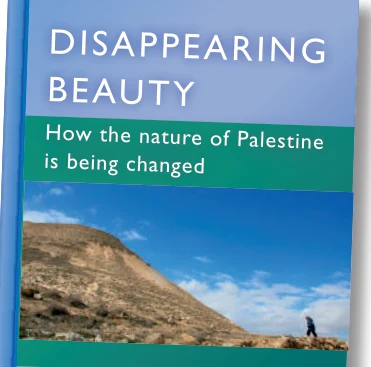
1 Look at the book cover. Then discuss these questions in pairs or small groups. What kind of book do you think this might be? What do you think might be included in the book?
2 Read the back cover of the book below. Then complete the tasks on page 49.
DISAPPEARING BEAUTY
How the nature of Palestine is being changed
NABIL HAMED
DISAPPEARING BEAUTY NABIL HAMED
If you really want to understand what’s happening in this part of the world, I strongly suggest you read Hamed’s book. Joe Harman, Daily Record
As a child, Nabil Hamed used to wander in the hills and valleys of Palestine with his father, a shepherd. After taking a break to continue his education abroad, he returned to Palestine and continued hiking, simply for the love of walking and nature. As time went by, he began to notice irreversible changes: the beauty of this ancient land was being destroyed by the Israeli occupation, somtimes rapidly, sometimes gradually. Olive trees and grapevines were pulled up, old stone buildings and even whole villages were pulled down to make room for more and more settlements, their roads and dividing walls.
The walks he describes in this book cover the hills of Ramallah, the wild countryside around Jerusalem and the valleys near the Dead Sea, and each takes place at a different period of Palestinian history. Today, many Palestinian natural treasures have become impossible to visit. Nabil Hamed, now in his sixties, has written this book to preserve them, at least in words. It tells the story of how a pleasure so many of us take for granted is being taken away: the freedom to wander through the countryside.
It includes what other books forget to mention: the small details that really touch people and events that don’t usually appear in news reports. Sunday Journal
He writes beautifully, his language filled with a sense of loss. An important record of a land that is changing every day. Daily Review
We felt it was a perfect combination of the personal and the political. Derek Bateman, chair of the Marshall Prize committee, 2008
Disappearing Beauty is Nabil Hamed’s first book. It has been highly praised and has won several international awards, including the Marshall Prize for political writing.
Period 1 / Reading and Comprehension
1 Say which person or newspaper: 1 gives a reason why this book won a competition. _ 2 advises people to read the book. 3 mentions the way the book is written. 4 talks about what happens in the book. 2 Complete the sentences with the highlighted words and phrases from the text. 1 After many years under , the country has finally become independent. 2 They the wall in the park to make a bigger play area. 3 We don’t have any plans, so we have time just to around the city on foot. 4 Some people don’t even think about basic freedoms. They just them . 5 His decision is . There’s no going back to how things were before. 6 The plant was getting too big for the garden so we it . 7 This event every year on the same date. 8 I sometimes fruit in sugar to stop it from going bad. 9 Music and poetry really me. They can make me laugh or cry. 10 The film was highly __. Everyone said how good it was. 3 Look at the examples. Then complete the table by placing the adjectives from the box under the correct negative prefix. Examples ‘Disappearing Beauty’ ‘… he began to notice irreversible changes …’ ‘… many Palestinian natural treasures have become impossible to visit.’ The book looks at things from an unusual point of view.
regular necessary probable agree dependent hurt polite accurate
| dis- | ir- | im- | in- | un- |
|---|---|---|---|---|
| ___ | ___ | _ _ | _ _ | _ _ |
4 Complete these sentences with negative adjectives from the table. 1 Most mountains have an _ shape but this one looks like a triangle. 2 I can’t say it will never happen but I think it’s very . 3 He’s a very person. He never asks other people for help. 4 In some countries, people don’t like you eating in the street. They think it’s . 5 Many people waste money buying luxuries and other things. 6 Amazingly, the driver and passengers were after the accident. 7 In general, I think he’s right, but I with him on a few points. 8 It’s important that your CV isn’t _ and full of mistakes.
Period 2 / Reading and Comprehension
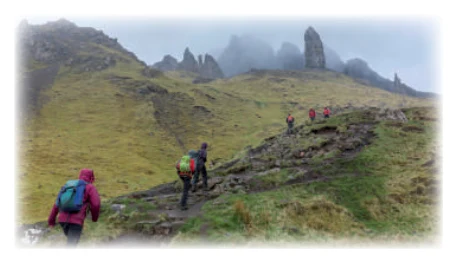
1 Look at the pictures. Then answer the questions below.
1 What are the people doing? 2 Why do you think they are walking together in a group? 3 Why do people enjoy walking in the countryside? 4 What kind of countryside are the people walking through in each picture? 2 Read the website article below. Then complete the tasks on page 51.
About us What we do Find a walk Members’ page Contact us The Rambling Society Our history Walking in the countryside (or ‘rambling’) was popular in 19th-century Britain. For people living in towns and cities, walking was a way of escaping from a polluted environment and the stress of daily life. Access to the countryside, however, was becoming more of a challenge due to an increase in the ownership of large areas of land by a small number of people. A number of walking clubs and groups were set up to protect walkers’ rights, and finally, in 1935, they joined together to create The Rambling Society, a national organisation aiming to improve access laws and expand the areas where people could walk. Aims and achievements Thanks to our efforts, a new law was finally passed in 1949 called the National Parks and Access to the Countryside Act. This law set up the first National Parks and Nature Reserves, as well as stating that public footpaths in England and Wales had to be recorded on maps. It was a big step forward as it meant that everyone would know where they were allowed to walk, even if the path crossed someone’s land. Many landowners, however, let grass grow over the footpaths so that they were hard to find, so a lot of our efforts were put into walking on as many paths as possible in order to keep them open. Why not try walking? Our original aims remain the same, but we have continued to change with the times. In the 1990s, it became clear to us that walking was becoming less popular, and that we needed to encourage walking as healthy exercise. Since then we have reached out to non-walkers to help them take up walking.
1 Look at these words from the text and decide which meaning makes the best sense in the sentence. 1 countryside: A nationality B natural areas 2 access: A being able to enter or reach something B doing something without problems 3 ownership: A having something that belongs to you B feeling proud of doing something 4 achievements: A successes B important points 5 stating: A believing strongly B saying clearly 6 take up: A enjoy (a hobby) B begin (a hobby) 2 Decide whether the statements are TRUE or FALSE. 1 The air in nineteenth-century British cities was not healthy.
TRUE FALSE
2 During the nineteenth century it became more difficult to walk in the country.
TRUE FALSE
3 There were no organisations for protecting walkers’ rights before 1935.
TRUE FALSE
4 The work of the Rambling Society helped to change the law to help walkers.
TRUE FALSE
5 Walking on a public footpath is against the law if it crosses somebody’s land.
TRUE FALSE
6 The aims of the Ramblers Society are the same now as they used to be.
TRUE FALSE
3 Look at the example. Make other nouns by adding the suffix -ship to the words in the box. Then use them to complete the sentences below. Example ‘… an increase in the ownership of large areas of land …’
friend partner member relation citizen scholar
1 One of the best things anyone can have is _. 2 of the club costs £10 per year. 3 She doesn’t have a very good with her sister. 4 The university gave him a so he didn’t have to pay for his course. 5 He doesn’t own the whole company himself. It’s a with another person. 6 She has Australian _ because she is married to an Australian.
3 Discuss these questions in pairs or small groups. 1 Do you enjoy walking? Why? / Why not? 2 How much walking do you do in a normal week? 3 Would you prefer walking alone or in a group? Why? 4 Do you agree that people should be allowed to walk anywhere they like? Why? / Why not?
Period 3 / Language and vocabulary study
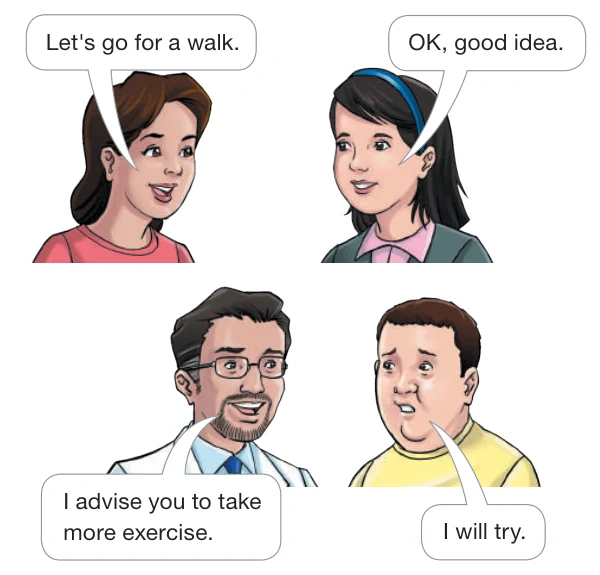
1 Look at the examples of suggestions in the two boxes. Then answer the questions below. Box 1 A: Let’s go for a walk. B: OK, good idea. A: Shall we have a rest? B: Why, are you tired already? A: Why don’t you join a walking club? B: I prefer walking alone. A: Why not try walking to stay healthy? B: Yes, I might do that. Box 2 I advise you to take more exercise. I suggest/recommend going for a walk. I suggest/recommend you read this book.
Let's go for a walk. OK, good idea. I advise you to take more exercise. I will try. 1 Which box contains more informal or conversational suggestions? _ 2 Which box contains more formal suggestions? 3 Which suggestions are for another person? 4 Which suggestions include the speaker? 5 Two suggestions do not use the infinitive form of the verb without to. What forms of the verb do they use instead? __
2 Read these short conversations. Rewrite what the second person says, beginning with the words given. 1 A: Well, we’ve finished the painting at last. Do you like it? B: Yes, I do. But shall we ask my mother what she thinks? I suggest _. 2 A: I really enjoy mountain climbing but I think I might be getting too old for it. B: Yes, it’s a bit dangerous. I recommend taking up hill walking. Why ? 3 A: Moving all this furniture is going to take a really long time. B: Oh, there’s not so much. Come on, let’s do it together. Shall ? 4 A: I’m so busy this afternoon. I don’t think I’ll have time to go shopping. B: There’s nothing we need today. Why not leave it until tomorrow? I suggest . 5 A: It takes about half an hour to walk to the office from the station. B: Well, we don’t want to be late. I recommend going by taxi instead of walking. Let’s __.
3 Look at the suggestions on the right. Say which one uses rest as a verb and which uses rest as a noun. A Let’s stop and rest for a few minutes. B Shall we stop and have a rest? 4 Many English words can be used as verbs or nouns. Complete the sentences below with words from the box, using the correct form of have a ___.
look guess joke break/rest drink try
Spelling reminder You won’t get better if you don’t practise. (verb) I think I need more practice. (noun)
1 Let me _. Maybe I can see what the problem is. 2 I wasn’t sure what the answer was but I . 3 I’m getting tired. Shall we stop and ? 4 It doesn’t matter if you do it wrong. Just . 5 Let’s stop and at that café. 6 I wasn’t being serious. I was just _ with you.
Period 4 / Language and vocabulary study
1 Listen to your teacher reading these two sentences. Then complete the pronunciation rule. This book is an important record of what is happening. You can record your answers on the CD. Complete the pronunciation rule 1 When the word record is a noun, the stress is on the _ syllable. 2 When it is a verb, the stress is on the _ syllable. 2 Use words from the box to complete the sentences. Look at the grammar of the sentence and show if the words are used as verbs or nouns. Then read the sentences aloud, with the correct stress.
increase/decrease import/export present upset survey
1 I’m looking for a _ to give my brother. VERB / NOUN He is going to a news programme on Palestine TV. VERB / NOUN 2 Before oil fields were discovered, the country had to most of its oil. VERB / NOUN The companies their products to other countries. VERB / NOUN 3 I don’t understand what I did to you so much. VERB / NOUN She’s very sorry for the she caused. VERB / NOUN 4 We hope that next year we will be able to our sales. VERB / NOUN Unfortunately, there has been a in the number of people who walk. VERB / NOUN 5 I recommend you the scene from the top of the hill. VERB / NOUN A new _ shows that walking is even better for health than people thought. VERB / NOUN
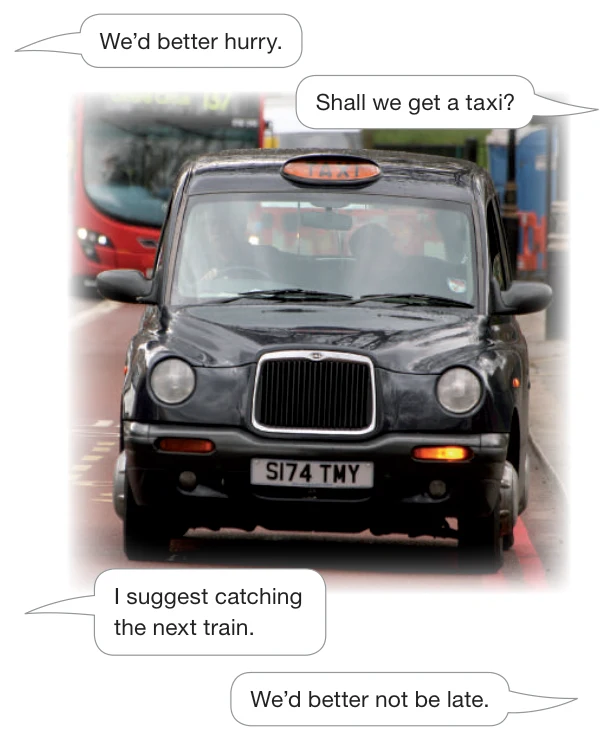
3 Look at the examples. Then complete the grammar rules. Examples It’s going to rain. You’d better take an umbrella. It’s getting late. We’d better hurry. You’d better not forget to phone him or he’ll be angry. Complete the grammar rules 1 The phrase had better + _ (without to) is used for strong advice and warnings. 2 We can use the phrase to give advice to or to other people. 3 We make the phrase negative by adding not the infinitive. 4 It is usual to use the contracted form (_) instead of the full form. 4 Work in small groups. Look at the situations below and make suggestions or give strong advice, as in the example.
- You and your friends need to catch a train. The train leaves quite soon and you haven’t left home yet.
- You have been in the town centre and have missed the last bus home.
- You and your friend are thinking about going for a long walk, perhaps lasting all day. The weather will probably be very hot.
- You and your brother or sister are trying to decide what to buy as a present for your mother.
_ __
We’d better hurry. Shall we get a taxi? I suggest catching the next train. We’d better not be late.
Period 5 / Integrated skills
1 Listen to a woman talking about a walking holiday. Then complete the sentences below. 1 The woman was surprised that the holiday was so _. 2 She had a holiday walking on the of Italy. 3 While walking, they only had to what they needed that day. 4 The countryside was . 5 Most of the walks weren’t . 6 She went with her husband and his . 7 The were sometimes difficult for them because they are over 60. 8 Apart from the countryside, she really enjoyed the . 9 The organisers were called Italian . 10 Early booking is recommended because the tours are very __. 2 Use the information from the recording to complete the woman’s online review on a website that helps people choose holidays.
CHOOSE YOUR TRIP
By writing a review of your holiday, you will help other people to compare different possibilities and choose the best trip for them. Name of tour company: _ Date of stay: July 2015 Number in group: _
WRITE YOUR REVIEW HERE:
I went on a walking tour of _ with and , organised by . We walked every day from . You might think it would be hard work but actually it was very because they took all our things to the next town every day, so we didn’t have to (just the they gave us and anything else we needed on the walk). The only negative thing I can say is that, although the advert said , my found one or two of them difficult because they are . Generally, though, this was a great holiday, especially the and . I can recommend this holiday to other people, but you leave it too late because __. HOW WOULD YOU RATE THIS HOLIDAY? Choose one: 1 2 3 4 5 3 Write an online review of a holiday/tour you went on, or a place you stayed. Write three short paragraphs and include these points: Paragraph 1: Say where you went, where it was and who you went with. Paragraph 2: Say what you thought about the holiday/tour/place (write about anything you enjoyed or didn’t enjoy). Paragraph 3: Make a suggestion or give advice to people who might be thinking about going on a similar holiday/tour or visiting the same place.
Period 6 / Writing
1 Look at the examples. Then complete the rule. Examples It’s the small details that really touch people. The details are really touching. Reading the news always depresses me. I always find the news depressing. His stories usually amuse me. I think his stories are amusing. (= quite funny) Complete the rule To make certain verbs into adjectives, we can use the ___ form. 2 Use -ing form of the verbs in the box to complete the sentences below.
amaze surprise touch annoy excite depress amuse
1 This is a _ story of the relationship between two sisters. 2 The last chapter was really . I couldn’t stop reading it. 3 I thought the way he kept changing from one story to another was quite . 4 But his book is really . You won’t believe it. 5 You might not laugh aloud but I think you’ll find it . 6 I don’t think you’ll guess what happens at the end. It’s very . 7 It’s a very sad book. In fact you might think it’s rather __. Spelling reminder surprise — surprising amuse — amusing amaze — amazing
3 Read the online book review. Then put the missing sentences from the box below in the correct places.
Sometimes it’s amusing, sometimes touching and at other times sad, almost depressing. but they don’t meet each other again until near the end. It’s very long, though. This is not surprising. I sometimes found this quite annoying.
4 stars!
SHARE THIS! READ MORE REVIEWS
This is a highly-praised book, and most people have given it five-star reviews.
- ___
It’s beautifully written, and it will make you want to keep turning the pages until you reach the end. It tells the story of two young men who were at the same school but at the time didn’t like each other. As they grow up, their lives become more and more connected,
- ___
When they do, it’s rather surprising, for them and for the reader. It’s difficult to say what kind of book this is because it keeps changing. (3) ___ I’ve only given it four stars for one reason: again and again, one person’s story is beginning to get really interesting when the writer suddenly stops and moves to another person.
- ___
Still, I would recommend the book to anyone who enjoys getting lost in a story.
- ___ You’d better not start reading it when you’re busy!
4 Write an online review of a book you have read or a film you have seen. Write three short paragraphs and include these points: Paragraph 1: Give the title of the book and the name of the writer. Say what you enjoyed or didn’t enjoy about the book. Paragraph 2: Say what the book is about. Say who are the important people in it (if it is a story) or what the writer’s main points are (if it is not a story). Paragraph 3: Make a suggestion or give advice to people who might be thinking about buying the book. In this Unit you have learnt about:
- the changing countryside of Palestine
- walking for pleasure
- negative prefixes for adjectives
- making informal and formal suggestions
- advice and warnings using had better
- verb–noun stress changes
- verbs and nouns used with have a ___
- -ing adjectives from verbs
- writing online reviews
