
The topic explained
UNIT 3 Take care!
1 Read Text A and Text B quickly to find the answers to these questions. 1 Which text is from a price comparison website? A B 2 Which text gives advice for different situations? A B 3 Which text has information for employees? A B 4 Which text offers a way to avoid worrying about what might happen? A B
TEXT A
Accident prevention in the Home
Your home is the place where accidents are most likely to happen. Being aware of the dangers helps you prevent them from happening.
Fire safety Fires may start suddenly and spread quickly. Here are a few tips to prevent them from starting. Don’t place portable heaters and candles near furniture or curtains. Don’t dry clothes near a fire or cooker. Keep matches and lighters out of reach of children. Fit smoke alarms on each floor. (a) ___
Cooking The kitchen is where some of the most serious home accidents happen. Sharpen knives regularly. Blunt knives are more dangerous. (b) _ If there are young children around, take extra care with hot water and hot drinks. (c) _ When cooking on the oven top, keep handles of pans turned inward.
DIY* and garden safety One of the biggest causes of DIY accidents is being too ambitious. Don’t do a job yourself unless you know what you’re doing, especially gas and electrical work. Ask a professional. Never use a tool that has an electrical fault. Pre-planning is important. You’re more likely to have an accident if you are unprepared or in a hurry. (d) _ (e) _ Keep all products in their original containers.
- DIY (Do It Yourself) = doing jobs yourself instead of paying a professional to do them
2 Here are five pieces of advice. Read Text A in more detail and put each one into the correct section of Text A, (a) to (e). Keep tools, paint and chemicals out of reach of children. Never leave a pan unwatched when deep fat frying. Plan your escape route so that you can get out quickly if necessary. Unplug electrical tools before cleaning or working on them. Make sure electric things like kettles and food mixers don’t get wet.
Period 1 / Reading and Comprehension
TEXT B Insurance made clear Contents insurance is for accidental damage to things in your home like TVs and computers. If you add up the cost of repairing or replacing all the technology we have nowadays, you may be surprised. Taking out an insurance policy can be quite cheap and will give you peace of mind. You can usually add items that you often take out of the house, like mobile phones, cameras and watches. Personal accident insurance provides you with a tax-free monthly income if you are unable to work due to accidental injury, usually for up to a year. This type of policy is a good choice if you are worried that you wouldn’t be able to manage if you lost your regular income because of injury. Choosing the right insurance policy can take time but if you don’t want to waste money, it’s important to compare what’s on offer. We make the process as easy as possible by listing the best policies from leading insurance companies on one site.
3 Read Text A and Text B (pages 24–25) more carefully. Then complete the tasks below. 1 Find opposites of these words in the texts. (The words are in the same order as in the texts.) 1 fixed (Text A) _ 2 sharp (Text A) 3 outward (Text A) 4 limited (in what you try to do) (Text A) 5 someone doing something that isn’t their job (Text A) 6 outgoings / spending (Text B) 2 Use the opposite words you have found to complete the sentences below. 1 He took an extra part-time job to increase his . 2 I stood at the front door, facing , so I couldn’t see who was behind me. 3 He believes he can succeed in anything he tries. He’s very . 4 She bought a CD player so that she could listen to music while travelling. 5 These scissors are . They won’t cut anything. 6 I’m not sure why it’s not working. You’d better ask a _. 3 Answer the questions. 1 How can people stop accidents from happening? 2 Why are fires especially dangerous? 3 Why is preparation important when doing jobs in the house? 4 What could happen if you don’t keep products in their original containers? 5 Why is it a good idea to insure computers, etc against accidental damage?
Period 2 / Reading and Comprehension
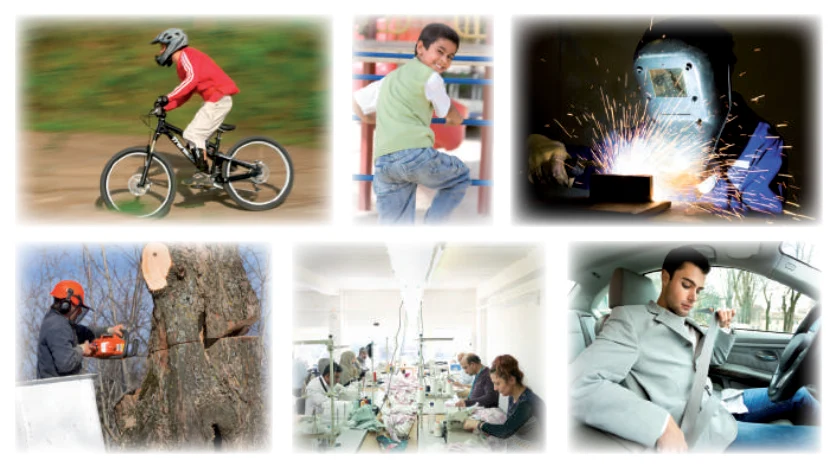
1 Look at the pictures. Then discuss the questions below. 1 Where are the people and what are they doing? 2 What do the pictures tell us about safety?
2 Read the text about safety regulations. Then complete the tasks below and on page 27.
Safety first? 1 In 19th-century Europe, life was full of danger for both agricultural workers and those who worked in the industrial factories with new machinery. Gradually, under pressure from workers’ organisations, governments began to pass laws to improve conditions, and employers now have to take responsibility for the safety of their employees. 2 In poorer countries, though, safety regulations are weak and the dangers remain. There is a feeling, usually unspoken, among governments and employers in these countries that safety in the workplace is a luxury that they can’t afford, and that safety regulations make businesses less competitive and brings less money. 3 Meanwhile, in richer countries, health and safety regulations have been extended into other areas of life, like transport, schools, hospitals and other public services. In most countries, for example, it is against the law to drive a car without wearing a seat belt. When this law was first suggested, some people believed it should be a matter of personal choice, but it is now accepted that wearing seat belts has saved many lives. 4 Over the last 20 years or so, there has been a gradual change in attitude, partly because of regular stories in the popular press about schoolchildren not being allowed to go on school trips or play traditional games in the playground. Some of these stories were not actually true, but still the feeling has grown that government regulation has gone too far, taking away people’s responsibility for their own safety. This may be one reason why there are still only two countries in the world where all cyclists, by law, have to wear helmets. In other countries, governments don’t want to restrict people’s personal freedom.
1 Find words and phrases in the text that have these meanings. 1 make new laws (paragraph 1) _ 2 accept that you should do something (paragraph 1) 3 rules and laws (paragraph 2) 4 something that is nice but not necessary (paragraph 2) 5 spread (paragraph 3) 6 slow, not sudden (paragraph 4) 7 opinion or way of thinking (paragraph 4) 8 newspapers read by many people (paragraph 4) 9 put limits on (paragraph 4) __
2 Use the words or phrases from Part 1 to complete these sentences. 1 There are lots of stories about famous people in _. 2 My parents’ to computer games is different from mine. 3 The government should to protect the environment. 4 Last year he his studies into other areas. 5 We should teach children to for what they do. 6 Owning a car may be necessary, but owning two is a . 7 New made it compulsory to wear seat belts. 8 The new law will what companies are allowed to do. 9 She didn’t get better suddenly. It was a change. 3 Answer the questions with sentences. 1 Why did governments in 19th-century Europe start to improve safety for their workers? Because they were . 2 Why are workplaces in poorer countries still dangerous? . 3 What did some people think about car seat belts at first? . 4 What has recently made some people change their minds about safety regulations? . 5 Why have most governments not made it compulsory to wear cycle helmets? _. 4 Can you guess which two countries have made cycle helmets compulsory for all? (You can find the answer on the next page.)
3 Match each word in column A with one from column B to make two-word noun phrases from the texts in Periods 1 and 2. Then use the phrases to complete the sentences below.
| A | B |
|---|---|
| 1 insurance | a regulations |
| 2 electrical | b damage |
| 3 accidental | c fault |
| 4 accident | d income |
| 5 regular | e services |
| 6 safety | f prevention |
| 7 public | g policy |
1 He looked on the internet to find a cheap _ . 2 It’s a good idea to insure your computer against . 3 An expert came to our office to give advice about . 4 Since losing his job, he hasn’t had a . 5 Hospitals, street lighting and rubbish collection are all . 6 Some companies say they are losing money because of . 7 Don’t use that machine! It has an _ and it’s dangerous.
Period 3 / Language and vocabulary study
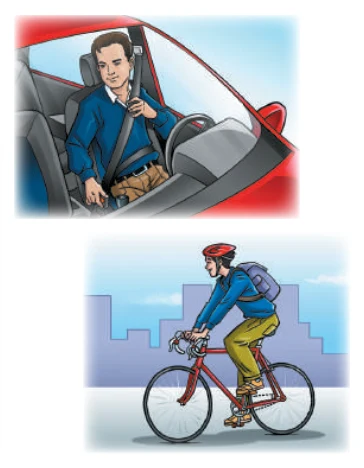
1 Look at the examples. Then match the different ways of talking about obligation with their meanings.
Examples In my country, all drivers have to wear seat belts. After 1983, cyclists had to wear helmets. You don’t have/need to do this if you don’t want to. When cars were first invented, you didn’t have/need to get a licence to drive them. Children are not allowed to play near the river. When I was young, I wasn’t allowed to play in the street.
| EXPRESSION/STRUCTURE | MEANING |
|---|---|
| 1 not be allowed to | a There is an obligation to do this. |
| 2 have to | b There is no obligation to do this. |
| 3 don’t have/need to | c There is an obligation not to do this. |
2 Complete the sentences by adding have/had to, don’t/didn’t have/need to or (not) be allowed to. 1 When do we _ finish this homework? 2 We arrived late and we go into the theatre after the performance started, so we wait till the break. 3 My old school had few restrictions on clothes, so pupils wear a uniform. 4 I think you arrange for a meeting tomorrow because the boss has already done it. 5 we __ use dictionaries during the test?
3 Look at the information about wearing cycle helmets. Then complete the sentences on page 29 with have/had to, don’t/didn’t have/need to or (not) be allowed to.
| Country | Date of law | Notes |
|---|---|---|
| Australia | 1989 | Compulsory |
| Austria | 2011 | Compulsory under 12 years of age |
| Chile | 2009 | Compulsory in towns and cities |
| Czech Republic | Compulsory under 15 years of age (changed to under 18 from July 2006) | |
| Finland | 2003 | Not enforced (no fine) |
| Germany | No law | |
| Japan | 2008 | Compulsory under 13 years age |
| New Zealand | 1993 | Compulsory |
1 In Australia and New Zealand, all cyclists _ wear helmets. 2 In Austria, before 2011, children under 12 wear helmets. 3 In Germany, cyclists wear helmets. 4 In Australia, you ride a bike without a helmet. 5 Until 2006, young Czechs between 15 and 18 ride bikes without wearing helmets. 6 In Finland, you wear a helmet in theory, but you pay a fine if you don’t wear one. 7 In Chile, cyclists only wear helmets in towns and cities. 8 In Japan, anyone over 13 __ wear a helmet.
4 Write three sentences about yourself and your life, using have to, don’t have/need to and (not) be allowed to. Then, in pairs, tell each other your answers. 1 At home, I _. 2 In my school, we . 3 In my country, people __.
Period 4 / Language and vocabulary study
1 Match each preposition with a noun to make fixed phrases. Then use the fixed phrases in the sentences.
| PREPOSITION | NOUN |
|---|---|
| 1 by | a theory |
| 2 in (×3) | b offer |
| 3 out of (×2) | c the law |
| 4 on | d practice (×2) |
| 5 against | e reach |
| 6 under | f pressure |
| g law | |
| h a hurry |
1 Sorry, I can’t talk now, I’m _. 2 Driving without a licence is . 3 I haven’t driven for several months, so I’m . 4 Giving false information is forbidden . 5 I’m not sure which one to buy. I’ll see what’s . 6 I agree with your idea . 7 However, I don’t think your idea will work . 8 He didn’t want to do it but finally agreed . 9 Make sure the container is high enough to be __.
2 Look at the examples. Then complete the grammar rules.
Examples You mustn’t leave that medicine where children can reach it. I mustn’t forget to post that letter. You don’t have to call him today, Tomorrow is fine. In my school we don’t have to wear a uniform. The teacher said we had to finish the work before we went home. She had to wear glasses when she was young.
Complete the grammar rules 1 We use _ to say that there is an obligation not to do something. 2 We use to say that there is no obligation to do something. 3 When expressing obligation, the past form of both must and have to is __.
3 Circle the correct option to complete the sentences. 1 You mustn’t / don’t have to buy bread. We’ve already got some. 2 She has to / mustn’t wear her glasses when she’s reading. 3 Before they changed the law, nobody must / had to wear a seat belt when driving. 4 I’d already read the book, so I had to / didn’t have to read it again.
4 Complete the sentences with mustn't, don’t / didn’t have to or had to. 1 ‘You _ ride your bike without a helmet,’ his father told him. 2 In the UK people carry an identification card, so many people don’t carry one with them. 3 She missed the last bus and walk home. 4 He got home on time yesterday because he work late. 5 I __ eat all of that cake or I’ll feel ill.
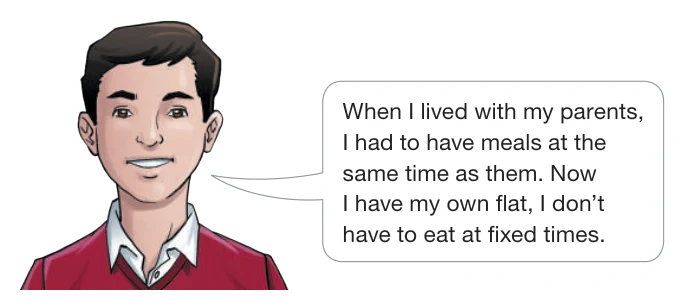
5 Work with a partner. Tell each other what you had to do when you were younger but don’t have to do now.
When I lived with my parents, I had to have meals at the same time as them. Now I have my own flat, I don’t have to eat at fixed times.
Pronunciation reminder Mustn’t sounds like mussnt.
Period 5 / Integrated skills
1 Listen to an interview with someone from the Accident Prevention Society. Then complete the tasks below. 1 Complete the sentences. 1 Mary Williams blames the _ for printing false stories. 2 She feels __ of what the APS has achieved. 2 Match each number or date to the correct fact.
| 1 1917 | a It became illegal to use mobile phones while driving. |
|---|---|
| 2 70% | b Number of lives saved by wearing car seat belts. |
| 3 1983 | c The Accident Prevention Society was first established. |
| 4 60,000 | d Fall in the number of pedestrians killed by traffic after changing rules. |
| 5 2003 | e Seat belts in cars became compulsory. |
2 Listen again to check your answers. Then complete any information that you didn’t catch the first time.
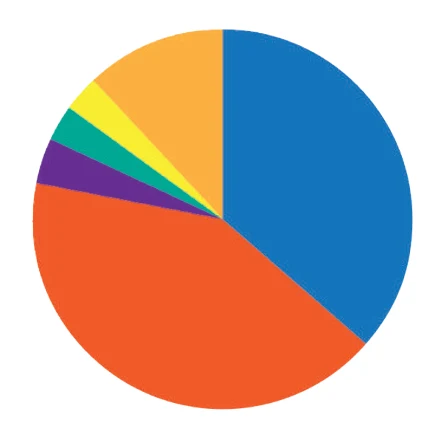
3 Look at the pie chart. Then complete the sentences below.
Causes of back injuries in Australia Traffic accidents 37% Falls 42% Knocked over/lifting 4% Other 3% Assault/fights 3% Sport 12%
1 The main cause of back injuries in Australia _. 2 12% of back injuries in Australia happened while people were . 3 The second most common cause of back injuries in Australia . 4 Only _ happened during fights or assaults.
4 Discuss this question in pairs or small groups. During the First World War, when all British soldiers were given better metal helmets to wear, the number of soldiers in hospital with head injuries rose sharply. How can you explain this rise? (Note: the answer is very logical. It is not a trick question.)
Period 6 / Writing
1 Study the tables below. Then use the information to write five sentences.
| Since 2009, / Since the law was passed, | there has been a | 45% / gradual / sudden / steady | fall / rise | in | serious accidents. / the number of people attending hospital. |
|---|---|---|---|---|---|
| Last year, / When the law was passed, | there was a |
| Since 2009, / Since the law was passed, / Last year, / When the law was passed, | serious accidents. / the number of people attending hospital | have/has fallen | by 25%. / gradually. / suddenly. |
|---|
1 _ 2 3 4 5 __
2 In pairs or small groups, look at the graph below. Then write a short paragraph saying what it shows. Use the notes on page 33 to help you.
Line graph, vertical axis 75 to 100 (75, 80, 85, 90, 95, 100), horizontal axis 2000 to 2020 (2000, 2002, 2004, 2006, 2008, 2010, 2012, 2014, 2016, 2018, 2020). Labels: future projection, women, men.
Summary of literacy rates in Palestine (2001–2013) In 2001, the gap between _. Men’s literacy was , while women’s was . After that, the literacy rate for men every year. Over the same period, more quickly. By 2013, the rate for men was , compared with for women. This means that, despite the progress in women’s literacy rates, there is still a just over 4% in favour of men. However, if literacy continues to rise, it is expected that all men and women __ before 2020.
3 In pairs or small groups, compare your answers to Activity 2. Then discuss the questions below. Is the paragraph clear and correct? _ Is there any information not included? What does the information tell us about the situation in Palestine? __
In this Unit you have learnt about: safety in the home and safety regulations different ways of talking about obligation and permission: have to, be allowed to fixed preposition + noun phrases fixed two-word noun phrases how to use mustn’t and don’t have to writing information from graphs and charts
PROGRESS TEST 1 (UNITS 1–3)
Progress test 1 Period 1
Reading 1 Read the text about sleep. Then choose the best ending for each sentence below and on page 35. Circle A, B or C.
A good night’s sleep I read this week about new research that says ‘the right amount of sleep’ helps students get better marks in tests. It also lowers the risk of some diseases in men, and is what makes women live longer than men. It sometimes seems that everyone thinks they know not just how much sleep others need but also where, when and how they do it. But is it possible to speak so generally? Famously, people like the French general Napoleon and British Prime Minister Margaret Thatcher managed quite well with only four hours a night, and the American inventor Thomas Edison said sleep was ‘a waste of time’. Parents often try to make young children sleep at particular times because they won’t sleep when we want them to: they wake us up in the middle of the night and they wake up too early. We say we’re doing this because it’s good for them, but actually it’s because it fits our lives. As for older children, the researchers say most six- to 12-year-olds need around 10 hours’ sleep a night, and that many parents don’t realise this. They are also shocked that fewer than 20% of parents realised that having TVs and computers in bedrooms made their children less likely to sleep. But why so shocked? What world do these researchers live in? Maybe some parents just understand better than others how young people’s lives have changed. Perhaps we should follow the example of the headmaster of a school in Manchester, who recently made the decision to change his school’s hours to fit the change in teenagers’ body clocks. Since last year, the school has been opening at 10.00 (an hour later than before), with the extra time added at the end of the day. Students’ exam results have improved by 19% or more in all subjects, which is hard to argue with. It’s also hard to disagree with Professor Simon Nelson, a ‘sleep expert’: ‘How much sleep we need is simply enough to stop us feeling tired when we’re awake.’
1 The research suggests that one advantage of sleeping enough is that it A improves exam results. B prevents diseases. C helps men live as long as women. 2 The writer thinks that advice to people about their sleeping habits is A a waste of time. B too general. C not possible. 3 The writer uses examples of famous people to show that A famous people need less sleep than others. B sleeping less is actually better for us. C not everyone needs the same sleeping time. 4 According to the writer, most parents A wake their children up too early. B know what is good for their children. C try to control their children’s sleep times. 5 Researchers were surprised about A the things many parents don’t know. B older children needing so much sleep. C children having TVs in their bedrooms. 6 The writer suggests that the researchers A didn’t ask enough parents. B don’t understand modern life. C should have asked more people. 7 The school in Manchester A now has shorter hours than it used to. B has made its pupils work harder. C is more successful in exams than it was. 8 In general, the writer’s opinion is that A sleeping needs change from person to person. B children should sleep when they want to. C most people get as much sleep as they need. 9 The word this (line 8) means A waking up early in the morning. B trying to change when children sleep. C sleeping at particular times. 10 The word They (line 10) means A the researchers. B many parents. C six- to 12-year-olds.
20/15 marks
Progress test 1 Period 2
Vocabulary/Language study 1 Match words from the box with their meanings below. method blunt evidence solution tip luxury challenge 1 piece of advice _ 2 answer to a problem 3 problem or difficulty 4 information that proves something is true 5 way of doing something 6 something nice but not necessary 7 not sharp __
2 Complete the sentences with words from the box. distract professional stress ambitious physical attention 1 Doing some _ exercise every day is good for the body. 2 It’s not safe to do it yourself. Ask a who knows about electrical faults. 3 Having the TV on while studying can your attention. 4 I’ve discussed the general points and now I want to turn my to the details. 5 She’s very . She wants to be a famous scientist before she’s 25. 6 I want to _ this point because it’s very important.
3 Match words from the left and right columns to make fixed phrases. Then use the phrases to complete the sentences below.
| 1 insurance | a income |
|---|---|
| 2 safety | b learning |
| 3 regular | c services |
| 4 public | d policy |
| 5 distance | e regulations |
1 I lost my computer but luckily it was included in my _ . 2 The government should spend more on like hospitals. 3 is good for students who have a full-time job. 4 The new will help to prevent accidents at work. 5 It’s hard to borrow money from a bank if you don’t have a _. Progress test 1 Period 2
4 Complete the sentences with prepositions from the box. for to (×2) against into on in 1 The company should invest more _ advertising. 2 He doesn’t understand because he never pays attention the teacher. 3 He needs to take responsibility what he has done. 4 I turn my notes a mind-map to help me remember them. 5 You can’t just take one example and apply it every situation. 6 It’s the law for anyone under 16 to drive a car. 7 Drivers should focus their attention __ what’s happening on the road.
5 Circle the correct options to complete the sentences. 1 Seat belts are compulsory here. Every driver has to / is allowed to wear them. 2 In some schools, students don’t have to / aren’t allowed to write in their textbooks. 3 You can come with me if you like but you are allowed to / don’t need to. 4 That phone was expensive. You mustn’t / don’t have to lose it. 5 Twenty years ago the family must / had to move to another country.
6 The sentences below use hope and wish. Complete each one using the correct tense or form of the verb in brackets. 1 I’ve applied for a new job. I hope I _ it. (get) 2 I wish I more of what I learnt in school but I’ve forgotten most of it. (remember) 3 She hopes a doctor when she finishes medical school. (become) 4 He wishes he eating fast food so much because he wants to be thinner. (not enjoy) 5 I hope they __ early. I haven’t finished cooking yet. (not arrive)
7 Complete the sentences below with either … or, both … and or neither … nor. 1 Everyone was worried. _ his friends his family knew where he was. 2 You can phone send an email. Which way is easier for you? 3 Ahmad his brother are studying at university. 4 The book is funny exciting. I didn’t enjoy it at all. 5 The person in the photo is a singer _ an artist. I can’t remember which.
8 Correct the mistakes in the sentences below. 1 It’s quite easy to do as far as you follow the instructions. _ 2 Provided than you have the right papers, there should be no problem. 3 If they lose the last match, they are sure to be champions. 4 As long that you don’t take risks, it’s a very safe sport. 5 I’ll be there at 4.30 unless I don’t have to work late. __
25 marks Progress test 1 Period 3
Writing
1 Look at the chart below. Then write a short paragraph (80–120 words) explaining what the chart shows. You may find the words and phrases in the box useful.
fall / rise / improve (slightly) a slight fall / rise compared with … while …
0 percentage 1990 2000 2010 present girls boys
Percentage of boys and girls getting top grades in tests, 1990–present
The chart shows _ __
5 marks
