
The topic explained
UNIT 6 Past history?
UNIT 6 Past history?
Past history? Two texts about similar events
‘That’s all past history. Let’s forget it and look towards the future.’ The phrase ‘(all) past history’ usually suggests something that is finished and not related to the present.
Why do you think the title of this unit has a question mark? What does it say about the past and history?
Discuss the main difference(s) between the two texts.
Which phrasal verb at the beginning of Text A suggests that things didn’t happen as expected?
‘… the cease-fire didn’t last, and before long the bombing and shooting began again …’
A cease-fire is
A the final end to a war or battle.
B an agreement to stop fighting for a time.
The phrase before long means
A soon afterwards.
B much later.
‘I remember I would go out with other boys …’ In this sentence, the modal verb would means the same as
A used to.
B wanted to.
Which phrase in Text B suggests an intended idea that didn’t actually happen?
Do you know a similar phrase that means the opposite of this one?
‘… they failed to intervene …’ The verb intervene means
A to have a personal interest in the result.
B to put yourself between two competing sides.
Period 1 / Reading and comprehension
Ways of telling what happened in the past
The words and phrases below are all connected with ways of telling what happened in the past. Match them with their meanings. Use a dictionary to help if necessary.
| WORDS AND PHRASES | MEANINGS |
|---|---|
| 1. first person | a story of someone else’s life |
| 2. third person | b I / me or we / us |
| 3. biography | c from a personal point of view |
| 4. autobiography | d story by someone who saw what happened |
| 5. memoir | e story of the writer’s life |
| 6. objective (adjective) | f telling a story |
| 7. subjective (adjective) | g personal recording of memories |
| 8. eye-witness account | h he / she / him / her or they / them |
| 9. narrative (noun or adjective) | i not including personal opinions |
Arrange the words and phrases from Activity 3 into two lists.
first person narrative third person narrative
If you want to know what happened in the past, what are the advantages of these three types of text?
a memoir or autobiography looking back at the events an objective historical study an eye-witness account written or recorded at the time
Period 2 / Reading and comprehension
The Diaspora: a home from home
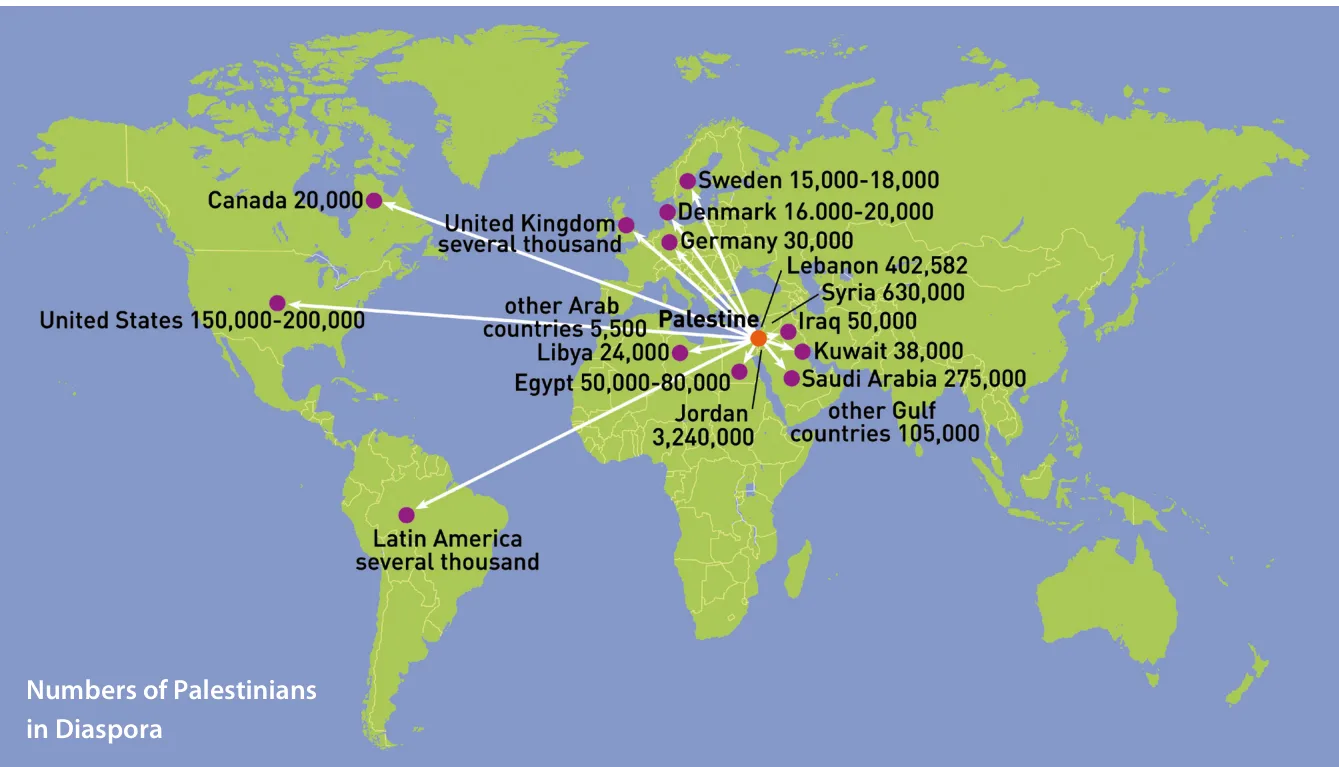
Look at the map and discuss the questions in pairs or small groups.
What does the map show?
Do you have relatives who live outside Palestine? Where do they live, and where are their families originally from?
Read the text quickly. Then answer the questions.
What period is the text about?
Where was the writer living?
Replace the underlined parts of the sentences with words from the text. (The sentences are in the same order as the words in the text.) He explained the real size of the problem we were facing.
As a result of the disaster, thousands of people have been forced to leave their homes.
It’s hard to refuse her because she’s very unlikely to give up or take no for an answer.
The President tried his best to make people stop worrying about the situation.
People think we have continuous and endless sunshine here, but it does rain sometimes.
‘… over 700,000 Palestinians were forced to leave their home ... with more to follow.’ What does more refer to?
‘… it became a “home from home” for them.’ What does the writer mean by home from home?
‘… about people’s origins and backgrounds …’ What is the difference between the meaning of origin and background?
‘… the deeper importance that they had after 1948.’ What does they refer to?
Discuss the questions in pairs or small groups.
Why does the writer begin by giving facts and numbers?
Roughly what period in history does the text look back to?
Why didn’t the writer and his family realise at the time how large the Diaspora was?
Why are names and backgrounds especially important at this time?
‘Surely the rest of the world can see how unfairly we’ve been treated, and won’t allow it to continue.’ Looking back and knowing what happened later in the 1950s, 60s and 70s, how does this view of the situation now sound?
A sad?
B foolish?
C moving?
Do you think the writer intends it to sound this way? Why?
Period 3 / Reading and comprehension
Building bridges to the world: Arafat at the UN
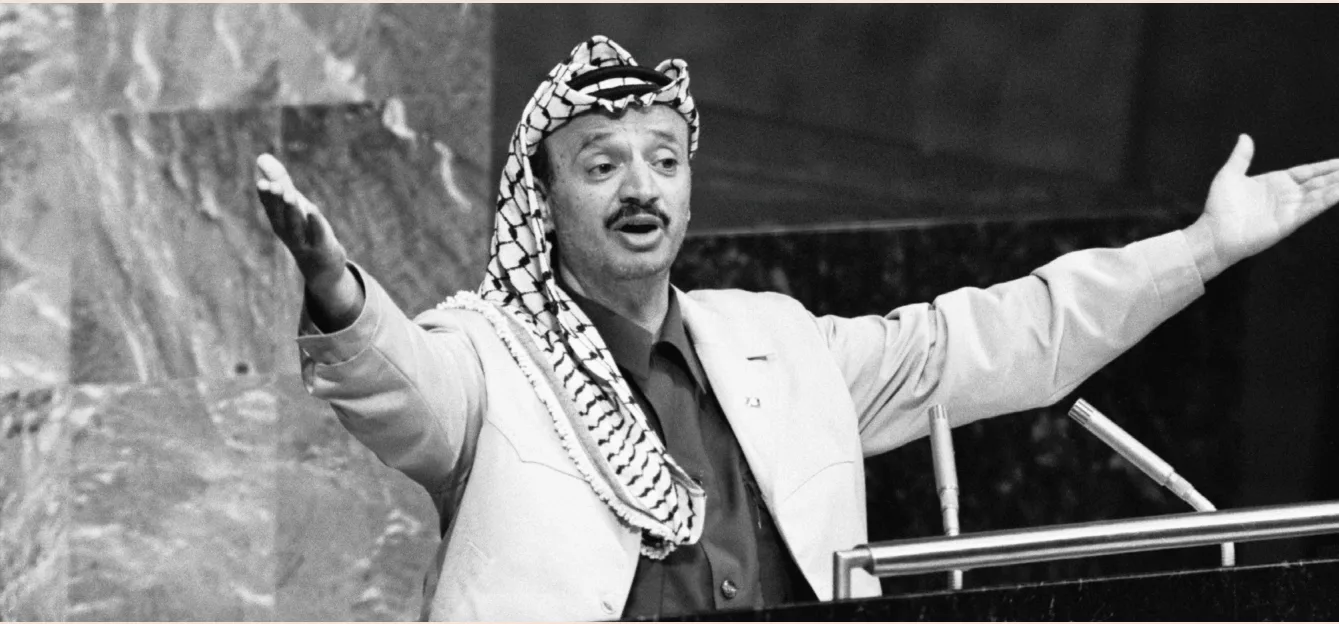
Look at the title of the article and the picture. Then discuss these questions in pairs or small groups.
What do you know about the famous event shown in the picture?
What do real bridges do?
What kind of bridges is the title referring to?
How do you think the title and the photo are connected?
Match the words and phrases from the text with their meanings.
| WORDS AND PHRASES FROM THE TEXT | MEANINGS |
|---|---|
| 1. cause | a position |
| 2. late | b raise to a higher or better level |
| 3. rang out | c an idea people support or fight for |
| 4. setbacks | d be heard strongly and clearly |
| 5. diplomatic | e no longer living |
| 6. struggle | f connected with high-level discussions |
| 7. representative | g a fight or a difficult task |
| 8. upgrade | h problems that stop progress |
| 9. status | i person speaking or acting for others |
Use the words in Part 1 and phrases to complete the sentences.
1 He argued for a ___ solution to the problem rather than a military one.
2 It will be a long _ with many _ , but we will succeed in the end.
3 I need to ___ my computer to a better model.
4 We need to bring our ___ to the world’s attention and get them to support it.
5 She wrote the book in memory of her ___ husband.
6 They are sending a ___ to the discussions to make their opinions known.
7 As a Professor, she has a high ___ at the university.
8 The noise of a shot suddenly ___ , making us all jump.
What do these words, highlighted in the text, refer to?
- That (line 3)
- They (line 7)
- This (line 8)
What is the symbolic meaning of the olive branch and gun that President Arafat said he was holding?
What choice was he offering to the world?
What did he mean when he said ‘Do not let the olive branch fall from my hand’?
How did the speech change the way many Palestinians thought about their relationship with the rest of the world?
Period 4 / Reading and comprehension
Said, Sharabi and the bridges still being built
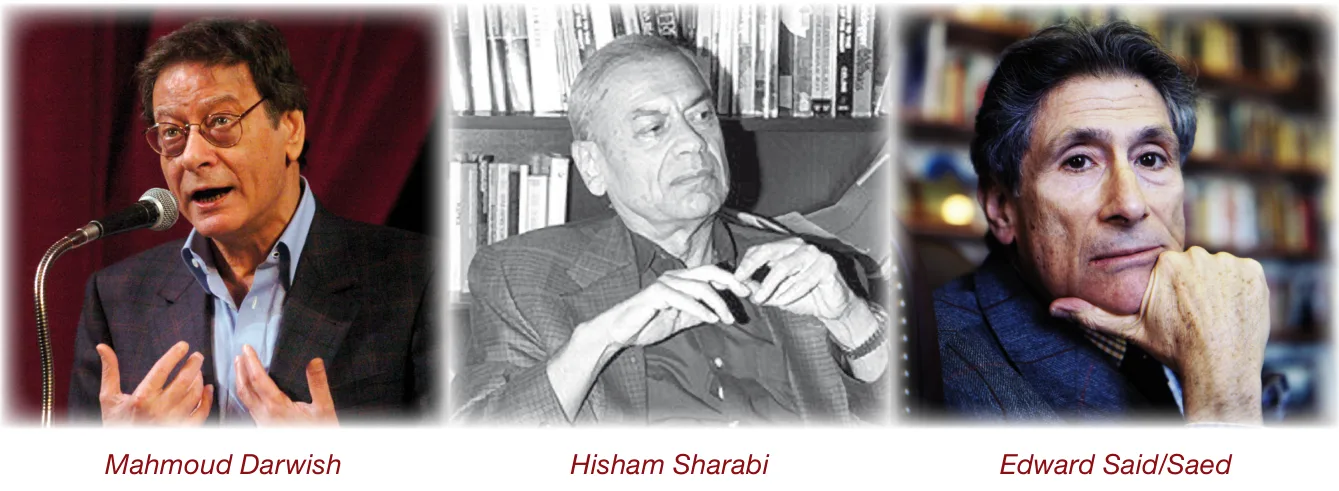
Look at the pictures. Then answer the question in pairs or small groups.
What do you know about these people?
where and when they were born what they did in their lives what connection there is between them
Replace the underlined parts of the sentences with words from the text. (The sentences are in the same order as the words in the text.) He is a well known and important person in the country’s history.
When one side has all the advantages, there can be no fair balance.
They are convinced of the fairness of their demands.
He was both a politician and an intelligent, academic person.
There are many problems that need to be discussed before we can reach a solution.
The government is trying to control the number of people coming from other places to live in the country.
I’m sure we can reach some kind of acceptance that not all demands will be achieved.
My opinions are all based on the idea of human rights.
This book will give good ideas to anyone who wants to succeed in life.
She was encouraged to do something by her wish to help other people.
Explain in your own words why Mahmoud Darwish was unable to say goodbye to Edward Said.
Say what non-academic work Hisham Sharabi did to help the Palestinian cause.
What was the issue on which Sharabi refused to compromise?
Looking at the whole article (including the part that you read in Period 3), say what these dates refer to.
1948 The year when
1974 The year when
2012 The year when
1927 The year when
1975 The year when
1993 The year when

