
The topic explained
UNIT 2 Fitting in; Period 1 / Reading and comprehension; Period 2 / Reading and comprehension; Period 3 / Reading and comprehension; Understanding idioms
UNIT 2 Fitting in
Fitting in or standing out? An article begins
Look at the definition. Then discuss the questions below in pairs or small groups.
How important is it to fit in with other people?
What different groups do you belong to? Think about the areas below and add groups to the diagram. Then compare with another student.
your family life ▶ your social life ▶ your village / town / area / country your school life ▶ your interests
Can you think of any reasons why it might not always be a good idea to fit in with others?
Period 1 / Reading and comprehension
Word building and phrasal verbs from the article
'Nearly all the lifestyle advice and self-help sites seem to agree ...' What is someone's lifestyle? ___
What kind of advice do websites like this usually offer? ___
'A feeling of belonging is unquestionably “a good thing” ...' Complete the table to show how the word unquestionable / unquestionably is made.
NEGATIVE PREFIX | VERB | ADJECTIVE SUFFIX | ADVERB SUFFIX
If something is unquestionable, what is it impossible to do? ___
If something (e.g. a book, a piece of music or a painter) is described as incomparable, what does it mean? ___
Replace the words in brackets with phrasal verbs from the text.
He often (arrives or appears) late for meetings. ___
We should use a different colour to make this sentence (look different from the others). ___
The phrasal verbs are not used in exactly the same way in the sentences as in the text. How are the two meanings connected?
A They refer to similar situations, but the meaning is different.
B They have similar meanings, but refer to different situations.
'The implication is clear ...' Match these verbs with their meanings. Then add them to the table, with their nouns.
- simplify
- apply
- multiply a what you do to get a job b increase in number c make something easier VERB | NOUN imply | implication
Discuss the questions in pairs or small groups.
How is fitting in different from belonging?
What do you think Dr Seuss means when he says people are born to stand out?
Why might some people, especially young people, not want to stand out from others?
Period 2 / Reading and comprehension
Teenagers, outstanding people and why we need groups

Look at the picture. Then discuss the questions in pairs or small groups.
How do you think the person at the front is feeling?
What do you think the others are doing or saying?
What reasons might there be why this person doesn't fit in?
Can you remember the quotation from Dr Seuss from Period 1? How does it relate to the picture?
'... standing out and not being accepted as “normal” is horribly embarrassing.' Why do you think the writer puts the word normal in inverted commas?
When you are embarrassed, you feel as if everyone is looking at you. What kind of things or situations might people find embarrassing?
'... a young person might deliberately choose not to work hard at school ...' What does deliberately mean?
A on purpose B freely
'This feeling is something that most people grow out of.' The phrasal verb grow out of (something) means
A to gradually become too big.
B to lose a habit or feeling as you get older.
C to be made or produced from something.
Can you think of other examples of things that children usually grow out of?
'... when someone is described as an outstanding actor / writer / business person / leader, it's high praise.' What does outstanding mean?
A unusual or strange B better than most others
Give real examples of people you believe are outstanding leaders, writers, musicians or sports people. What makes them outstanding?
'The process can take quite a long while though.' What process is the writer referring to here? ___
'... being left out of or cut off from the group would more than likely lead to death.' The two phrasal verbs used in the sentence are similar but not exactly the same. Match them with these meanings.
a to _ something or someone (= to not include) b to something or someone _ (= stop communicating with) What prepositions are used with each one if we want to add an object?
a leave out _ a group b cut off _ a group
Find fixed phrases in the third paragraph with these meanings.
- shared aim ___
- single person ___
- almost certainly ___
The verb survive is used twice (lines 36, 42), with slightly different meanings. Find the two uses and say which one means:
- to remain the same ___
- to continue living ___
'... people who don't feel that they belong to a group are more likely to become ill than those who are part of a community, and they don't live as long.' What does the highlighted word they refer to in this sentence?
A people who are part of a community
B people who don't belong to a group
Complete the explanation. Then compare your answer with another student.
Fitting in means trying to (1) ___ This is often seen as a bad thing to do because it stops you from being yourself.
Belonging, on the other hand, is the feeling that (2) ___ This is something we all need.
Period 3 / Reading and comprehension
The black sheep of the family
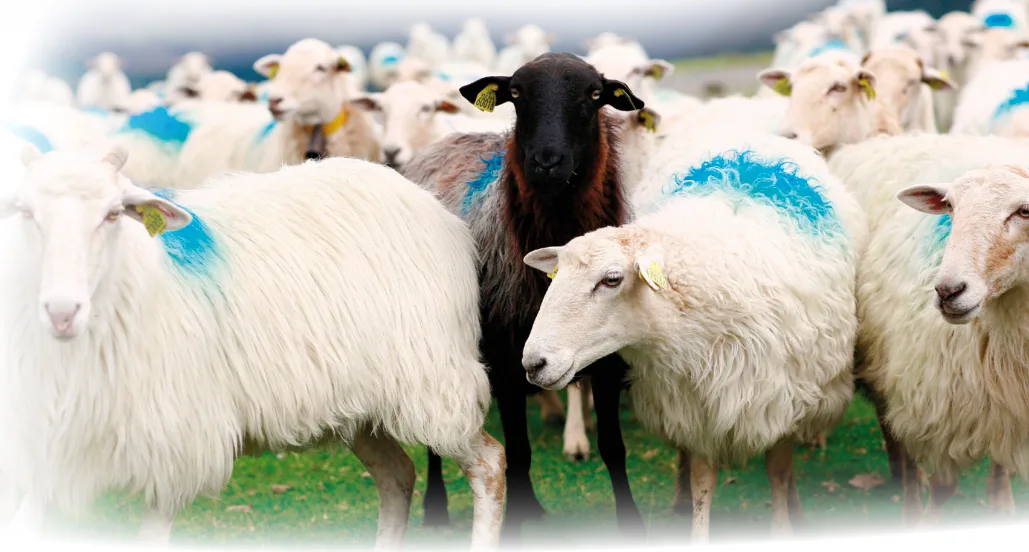
Look at the picture. Then discuss the questions below in pairs or small groups.
Have you heard the phrase 'the black sheep of the family'? What do you think it means?
Is the same phrase used in Arabic, or something similar?
Match the headings with the paragraphs in the text. (There is one more title than you need.)
A Where the meaning comes from paragraph ___
B Why some people become black sheep paragraph ___
C Some examples of black sheep paragraph ___
D The story behind a popular book paragraph ___
E A definition of the phrase paragraph ___
Complete the sentences with a maximum of two words from the text.
- The idea of being a 'black sheep' seems to be quite ___ in European countries.
- Several languages have an ___ similar to the English phrase 'black sheep of the family'.
- In real life, however, black sheep are not common; in fact, they are ___.
- Black wool is _, so farmers regard it as _.
- The modern meaning of 'black sheep' isn't as ___ as it used to be.
- The life of 'black sheep' may be more exciting because they are more likely to ___.
- ___ people tend to be black sheep as they see the world differently from others.
- Women have sometimes been seen as black sheep because there were stricter ideas about what it was ___ for them to do.
- Mary Shelley's Frankenstein is the most famous of several ___ that were made up one afternoon.
Answer the questions.
- How has the meaning of the phrase black sheep changed nowadays?
- How old was Mary Shelley when she first made up the story of Frankenstein?
- What do you know about the story?
- What might be surprising about the fact that a story like this was written by a nineteen-year-old girl in the nineteenth century?
Discuss the questions in pairs or small groups. Then compare your ideas with others.
- Do you know any other examples of people who could be described as black sheep?
- Can you think of any other idioms in Arabic that relate to the topic of belonging to groups and fitting in (or not fitting in)?
- Can you translate them into English?
Understanding idioms
How to work out an idiom you do not know
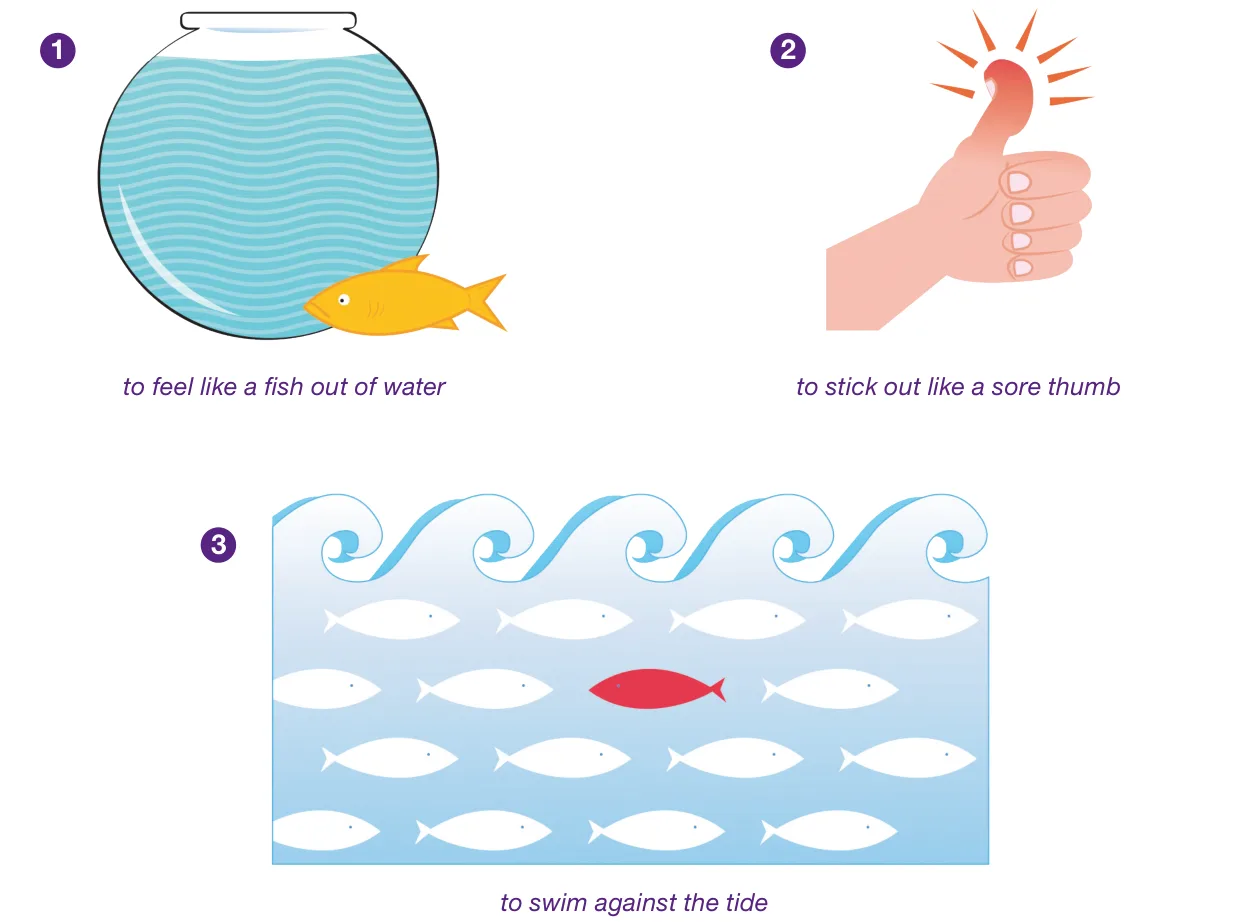
Look at three more idioms. Then match them with their meanings. In what situations do you think they might be used?
- to feel like a fish out of water
- to stick out like a sore thumb
- to swim against the tide a to think or act differently from others _ b to feel that you are not in your natural place c to look very different from other things or people __
Complete the sentences with the idioms in Activity 1. (You may need to change the form of the verb.)
- Everyone else agreed with the plan. He seemed to be the only one who thought there was a problem with it. He didn't say anything in the end because it's hard to ___ .
- All the other people at the party were experts in their fields. I couldn't join in their conversations because I didn't understand what they were talking about. I ___ .
- She was late and had to go to the restaurant straight from work, in her normal clothes. When she got there, she saw that the others were all dressed in their best evening dresses. She was sure she ___ .
Look at the pictures. Then match the beginnings and endings of the proverbs.
- When in Rome,
- You can't put a square peg
- Birds of a feather
a. flock together.
b. do as the Romans do.
c. into a round hole.
Match each proverb in Activity 3 with the situation it might be used to describe.
- I don't really like tea, but I used to drink it at 'tea time' when I was in England.
- You can tell he's not a good person by looking at the kinds of people who are his friends. ___
- She loved art and poetry, but her father wanted her to be a doctor. She tried, but it didn't work, and now she's a well-known painter. ___
- Do you agree with what the proverbs are saying about life?
- Are there any similar proverbs in Arabic?

