
The topic explained
UNIT 3 The global village; Period 1 / Reading and comprehension; Period 2 / Reading and comprehension; Period 3 / Reading and comprehension; Period 4 / Reading and comprehension
UNIT 3 The global village
The global village: how old are these words?
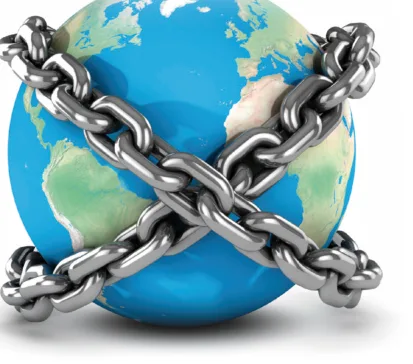
Look at the pictures. Then discuss the questions below in pairs or small groups.
Have you heard of the words global village and globalisation? When do you think they began to be used?
about ten years ago about twenty-five years ago over fifty years ago
Which picture gives a positive impression and which gives a negative impression? What message do you think each picture is trying to give?
Period 1 / Reading and comprehension
Meanings from the text, and true or false
Choose the correct meaning for these words and phrases from the text.
- term (line 1) A name for an idea
B period of time
- transforming (line 2) A taking from one place to another
B completely changing
- widely (line 5) A not exactly
B commonly, often
- the chances are (line 13) A it is likely
B there are opportunities
- see the point (line 13) A understand the idea
B know the purpose
- Far from (line 13) A Instead of
B A long distance from
Use the words and phrases in Part 1 to complete the sentences.
- We’ll never succeed, so I don’t ___ of continuing.
- He left home an hour ago, so ___ that he’ll be here soon.
- She’s a popular singer in her own country, but not ___ known outside it.
- A lot of money was spent on ___ the land into a children’s play area.
- ___ criticising his ideas, I strongly agree with most of them.
- He may use a different ___ to describe it, but he’s really talking about the same thing as other writers.
‘The term global village was first popularized in the early 1960s.’ The suffix -ize (or -ise) changes an adjective into a verb and adds a meaning. To globalize (something) is to become or to make something more international. What does the verb popularize mean?
Decide whether the statements are TRUE or FALSE. Write the phrase or sentence from the text that helped you to decide.
The writer seems to think Marshall McLuhan’s idea was ahead of its time.
The word globalisation was widely used from the 1940s onward.
Young business students often think globalisation isn’t worth discussing.
Discuss the question in pairs or small groups.
How has globalisation affected your lives as young people?
Period 2 / Reading and comprehension
Is globalisation really something new?
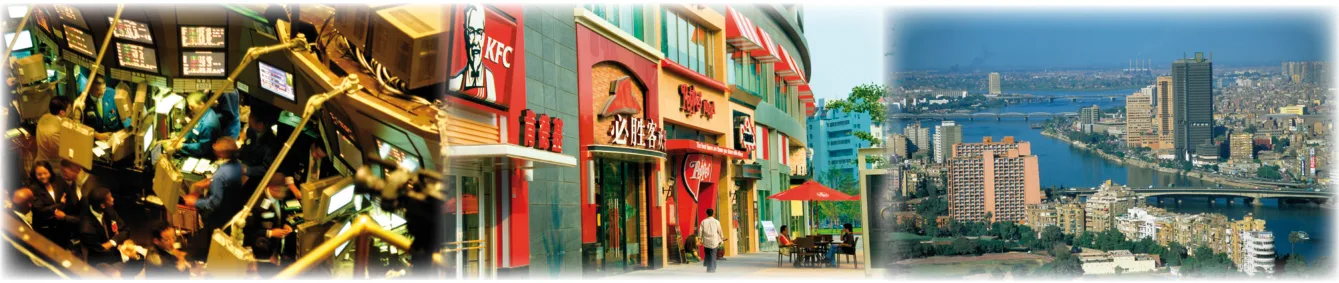
- What do the pictures show?
- How do you think the pictures might be connected with the topic of globalisation?
- Which effects of globalisation do the pictures show?
‘[They were] searching for cheap raw materials. They transported these back to their own factories and produced manufactured goods.’ Add these words to the table in the correct column . (One word can go in both columns.) coal paper cotton silver plastic glass wood RAW MATERIALS MANUFACTURED GOODS
‘The world became linked by trade and business.’ ‘The key role is that of computer technology.’
- Link and key are both normally used as nouns. What kind of words are they used as in the text?
- In what way can trade link the world?
- If something is described as a key part / point / question, etc., is it just important or the most important thing?
Find these words in the text. Then choose the correct meaning for each one.
- underestimates (line 6) A gives too little importance to
B falls below
- taken place (line 7) A been replaced
B happened
- vast (line 9) A unusual
B very large
- currency (line 9) A at the moment
B money used by a particular country
- entire (line 13) A whole
B early
Use the words in Part 3 to complete the sentences.
- They travelled for weeks through the ___ desert.
- I need to get some foreign ___ before my long business trip.
- He always ___ how long it takes to finish the work.
- My grandfather lived in the same village for his ___ life.
- A lot of changes have ___ in the town since we moved here.
What makes recent changes different from what has happened before?
Why is technology so important to these changes?
What disadvantage of instant currency movement does the text mention?
Why is globalisation important for everyone?
What do these words, highlighted in the text, refer to?
- even earlier (line 2) [earlier than when?]
- these (line 4)
- them (line 5)
- these changes (line 7) [which changes?]
- it (line 8)
Which sentence is the best summary of what the text says about globalisation?
A Globalisation is simply a continuation of what was already happening hundreds of years ago.
B Despite what some people argue, there are important differences between recent developments and what happened in the past.
C The main advantage of globalisation is that it has made trade much easier and quicker.
Global culture, food and the Big Mac index
Period 3 / Reading and comprehension
Look again at the last paragraph of the article in Period 2. Then discuss the questions below in pairs or small groups.
What effects has globalisation had on everyday life in Palestine? Think about:
food ▸ culture ▸ entertainment shopping ▸ family life
Of all these effects, which are positive, and which are negative?
POSITIVE NEGATIVE
Read the continuation of the article. Which of the effects you discussed are mentioned?
Answer the questions.
What can now be bought in shops around the world?
What does the example of Nelson Mandela show?
What, it appears, cannot be prevented?
Which phrase means ‘the same thing happening as in the past’ (paragraph 3)?
What do people still argue about, even though they agree that globalisation is different from what has happened before?
Discuss the questions in pairs or small groups.
Do you listen to rap or hip-hop music? Is there an Arabic or Palestinian version of this kind of music?
Can you explain how the ‘Big Mac index’ compares the purchasing power (how much can be bought) with different currencies?
What is your answer to the two either/or questions at the end of the text?
Read about the author of a book called Globalization and its Discontents*. From the title of the book, would you expect it to be for or against globalization?
Period 4 / Reading and comprehension
Two online reviews of the book
The writer of the first review didn’t give five stars because he knows there are better books available.
The first reviewer suggests that globalisation works in favour of rich countries and large companies.
The first reviewer says that the book was written mainly for specialists in this subject.
The second reviewer suggests that the book’s title is not a good one.
The reviewers agree that only other economists would fully understand the book.
Both reviewers seem to be against globalisation.
The verb reform means to change something that is not working properly. Which two ways does the first reviewer use to suggest that this isn’t the best way to describe the economic changes recommended by the World Bank and IMF?
In what way does Joseph Stiglitz have ‘inside knowledge’?
What two areas does the second reviewer think are missing from the book?
The second review ends with a question. What answer do you think the writer expects?
Discuss whether this sounds like a book you would like to read (if there was a translation into Arabic).
It sounds too technical for me. I’ll find something else on this topic.
It’s good to read an expert’s opinion so I’d be interested in reading it.

