
The topic explained
Period 6 / Writing skills; Period 7 / Writing; In this Unit you have learnt about:
Period 6 / Writing skills
- New Year customs in different countries
- making and keeping resolutions
- dealing with unfamiliar vocabulary
- question words with the suffix -ever
- words with the prefix under-
- describing people with compound adjectives like dark-haired
- phrasal verbs with away and other particles
- compound adjectives made from nouns + -ing forms
- joining information in sentences
- writing advice letters
Joining information in sentences
- Examples:
- A New Year is a time for families to get together and people often travel long distances to be with their families.
- B It can last as long as two weeks, starting on the first day of the month.
- C Another custom, which is less popular now, is 'first-footing'.
- D To help you succeed, you need to include other people.
- Use a mixture of different ways to join the information, for example:
- relative clauses with which and who
- infinitive and -ing phrases
- conjunctions like so, but, because, when
- The sign [+] shows where sentences can be joined.
Look at the examples of ways of joining information in sentences. Then answer the question.
Which example relates to which description of sentence structure?
- a main clause with a relative clause Example ___
- two clauses joined with a conjunction Example ___
- a clause plus an -ing phrase Example ___
- a clause plus an infinitive phrase Example ___
Read the letter. Then rewrite it, joining the short sentences into longer ones.
Use a mixture of different ways to join the information
When you have finished, compare your letter with a partner.
Period 7 / Writing
Writing an advice letter
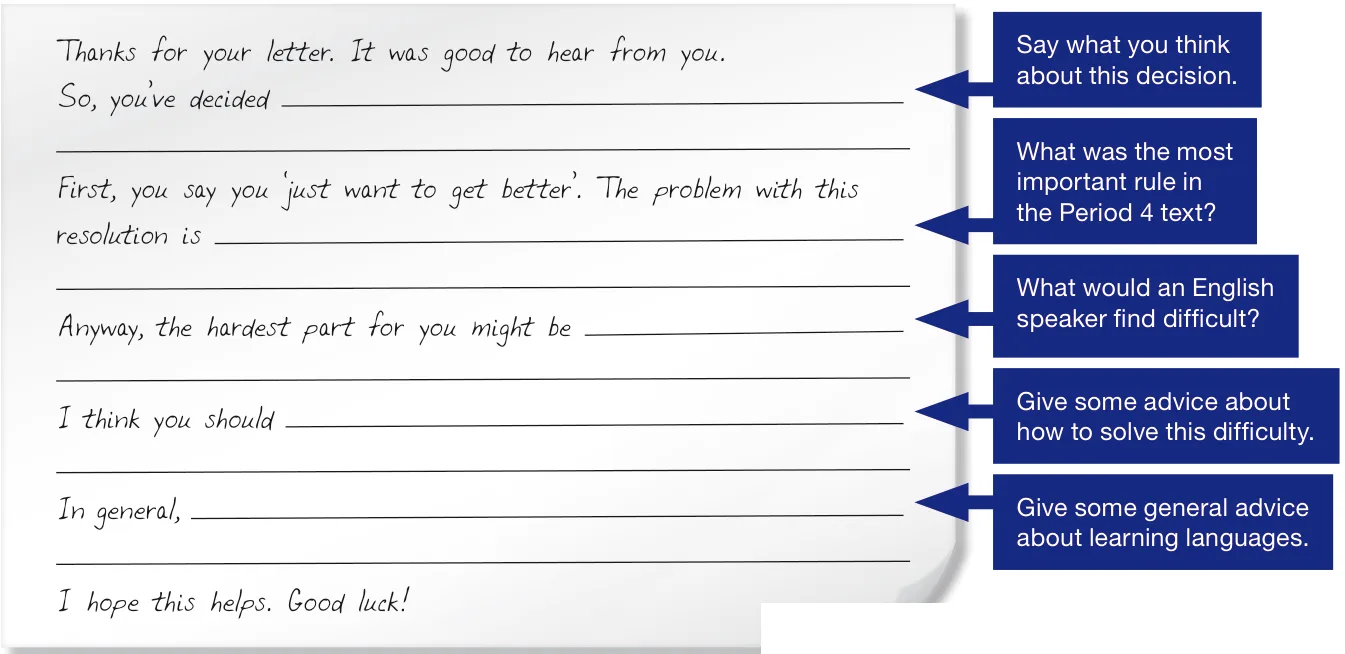
- Write a reply to the letter, using ideas from your discussion and advice from the text in Period 4.
- Thanks for your letter. It was good to hear from you.
- So, you've decided ___
- First, you say you 'just want to get better'. The problem with this resolution is ___
- Anyway, the hardest part for you might be ___
- I think you should ___
- In general, ___
- I hope this helps. Good luck!
- Think about a resolution you might make for the future. Then complete the plan.
- Resolution: I want to ___
- My goal: ___
- Steps toward the goal: ___
- What could go wrong: ___
- My chance of success (%): ___
Discuss the questions in pairs or small groups.
An English-speaking friend wants to learn Arabic.
What do you think English speakers might find most difficult about Arabic?
What is the best way to learn it?
What other advice would you give?

