
The topic explained
UNIT 4 Money talks; Period 1 / Reading and comprehension; Period 2 / Reading and comprehension; Period 3 / Reading and comprehension; Period 4 / Reading and comprehension
UNIT 4 Money talks
Four sayings about money
Which of the quotations above have these meanings?
A All bad things in the world come from money.
B Nothing important happens without money.
C With money you can get people to do what you want.
Which pair of quotations gives a positive view of money, and which two are negative?
How true do you think the quotations are?
Four news stories about money
Read the newspaper headlines. Then discuss what the stories might be about in pairs or small groups.
Read the first paragraph of one of the news stories. Then match it with its headline in Activity 2.
Replace the underlined parts of the sentences with words from the text. (The sentences are in the same order as the words in the text.)
- All the workers were given extra payments when company profits went up.
- I don’t mind paying a reasonable amount, but this is too much.
- All companies need to be able to be equal to or better than others.
- You’d better take your bag with you. If not, someone might take it.
- This is just one of her many special abilities.
- If customers can’t get what they want, they’ll go to another place.
Read the first paragraphs of the other three news stories. Then match them with their headlines in Activity 2. Were your ideas about the stories right?
The stories and headlines use synonyms (words with similar meanings) to avoid repetition. Match the pairs of synonyms (1–7 with a–g).
Words: 1 proof · 2 employees · 3 prediction · 4 cuts · 5 drop · 6 divide · 7 boss.
Matches: a fall · b gap · c evidence · d forecast · e chief · f staff · g reductions.
Decide whether the sentences are TRUE or FALSE. If there is not enough information to decide, choose DOESN’T SAY.
- The bank chief doesn’t care about the problems of poorer people.
- The FESR believes that the gap between rich and poor has reached its widest point.
- The Finance Minister said that the government’s aims hadn’t been achieved yet.
- The fall in share prices was caused by lack of confidence.
Discuss the questions in pairs or small groups.
- What effect does it have on society if there is a large gap between the rich and the poor?
- How might government spending cuts affect people’s daily lives?
- Why are falling share prices seen as dangerous for the world’s economy?
- Which opinion below do you agree with most? Why?
It’s not fair that top business people should be paid so much extra just for doing their jobs when other people have so little.
If companies think they need to pay extra to keep good staff, it’s no business of the government to try to stop them.
Period 2 / Reading and comprehension
From cowries to contactless: how money developed
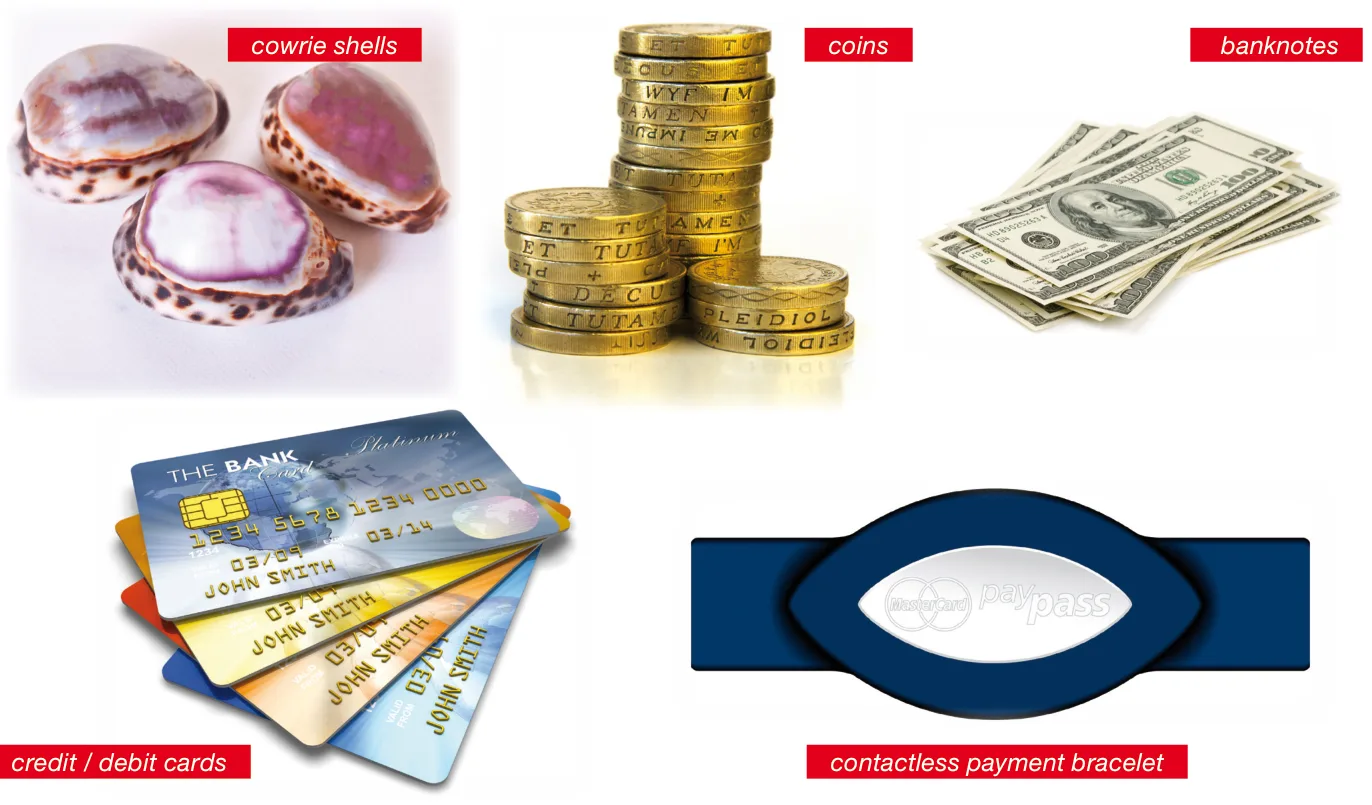
Look at the pictures. Then discuss the question below in pairs or small groups.
What do you think is the connection between the five pictures?
The pictures: cowrie shells · coins · banknotes · credit / debit cards · contactless payment bracelet.
Five sentences have been removed from the article. Write the missing sentences in the correct blanks.
A It didn’t have to be something that they needed, just something desirable.
B But this only worked on two conditions.
C More recent developments have moved even further in this direction.
D This is why it is known as representative money.
E Other countries soon followed, making their own coins with agreed values.
Choose the best title for each paragraph.
A No value in the materials
B The beginning of money as we know it
C Towards unreality
D What is money?
E Different examples of ‘money’
F Before money
Choose the best way to continue the sentences. Circle A, B or C.
- Bartering is described as
A the earliest form of money.
B only used by particular societies.
C a trading system with certain problems.
- Salt could be used as currency because
A it was something most people wanted.
B it could be found almost anywhere.
C it was easy for people to carry around.
- The main point that the text makes about paper money is that
A it was first made in China.
B it has no value as a material.
C it is difficult to copy exactly.
- The text suggests that the history of money is
A an important subject for economists.
B a series of steps that move away from real life.
C the story of the development of early human societies.
Discuss the questions in pairs or small groups. What type of money do you use most often? Why?
I’ve got a card, but I don’t use it much. I prefer paying in cash.
I normally use my card because it’s easy, but I never write cheques.
Period 3 / Reading and comprehension
W.H. Davies: when money brings false friends
Read about a poet. Then answer the questions below.
- What kind of man does W.H. Davies seem to be, and what kind of life did he have?
- What do you think the lines from his famous poem mean?
Read the poem. Then discuss the questions on page 61 in pairs or small groups.
- Why does the poet describe the people who knock at his door as ‘false’?
A They had chosen the wrong door by mistake.
B They could not be trusted as real friends.
- In the second verse, he compares himself as a man with money to a child who has a trumpet that he isn’t brave enough to blow. What is it that he felt he couldn’t say?
A His ‘friends’ were not really friends at all.
B Someone he knew had died.
- What do you think he means by saying that poor men don’t need to ‘go up’, but rich men ‘should come down’.
A It is unfair that some people have so much more than others.
B It would be better if rich people had less money.
- Do you think the last line sounds
A happy?
B sad?
- Looking at the poem and the life of the poet, do you think his opinions were based on
A other people’s experiences?
B the poet’s own experience?
Read the quotation from an article. Then discuss the questions in pairs or small groups. (You will read the whole article in Period 4.) ‘It seems that a lot of people have forgotten something that nearly everyone used to think was obvious: money and happiness are not the same thing. I hesitate to write this, because someone will say that I am romanticising poverty.’
- If you romanticise something, you give an unrealistic picture of it, making it seem nicer than it really is. Who is more likely to ‘romanticise poverty’ – a rich person or a poor person?
- Do you think W.H. Davies can be accused of ‘romanticising poverty’ in his poem?
How would you say these lines in modern, conversational English?
- For many a false man as a friend came knocking all day at my door.
- Much have I thought of life.
- Poor men, think I, need not go up.
Period 4 / Reading and comprehension
Is more money more happiness?
Read the text. Then choose the best title for the article.
A Poor but happy
B The true meaning of happiness
C How much is enough?
Phrases 1–6 are used to introduce sentences and show the writer’s attitude. Match them with their meanings a–f.
Phrases: 1 To be honest, · 2 Obviously, · 3 Admittedly, · 4 Put simply, · 5 Personally, · 6 Generally speaking.
Meanings: a Others may think differently · b This may not be true in all cases · c Of course · d I’m telling the truth · e This is the basic meaning · f I accept.
Check your answers. Then add the phrases to the text in the correct places.
- The price of oil reached its highest point two years ago, but then began to fall.
- The number of people feeling satisfied with their lives is becoming less.
- Poverty is often connected with lack of education.
- Most people want to have friendly contact with others at some times in their lives.
- Being rich is no guarantee that you will have a happy life.
- There are various kinds of habits that are hard to stop, like shopping, computer games or eating chocolate.
Look at the examples from the article. Then answer the questions below.
Why do people still spend so much time and effort on getting richer?
How many homes can you live in at any one time?
The only explanation I can come up with is that it is a kind of addiction.
- Which question is the third sentence an answer to?
- What might the answer be to the other question?
- Why doesn’t the writer give this answer?
Look back at the poem in Period 3. Then discuss the questions in pairs or small groups.
- Which opinions in the article are similar to those in the poem?
- Do you agree that poor people are usually happier than rich people?
- What are the ‘basic human needs’ referred to in the second paragraph of the article?
- Why do you think some people feel the need to make more and more money?
I agree with the writer of the article. They just can’t stop.
Maybe they feel that they need more money to make the future safer.

