
The topic explained
UNIT 1 Making changes; What to do with words you don't know; Reading skill reminder; Period 1 / Reading and comprehension; Period 2 / Reading and comprehension; Period 3 / Reading and comprehension
UNIT 1 Making changes
New Year around the world: three short texts
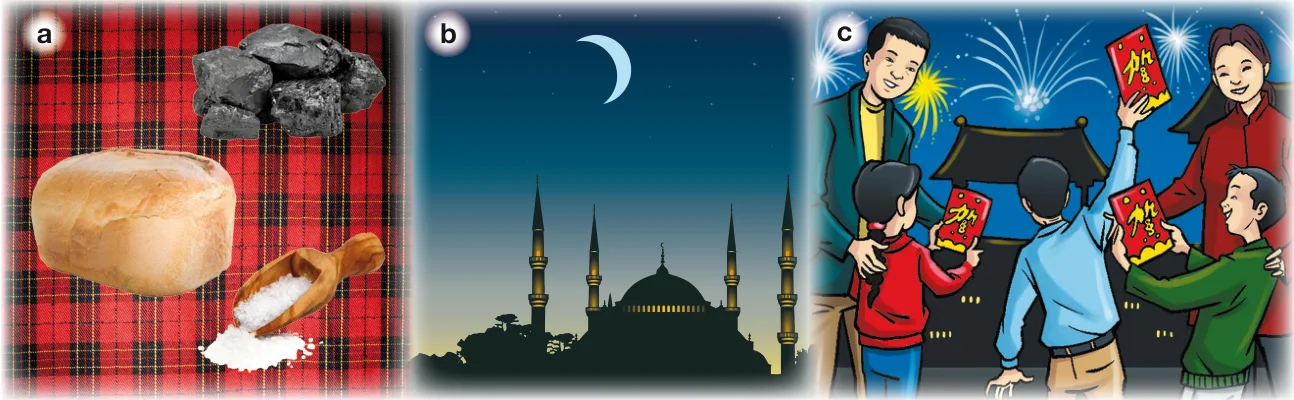
Read the texts. Then look at the pictures and discuss the questions in pairs or small groups.
Which picture goes with which text? Text 1 _ Text 2 Text 3 __
What do the pictures show?
Which countries do you think the texts might be about?
What to do with words you don't know
New word? Keep reading before you reach for a dictionary
- Keep reading: when you find a new word in a text, it is usually best to continue reading at first.
- Ask yourself: can you understand the sentence without knowing what the word means?
- Then guess: if necessary, try and decide more or less what the word means instead of immediately looking in a dictionary.
Do you know what 'first-footing' is in Text 2?
Can you understand the sentence without knowing what it means?
Reading skill reminder
Five questions that help you work out a new word
- To help you decide what a new word in a text means, ask yourself questions like these:
- Kind of word: what kind of word is it (noun, verb, etc.)?
- Noun: is it singular, plural, uncountable?
- Adjective: does it seem to be positive or negative?
- Word family: does it (or part of it) look like a word you already know?
- Clues: are there any other words in the sentence that help to explain it?
Period 1 / Reading and comprehension
Chinese New Year: red for luck, families together
Decide more or less what the missing words in the sentences mean, using the questions in the reminder box.
Children are sometimes frightened of the ___ that people wear.
It was ___ outside, so we lit the fire and stayed inside.
What I like about her is her ___ to other people.
He was ___ to find that they'd gone without him.
Some of the other students ___ me for not knowing the answer.
Look at these words from the texts on page 4. Decide which meaning makes the best sense in the sentence.
lunar (Text 1) A connected with the moon B a fixed time or period
occasion (Text 2) A to happen B a special time or event
mark (Text 3) A a cross or tick made with a pen or pencil B to show that something is different from normal
joint (Text 3) A connected B not individual
gratitude (Text 3) A thanks B greatness
'Red is the symbol of fire.' What do you think a symbol is?
A a small piece of something larger B something that stands for an idea
C a thing which is the same as something else
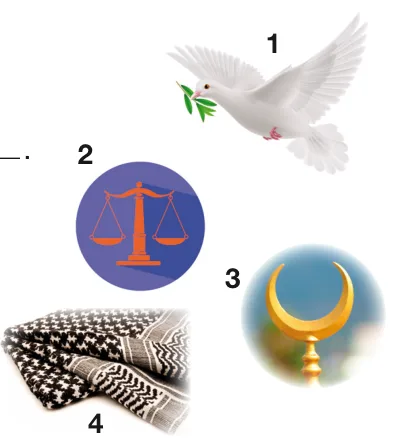
Work in pairs or small groups. Discuss what symbols 1-4 stand for. What do they symbolise?
The dove carrying an olive branch symbolises ___.
The balanced scales symbolise ___.
For Muslims, the crescent symbolises ___.
For Palestinians, the kuffiyeh symbolises ___.
Compare your ideas with other pairs or groups.
Period 2 / Reading and comprehension
Scotland and Egypt: first-footing and the Hijra
Replace the underlined parts of the sentences with words or phrases from the text. (The sentences are in the same order as the words in the text.) I'm not sure how much I have borrowed and need to pay back to my parents.
At this time of year, performing groups of dancers, etc. visit the town.
He wrote several poems expressing admiration for God.
This event takes place in order to remember the life of a national hero.
'A lot of the New Year "traditions" in countries like England, Australia and the USA are actually Scottish in origin.' The phrase Scottish in origin means that
A the traditions first started in Scotland.
B the traditions came to Scotland from other countries.
The writer puts inverted commas round the word 'traditions' to show that
A the word is a quotation from somewhere else.
B the customs don't really come from the countries mentioned.
'These include joining hands and singing.' The phrase joining hands means:
A putting your hands together.
B holding the hands of other people.
'Although modern technology now makes it possible to know this well in advance, the new moon should be observed with the naked eye.' The phrase well in advance means
A a long time before.
B making good progress.
The phrase with the naked eye means
A see something using glasses
B see something without using a telescope
'Whatever culture you look at, there seems to be one idea that underlies many of the New Year customs.' Adding the suffix -ever to question words like what, where, when or how adds the meaning that:
A it doesn't matter what / where / when / how.
B the question what / where / when / how changes with time.
Complete the sentences with similar ...ever words.
a ___ hard I tried, I couldn't open the door.
b You can visit me ___ you want to. I'm free all week.
c I take this book with me ___ I go.
d You should try your best, ___ you do in your life.
Adding the prefix under- can add either of these meanings: at the level below or not enough. Which meaning does it add in these sentences?
a One idea underlies many New Year customs.
b Don't undervalue your work; it's better than you think.
c Many large cities have an underground railway system.
d You can mark important points by underlining them.
e I think I'm underpaid for all the work I do for my company.
What do these words, highlighted in the text, refer to?
These (line 2)
it (line 5)
this (line 13)
one (line 20)
What examples can you find in the text of customs that show the ideas of 'a new beginning' and 'leaving a period behind'? Can you think of any other examples?
Period 3 / Reading and comprehension
Resolutions: what people promise themselves
| WORDS AND PHRASES FROM THE TEXT | MEANINGS |
|---|---|
| 1 in favour of | a fell |
| 2 dropped | b succeeds in reaching or doing |
| 3 reflects | c preferring |
| 4 makes it | d relates to, is connected with |
Why do you think New Year is traditionally a time for making resolutions in many cultures?
What do you think the two quotations are saying about resolutions?
'I think in terms of the day's resolutions, not the years'.
Henry Moore (British artist) 'Every time you tear a page off a calendar, you present a new place for new ideas and progress.' Charles Kettering (US inventor)
In 2013, a website produced a list of the most popular 'New Year's resolutions' in the UK.
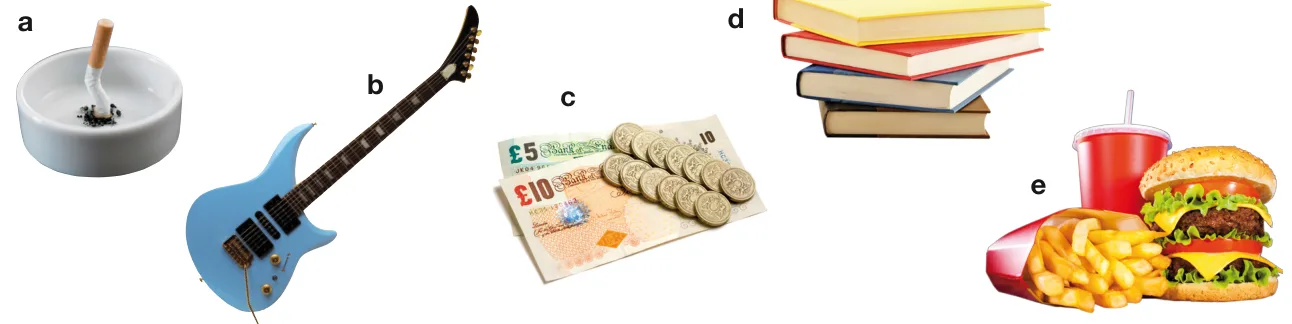
Look at the list of the top ten resolutions, in which the order has been changed. What do you think might be the correct order?
Eat better 1 _ Learn a musical instrument 2 Stop smoking 3 Read more 4 Spend more time with friends and family 5 Get a better job 6 Learn a new language 7 Spend less money 8 Exercise more 9 Spend less time texting and chatting online 10 _
Match the words and phrases from the text with their meanings.
Use the words and phrases in Activity 3 to complete the sentences, changing the form if necessary.
During the night, the temperature sometimes ___ by 20 degrees in desert areas.
To get fit, some people stop taking lifts ___ using the stairs.
Climbing the mountain was hard, but we finally ___ to the top.
His opinions ___ the fact that he had a difficult childhood.
Why do you think 'spending less money' has become the most popular resolution?
According to the text, why do fewer people than before choose to stop smoking? Can you think of a reason not mentioned in the text?
Of the top ten resolutions, which one would improve your life most?
Are there any resolutions you might make that are not included in the list?
Period 4 / Reading and comprehension
New Year, New You: five steps to keep a goal going
Replace the underlined parts of the sentences with words or phrases from the text. (The sentences are in the same order as the words in the text.) I always connect this song with the holiday we had two years ago.
It's easy to make resolutions, but harder to not change your mind about them.
Unfortunately, my birthday is at the same time as the end of the holidays.
When I started, I felt that everything would be fine.
She wants to start a new hobby, but she isn't sure what to choose.
He's just started playing the guitar and is full of a strong positive feeling.
What two things, according to the article, are wrong with the idea of 'New Year's resolutions'?
What do you think the rest of the article is going to do?
A explain more about the points in the first paragraph
B give some helpful advice to readers
C make some new points about doing new things
Read the rest of the article. Then put the titles below into the correct position (1-5).
One step at a time | Enjoy yourself | Think negative | Share it | Set clear goals
Discuss the questions in pairs or small groups.
When you decide to take up something new, are you the kind of person that sticks to it, or the kind of person that might give up after a time?
Which of the pieces of advice in the article do you think might be helpful when learning a language?
I'd like to say I stick to resolutions, but I think I might be a bit lazy.
I like the idea of including other people. I think that would probably help a lot.

