
تجاوز إلى المحتوى الرئيسي
TawjihiAI: دراسة التوجيهيادرس وتدرّب من هاتفكحمّل التطبيق
Topics

⁦1.4⁩ Looking Good Reading and Vocabulary

Textbook

From the English Language curriculum

In this topic (3)

I can understand the main idea and identify specific details in an article and talk about stereotypes.

LESSON 4A READING AND VOCABULARY

1 SPEAKING In pairs, talk about your favourite/least favourite clothes and accessories. Why do you like/dislike them?

2 In pairs, look at the photos, the captions and the title of the article on page 9. What do you think it is about?
3 Read the article and choose the correct answers. 1 In the first paragraph, what does the writer say about how we judge appearances? a We are not aware of how much appearances affect our decisions. b First impressions are usually wrong. c We always make decisions based on physical characteristics. 2 Which statement is true about the experiment in the second paragraph? a Participants in different countries rated people differently. b We only judge the characters of people we know. c We trust mature people more. 3 In the third paragraph, what does the writer suggest? a People who wear glasses are more intelligent. b We often believe stereotypes. c People who wear uniforms are better listeners. 4 How can putting on a white coat influence you? a It can make you believe you’re a doctor. b It can help you concentrate better. c It can help you control other people. 5 What would be the most suitable sub-heading for this article? a Some stereotypes are false, but the way people look tells us a lot about them. b The way we look affects what people think of us and how we feel and behave. c Studies show it’s better to dress well if you want to be successful in life.

4 In pairs, rewrite these statements using the highlighted phrasal verbs and phrases from the article. 1 I admire people who work hard to achieve their goals. I look up to people who work hard to achieve their goals. 2 I don’t think it’s right to consider yourself better than people who don’t care about high-status jobs or titles. 3 I’d like to start my own research company one day. 4 I often make a mistake when I don’t take the time to listen carefully. 5 I think that challenging situations can make people’s best qualities more noticeable.

5 Study Watch Out! and rewrite sentences 1–4 using compound adjectives. 1 I’ve got broad shoulders and curly hair. 2 I can’t decide whether to wear a shirt with short sleeves or long sleeves. 3 My hair is short, but my friend has long hair. 4 My eyes are blue and my sister’s are brown.

> ### WATCH OUT!

We can use compound adjectives to describe clothes and people. If a person has grey hair, we say he/she is grey-haired. If a person is neither young nor old, we say he/she is middle-aged.

6 SPEAKING How do these make you feel? a uniform a white coat casual clothes formal/smart clothes glasses sunglasses

7 REFLECT | Values Appearance is not important. It’s what’s inside that counts. Do you agree? Discuss in groups.

8 WRITING What does the expression ‘Never judge a book by its cover’ mean?

□ I can understand the main idea and identify specific details in an article and talk about stereotypes.

The power of appearance

When we see someone for the first time, our brains instantly notice things like their age, hair, eye and skin colour or height and voice, and we use this information to make assumptions about their education, social position and character. Without realising it, we then make important decisions – such as who to vote for, who to give a job to or who to trust – based on these assumptions.

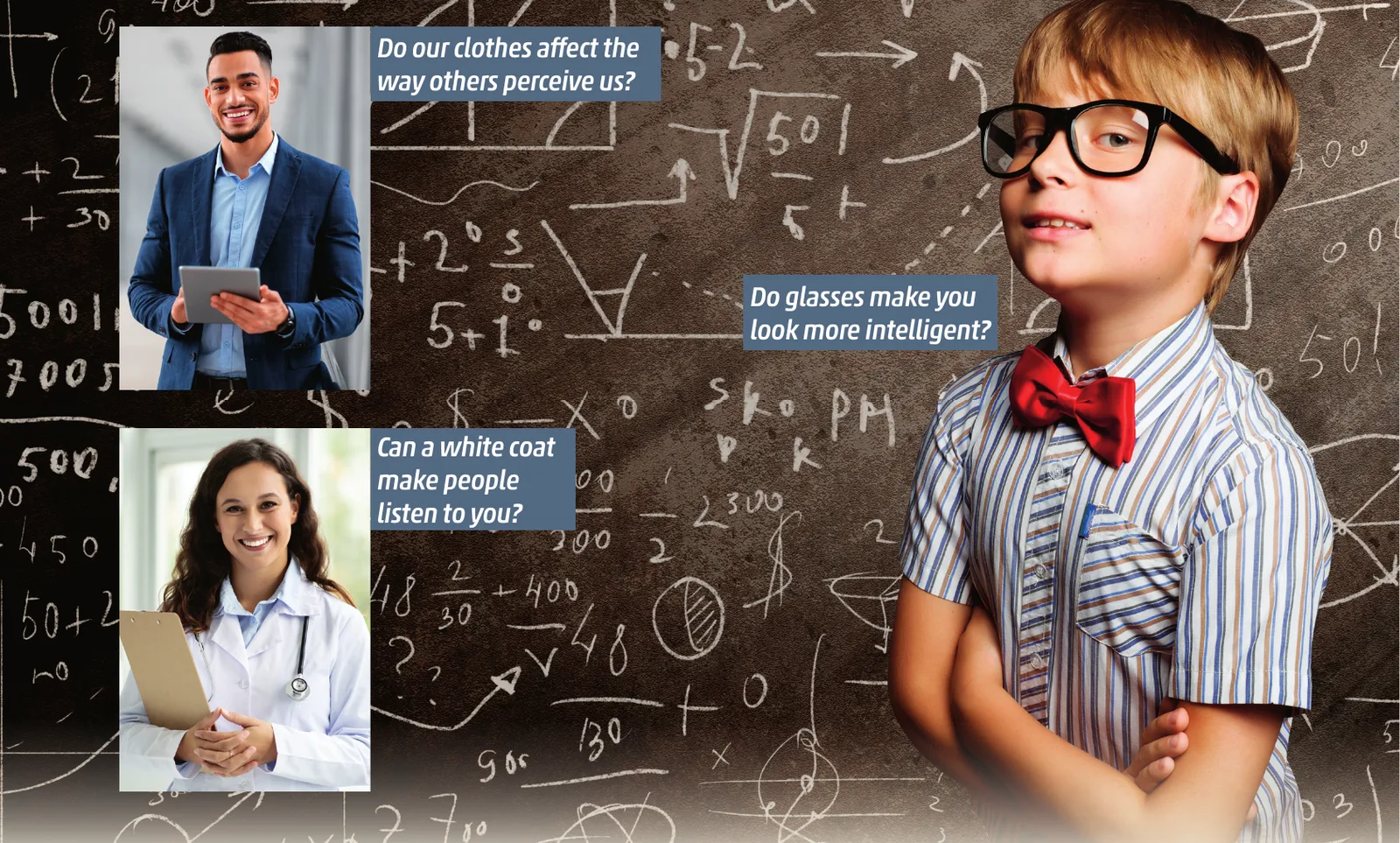
A few years ago, social scientists set up an experiment in 45 different countries, in which people had to guess what 120 individuals were like based on pictures of their faces. The results showed that in every region of the world, people rated men and women over 40 as more confident, responsible, sociable and reliable. There are also studies that show that we perceive grey-haired individuals as wise or mature, or people who wear glasses as intelligent.

The way we dress also has an impact in situations such as school, social occasions or work. We often look up to someone who is very well-dressed and look down on those who don’t dress as smartly. We show more respect to people in uniforms and are more likely to listen carefully to a doctor when he or she is wearing a white coat instead of casual clothes.

The clothes we wear don’t just affect what others think of us; they also affect how we feel about ourselves. In one fascinating experiment, scientists showed that if you wear a white coat that you believe belongs to a doctor, your ability to pay attention increases sharply. Apparently, wearing what you think is a doctor’s coat can bring out the best in you! However, if you wear the same white coat believing it belongs to a painter, there’s no improvement in your ability to concentrate. As the scientists behind the experiment stated, ‘The clothes we wear have power not only over others, but also over ourselves.’

So our physical appearance and clothes influence the opinions people have of us and their behaviour towards us. This can sometimes make them use unfair stereotypes and get it wrong. But it seems that the clothes we wear also have a powerful effect both on how we feel and how we act. Perhaps that’s worth remembering the next time you’re trying to decide what to wear.

Keep reading this subunit

Sign up free to read the rest of this subunit; we bring you back here.

  • > ### WATCH OUT!
  • The power of appearance
Start freeLog in

Last updated:

A preview of “Looking Good Reading and Vocabulary” from the unit “Looking good” in English Language: 3 lesson sections, 3 definitions.

Source: National Center for Curriculum Development, 4A Reading and Vocabulary (pp.10-11)

More in this unit

Continue studying
