تجاوز إلى المحتوى الرئيسي
TawjihiAI: دراسة التوجيهيادرس وتدرّب من هاتفكحمّل التطبيق
Topics

⁦10.1⁩ Food for Thought Vocabulary and Grammar

Textbook

From the English Language curriculum

In this topic (4)

I can use modal verbs to speculate about the present.

10 Food for thought

VOCABULARY Food tastes, cooking instruments and instructions, phrasal verbs, healthy eating LISTENING A radio discussion about healthy eating GRAMMAR Modal verbs for speculating about the present and the past READING Reviews of unusual restaurants SPEAKING Comparing and contrasting photographs WRITING A formal letter PRESENTING AND VIEWING Comparing photos for a student campaign

LESSON 1A VOCABULARY AND GRAMMAR

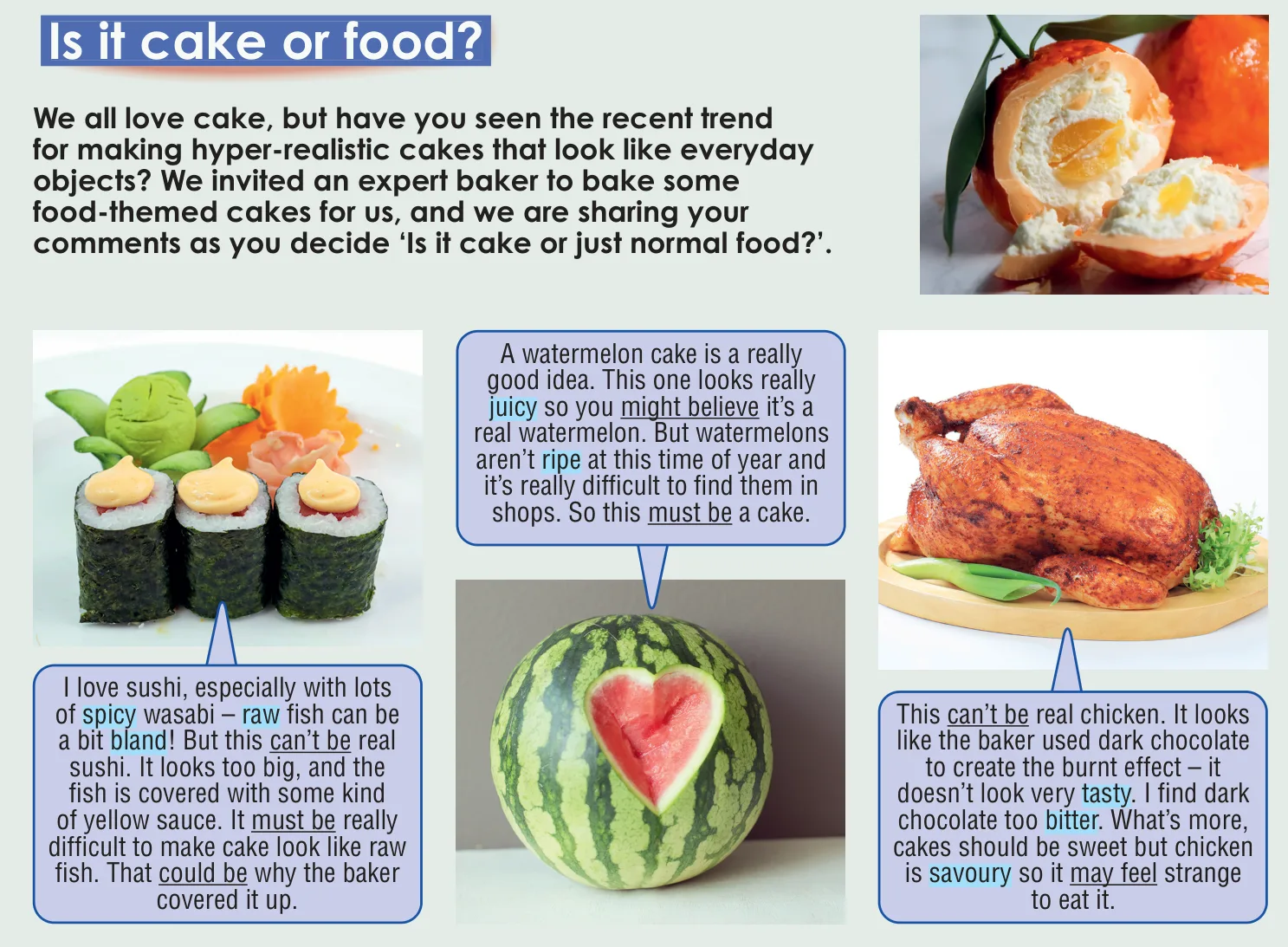
1 Read the introduction to the text and look at the pictures. Decide if each image is cake or real food. Say why.

2 Read the comments. Do you agree or disagree with each one? Say why.

3 Use a dictionary to check the highlighted words in the comments. Then think of one or two types of food that can be described with each word. Juicy - oranges, chicken Savoury - cheese, chips ...

Is it cake or food?

We all love cake, but have you seen the recent trend for making hyper-realistic cakes that look like everyday objects? We invited an expert baker to bake some food-themed cakes for us, and we are sharing your comments as you decide 'Is it cake or just normal food?'.

A watermelon cake is a really good idea. This one looks really juicy so you might believe it's a real watermelon. But watermelons aren't ripe at this time of year and it's really difficult to find them in shops. So this must be a cake.

I love sushi, especially with lots of spicy wasabi - raw fish can be a bit bland! But this can't be real sushi. It looks too big, and the fish is covered with some kind of yellow sauce. It must be really difficult to make cake look like raw fish. That could be why the baker covered it up.

This can't be real chicken. It looks like the baker used dark chocolate to create the burnt effect - it doesn't look very tasty. I find dark chocolate too bitter. What's more, cakes should be sweet but chicken is savoury so it may feel strange to eat it.

What do you think? Write in and tell us your views. Modal verbs for speculating about the present

4 Match the underlined parts of sentences 1-5 with the meanings a-c. 1 □ This must be real bread. □ I can't believe this is a cake. 3 □ It may taste ok. 4 □ You might believe it's a real watermelon. 5 □ That could be why the baker covered it up.

a It's possibly true. b It's almost certainly true. c It's almost certainly impossible / not true.

5 Study the grammar box and Watch out! Then find more examples of modal verbs for speculation in the comments on page 48.

Modal verbs for speculating about the present To speculate about the things in the present we use must/could/might/may/can't + the infinitive or be + -ing. must = we are almost certain something is true could/might/may = we think something is possibly true (might is slightly less probable than could/may) can't = we are almost certain something is impossible/not true Grammar Reference > page 73


> WATCH OUT!

When we speculate, the negative of must is can't, not mustn't. It must be true. (I'm sure it is.) No, it can't be true. (I'm sure it isn't.) NOT It mustn't be true.

6 Choose the correct options in the texts below.

The chef is sweating and looks very unhappy. I'm not sure why. It ¹can't / might be too hot in the kitchen. Or he ²could / must have too many dishes to prepare. Or he ³may / mustn't just feel stressed. Whatever, he ⁴can't / must wish he was somewhere else.

The customer at table 4 has her eyes closed but she ⁵can't / must be sleeping because she's half way through eating her meal. She ⁶could / must be so impressed by the flavour that she closed her eyes to focus, that's one possibility. Some people say that food ⁷can't / may taste better like that.

The baker ⁸can't / must feel very proud. Her cake looks and tastes amazing. I'm sure she ⁹can't / may lose this baking competition.

7 Complete the second sentence so that it means the same as the first one. Use the modal verbs from the Grammar box. 1 It's possible the restaurant is closed now. The restaurant may be closed now. 2 I'm sure this isn't the same recipe we used last time. This __ the same recipe we used last time. 3 I'm sure the chef doesn't want the dish to be bland. The chef _ the dish to be bland. 4 It's possible avocados are ripe at this time of year. Avocados _ ripe at this time of year. 5 I'm sure the chef is trying hard to prepare the food quickly. The chef __ hard to prepare the food quickly.

8 SPEAKING In pairs, use modal verbs to speculate about your family and friends. Where are they right now? What are they doing? A Where's your gran? B She could be at the shops. Or she might be at home. She may be reading a book but she can't be working in the garden, not in this weather.

□ I can use modal verbs to speculate about the present.

Keep reading this subunit

Sign up free to read the rest of this subunit; we bring you back here.

  • LESSON 1A VOCABULARY AND GRAMMAR
  • Is it cake or food?
Start freeLog in

Last updated:

A preview of “Food for Thought Vocabulary and Grammar” from the unit “Food for thought” in English Language: 4 lesson sections, 3 definitions, 15 worked questions.

Source: NCCD, 1A Vocabulary and Grammar (pp.50-51)

More in this unit

Continue studying