

LESSON 5A LISTENING AND VOCABULARY
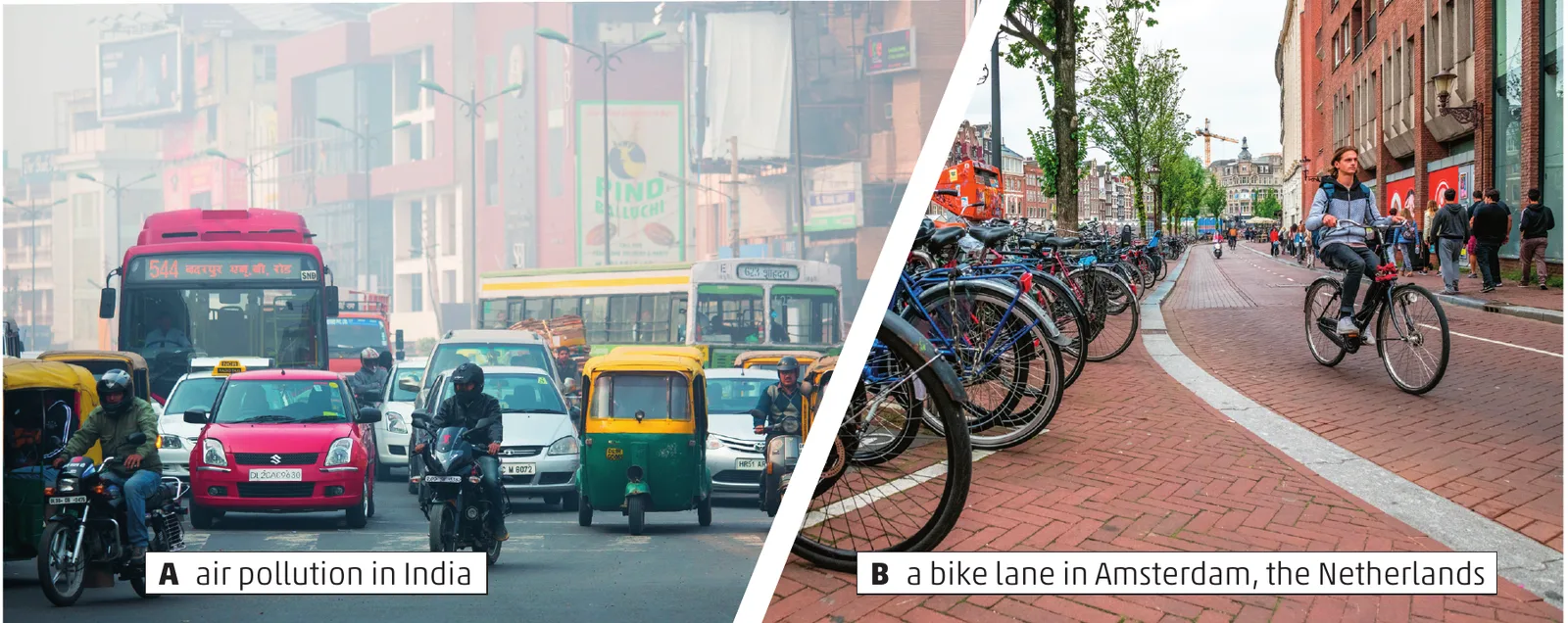
1 In pairs, describe the photos. Then answer the question. Which photo is most like the place where you live? Photo B is more like my city because …
2 4.7 Listen to a radio presenter talking about air pollution. Tick the words you hear from the box below.
□congestion □diesel □environment □fuels □exhaust fumes □ motorway □pollution □renewable □smog □sustainable □toxic
3 Now use the words you ticked to complete the sentences below. 1 You should wear masks in busy streets to avoid breathing in exhaust fumes from cars and other vehicles. 2 If a company pollutes our rivers or produces _ air, their executives should go to prison. 3 It’s better not to buy cars with engines because they cause more than petrol cars. 4 As long as fossil are cheaper, people will keep using them even though they are not . 5 _ , which is a mixture of smoke and fog, is bad for your health. You can get an app which tells you when it’s safe to go out.
4 4.7 Listen again. In pairs, say if the statements are true (T) or false (F). 1 In Delhi, India, sometimes nobody is allowed to go to school because of air pollution. 2 Traffic causes most of the air pollution in Amman. 3 The speaker thinks the best solution is to wear masks.
5 Choose the correct options to complete the sentences. 1 Cyclists should use the bike lane / pavement if there is one. 2 Cyclists should always give way to / run over pedestrians. 3 Cyclists should always stop at one-way systems / red lights even if there are no cars coming. 4 If a driver knocks down / picks up a pedestrian on a zebra crossing, he/she should lose his driving licence for a year. 5 Carpooling / Congestion helps cut down pollution by sharing our journeys to work or school. 6 The speed limit / traffic jams in cities should never be more than 20 kph.
6 SPEAKING In pairs, say if you agree or disagree with the sentences in Exercise 5. Say why.
□ I can identify specific information in a talk and a radio programme about urban transport and pollution.

