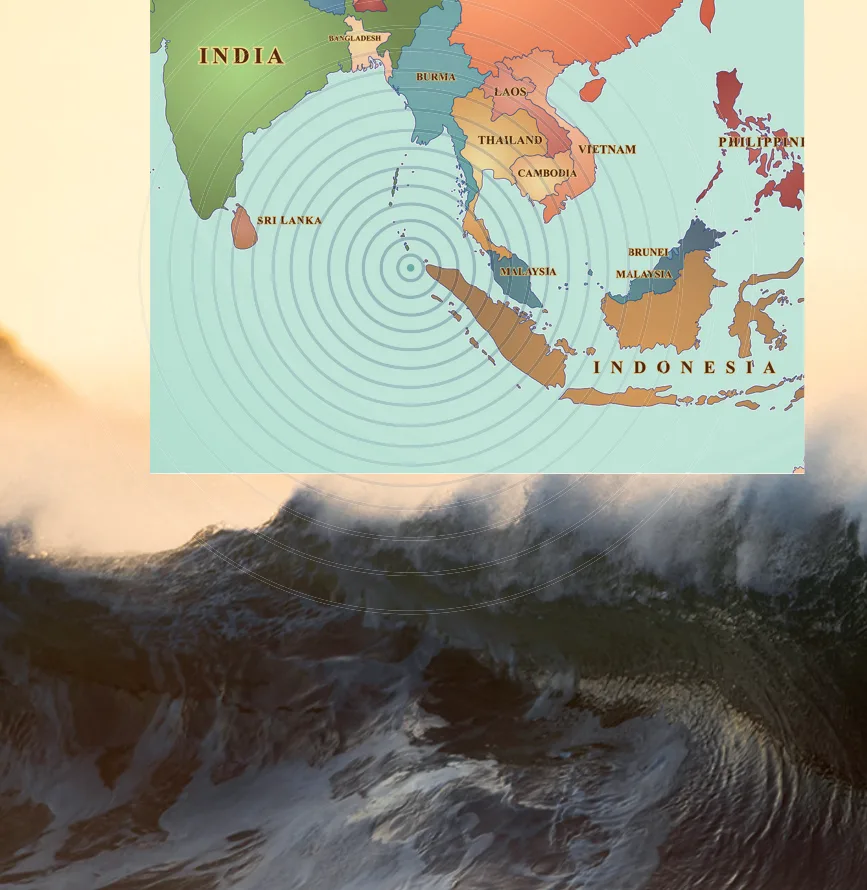
Today on our weekly programme Amazing Stories: listen to the story of a Spanish family who survived the Asian tsunami. They would not have survived if others hadn't helped them.
FACT BOX Indian Ocean tsunami
On 26 December 2004 a huge earthquake happened deep underwater in the Indian Ocean. The earthquake caused a series of giant waves called a tsunami. The tsunami travelled across the surface of the ocean in all directions and hit the shores of 14 countries. It caused strong currents which pulled people out to sea. Indonesia, Sri Lanka, India and Thailand were worst affected. Many people drowned and in total around 230,000 people lost their lives. Among the thousands of tragedies that day were a few incredible stories of survival. Several films and documentaries have been made about the disaster, with survivors sharing their experiences.
4 Look at sentences a and b from the story and answer questions 1-4. a The Belóns would not have survived if others hadn't helped them. b If Maria Belón had been underwater any longer, she might have drowned. 1 Do the sentences talk about the past, present or future? 2 Did the Belóns survive? Did others help them? 3 What tense is used after if in the sentences? What verb forms are used in the other clause? 4 Why is the punctuation different in sentences a and b?
The third conditional
We use the third conditional to describe unreal situations in the past. Unreal past event: If + Past Perfect Unreal past result: would/could/might have + Past Participle If a brave Thai man hadn't carried Maria, they could/would/might not have got to a hospital. Real past event - a brave Thai man carried Maria Real past result - they got to a hospital Question form What would you have done if you had been in their situation?
5 Match sentence beginnings 1-6 with endings a-f. 1 □ If the Belóns had stayed at home, 2 □ There wouldn't have been a tsunami 3 □ If the giant wave had come at night, 4 □ The Belóns could have run to the roof of the hotel 5 □ If Maria Belón hadn't held onto a tree, 6 □ Could Quique have saved his sons a most people would've been in bed. b if they had had more time. c if there hadn't been an earthquake. d if they hadn't called for help? e they would probably have watched the disaster on the news. f she might have drowned.
6 Use the third conditional to complete the text with the correct form of the verbs in brackets. A schoolgirl, Tilly Smith, saved over 100 people from the Indian Ocean tsunami in 2004. But if Tilly ¹hadn't done (not do) a school project on tsunamis, she ²wouldn't have been (not be) able to save them. After all, she ³__ (not warn) her parents against the tsunami if she ⁴_ (not recognise) the warning signs. Fortunately, her parents trusted her because if they ⁵_ (not believe) her, they ⁶_ (might not warn) the other people on the beach. It's clear that many more people ⁷_ (drown) if Tilly ⁸_ (not be) on the beach that day! But if Tilly ⁹_ (have) a different geography teacher, ¹⁰__ (she become) a hero? Perhaps not.
7 9.2 Listen to a survival story about a group of boys trapped in a cave in Thailand. Then use each pair of sentences to write one sentence in the third conditional. 1 It was the wet season. The cave flooded. If it hadn't been the wet season, the cave wouldn't have flooded. 2 The boys and their coach didn't read the sign. They went into the cave. 3 Rescuers found the boys' bikes and shoes. They knew they were in the cave. 4 The exit was blocked by water. The boys were trapped. 5 The boys didn't know how to dive. The rescue wasn't fast. 6 The boys were assisted by rescuers. They were able to swim out of the cave.
8 SPEAKING Complete the third conditional sentences so they are true for you. Then compare with a partner. 1 If I hadn't met my friend Jamal, I wouldn't have learned how to sail. 2 If __, I'd have been very unhappy. 3 If I'd known that _, I might have _. 4 I would've felt _ if _. 5 If my parents _, I would've _. 6 Last weekend would've been better if __.
□ I can use the third conditional to talk about unreal situations in the past.