Read the two texts and do the tasks below:
(Text A) Case study: Milton Secondary School.
Most schools claim to prepare students for the world of work, but Milton Secondary School
takes the claim very seriously. Before they even join the school, future pupils get an informal
interview at their primary school to discuss their hopes and preferences for the future.
The emphasis on employment continues during the first two years at Milton, and then in the
third year all pupils spend a day doing work experience at a local company. Two years later, this
becomes a whole week spent with a company, usually arranged by the students themselves.
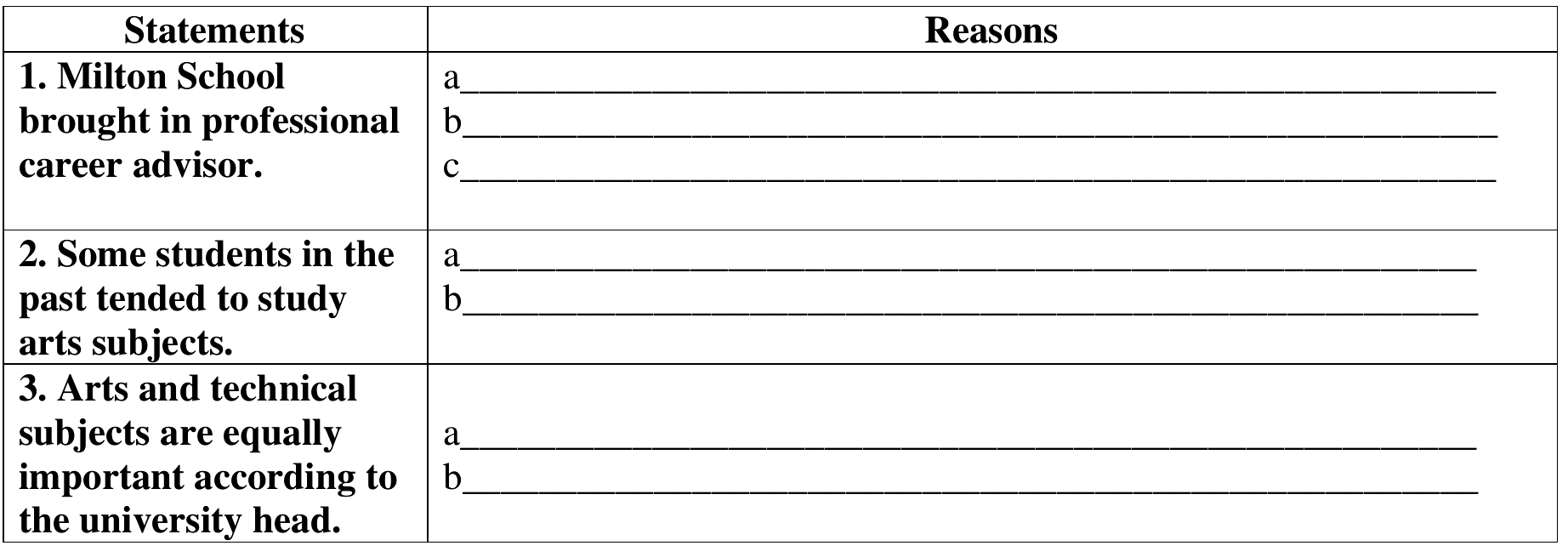
Throughout their secondary education, students have professional careers advice, which costs
the school over £30,000 a year. Head teacher Harriet Downs believes it’s worth it, though:
‘Teachers aren’t trained as careers advisers,’ she says, ‘so we bring in professional help. It’s part
of a co-ordinated programme that aims to make students aware of the employment options
available, and how to make the most of them. It’s too late to start talking about work in their
final year.’
(Text B) The Education Minister talks job prospects
In a speech yesterday, the Education Minister advised students to avoid arts subjects and choose
science or maths if they want to improve their job prospects. In the past, he said, arts subjects
like languages and history were chosen by students who didn’t have a clear idea of what they
wanted to do in the future. He explained that this was because of a feeling that they involved
skills that were useful for many different jobs, but he questioned whether this was still true:
‘Nowadays, we know differently, don’t we? The best subjects for keeping your options open are
ones like science, technology and engineering.’
It quickly became clear that the Minister’s words were controversial, with teachers and
university heads reacting strongly to his advice. ‘Of course science and technology are
important,’ said one, ‘but it would be completely wrong to neglect the arts. They provide
important skills and an understanding of the world and people in general. Also, the economy
depends as much on creativity as on technical knowledge.’
Read the two texts then answer the following questions:
Which text has different opinions about students’ choices? Text ……